

On this page
You slept well, ate breakfast, and still feel drained by the second period. Tiredness has many causes, but one common, checkable one is anaemia, and the reason lies in the biology of blood, iron and respiration.
What is anaemia, exactly?
Anaemia is "a condition in which the number of red blood cells or the haemoglobin concentration within them is lower than normal," according to the WHO anaemia fact sheet.
Haemoglobin is the iron-containing protein in red blood cells that carries oxygen from the lungs to the tissues. In the WHO's words, anaemia occurs when there "isn't enough haemoglobin in the body to carry oxygen to the organs and tissues." The WHO lists tiredness, dizziness, cold hands and feet, headache and shortness of breath among the symptoms.
It is common. The WHO estimates that 30% of women aged 15-49 and 40% of children aged 6-59 months worldwide are anaemic. In India, the NFHS-5 India fact sheet (2019-21) found anaemia in 59.1% of girls and young women aged 15-19 and 31.1% of boys and young men the same age, up from 54.1% and 29.2% in NFHS-4. The survey counts a non-pregnant woman as anaemic below 12.0 g/dL of haemoglobin and a man below 13.0 g/dL.
Why does anaemia make you feel tired?
Follow one breath of oxygen to a working muscle:
Your lungs load oxygen onto haemoglobin. In anaemia the lungs work fine; there are just fewer carriers.
Blood carries less oxygen per litre, so muscles and brain receive less each minute unless the heart pumps harder.
Cells need oxygen for aerobic respiration, where oxygen is the final electron acceptor in the mitochondria. When supply falls short, especially during effort, cells make less ATP (the cell's energy currency) this way.
Working muscles then lean more on anaerobic respiration, which yields far less ATP per glucose, so you tire sooner. The brain feels it too: dizziness and headaches are on the WHO list.
Iron also sits inside the iron-sulfur centres and haem cytochromes of the mitochondrial respiratory chain itself, as Rineau and colleagues explain in Nutrients (2021). In their study, mice that were iron-deficient but not anaemic showed lower endurance in a one-hour exercise test on a rotating rod, and complex I activity fell in their oxidative soleus muscle. It was a mouse study, but it suggests low iron may cause fatigue even before haemoglobin drops.
Our explainer on haemoglobin vs myoglobin shows how muscle stores its own oxygen.
How much less oxygen does anaemic blood carry?
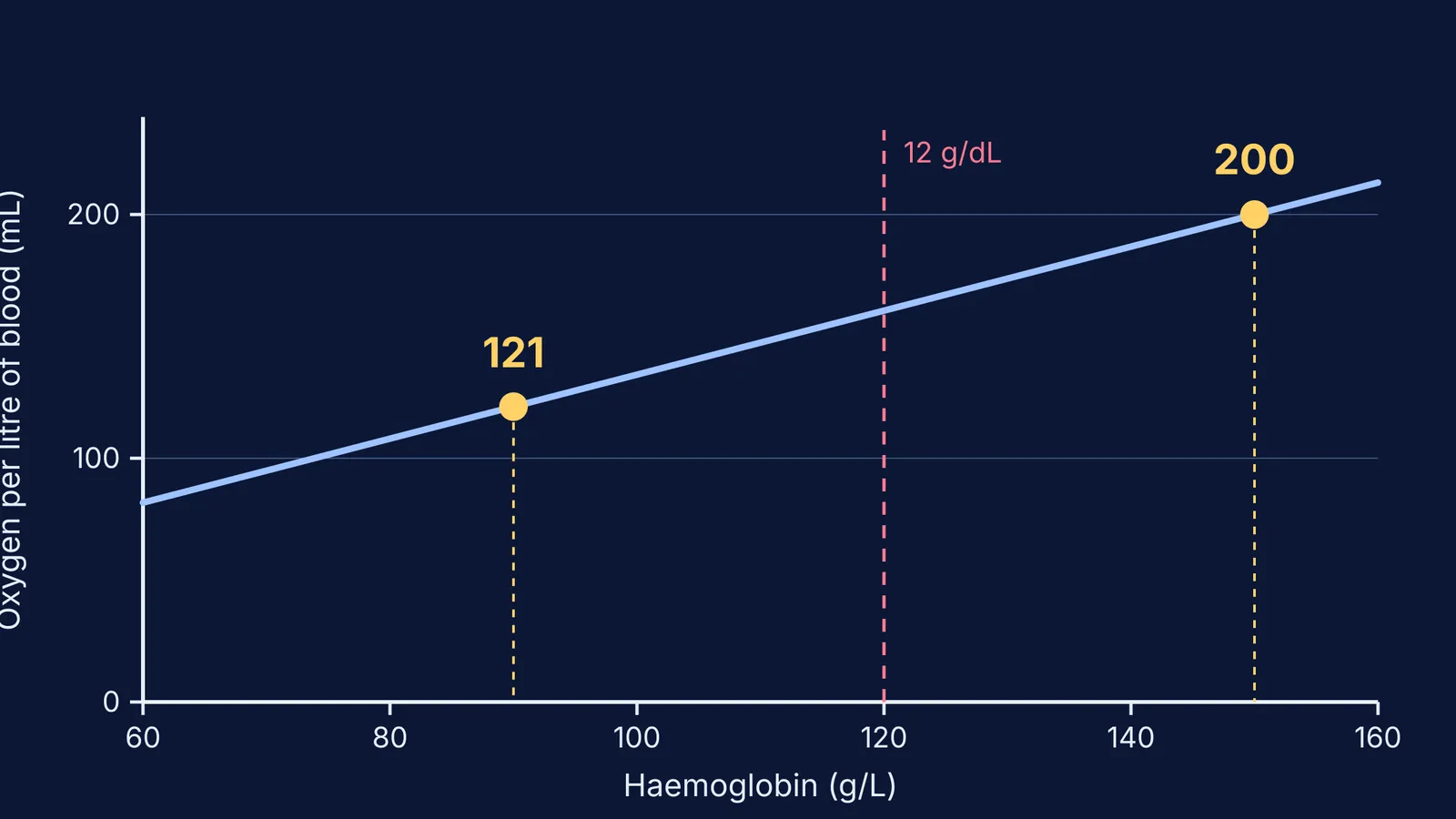
Here is the maths. Arterial oxygen content is (Hb × 1.34 × saturation) + (0.23 × PO2), with haemoglobin in g/L, PO2 in kPa and the answer in mL of oxygen per litre of blood, as set out in this e-Learning for Healthcare anaesthesia session. The 1.34 is the millilitres of oxygen that one gram of fully saturated haemoglobin can hold. The session's own example, with Hb 150 g/L, saturation 0.98 and PO2 13 kPa, gives about 200 mL/L.
Now keep the same healthy lungs and drop haemoglobin to 90 g/L (9 g/dL):
Bound to haemoglobin: 90 × 1.34 × 0.98 = 118.2 mL/L
Dissolved in plasma: 0.23 × 13 = 3.0 mL/L
Total: about 121 mL/L
That is roughly 39% less oxygen in every litre. To deliver the same oxygen, the heart would need to pump about 1.65 times as much blood, which is why a racing pulse and breathlessness on the stairs fit the picture.
Notice how small the dissolved part is: breathing faster barely helps, because the haemoglobin you have is already nearly full. For how saturation responds to pH, CO2 and temperature, read what shifts the oxygen dissociation curve. For curves like this, the Fermi Simulation Lab has interactive simulations for the ideas that are easier to see than to read.
Is it anaemia or just a late night?
Signs worth noticing:
You feel tired for weeks even after proper sleep.
You get breathless or your heart pounds on stairs you used to climb easily.
You feel dizzy when you stand, or get frequent headaches.
Your hands and feet often feel cold.
Someone has noticed you look paler than usual.
If several apply, only a blood test can say whether it is anaemia. Do not start iron tablets on your own; see a doctor, who can test your haemoglobin and look for the cause. A script for telling a parent: "I've been tired even when I sleep well, I get breathless on the stairs and I feel dizzy when I stand up. Can we ask the doctor about a haemoglobin test?"
For the food side, read our guide to iron, iodine and calcium deficiencies and the foods that supply them. If respiration or the transport of gases is still shaky, the Fermi Concept Library gives each biology concept its own lesson.


