On this page
Your child's school has a no-phone rule, and a fair worry follows: what if something happens and you cannot reach them? During school hours the school office, not the phone, is the channel to use. What you need is a plan that works without the phone, agreed before the day you need it.
Why are so many schools banning phones?
Your school is not unusual. UNESCO's education monitoring team counted 79 education systems, or 40% of those it tracks, with smartphone bans in school by the end of 2024, up from 60 a year earlier.
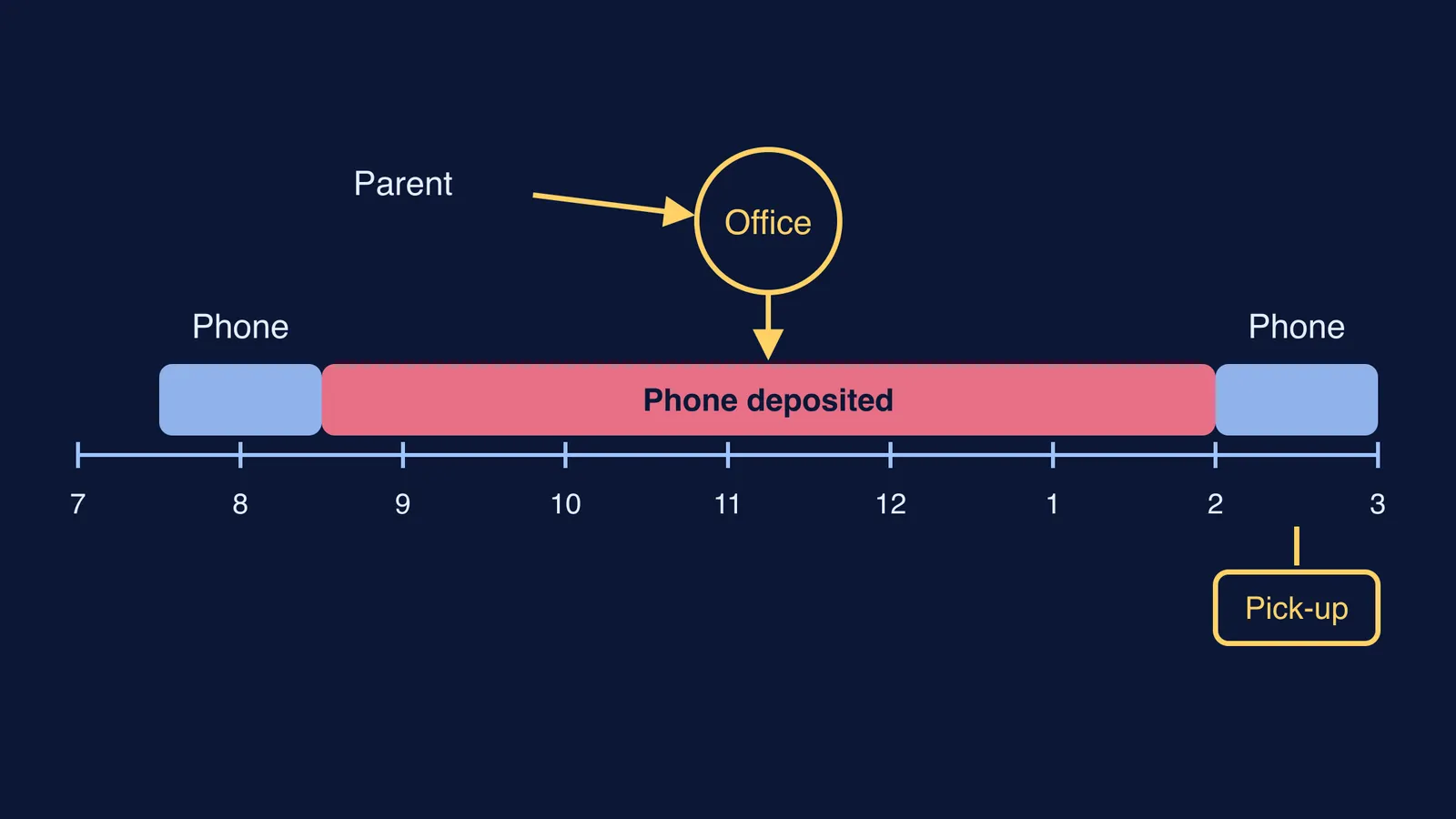
In India, the Delhi High Court took a middle path. In Y V v. Kendriya Vidyalaya, reported in March 2025, Justice Anup Jairam Bhambhani said a complete ban is undesirable and unworkable. Where schools can arrange safekeeping, students should deposit phones when they enter and collect them when they leave. The court added that policies should allow phones for safety and coordination while ruling out entertainment.
So in many schools the phone travels with your child but stays locked away all day. That school day is the gap to plan for.
How do you contact your child if the school does not allow phones?
Call the school office. The UK Department for Education's guidance on mobile phones in schools puts it plainly: parents who need to contact their child during the school day should be directed to the school office, where staff should know the school's policy on relaying messages. Its advice to schools on talking to parents tells them to reassure parents that in an emergency they can contact the school office to get a message to their child. The same route works in any school.
For real emergencies outside school, India has the 112 emergency number. The Kerala Police page on the Emergency Response Support System explains that the older police (100), fire (101) and ambulance (108) numbers are coordinated with 112.
What should a school emergency contact plan include?
Sit down with this at the start of the term. Check each item with the school and write the answers on one card.
The school office landline and the hours someone answers it, plus a second number (principal's office or class teacher's official contact) for when the line is busy.
Who the school will release your child to. Give the office the names and phone numbers of two backup adults, such as a grandparent or a trusted neighbour.
What the school does if no one arrives: where children wait, and for how long.
The bus or van driver's number and the attendant's number, if your child uses school transport.
A family code word. Anyone collecting your child unexpectedly must say it. Your child should never go with someone who does not know it, even someone they recognise.
A meeting point outside the gate if you get separated in the dispersal crowd.
How do you change pick-up plans without a phone?
Here is a worked example. Ananya's mother is held up at work at 1 pm and cannot collect her at 2:30. Her aunt will come instead.
1:05 pm: Mother calls the school office, not Ananya.
She says: "This is Priya Sharma, mother of Ananya Sharma, Class 6B. I can't come today. Her aunt, Meera Rao, is on our authorised list and will collect her at 2:30. Please let Ananya know her aunt is coming."
She asks the office to repeat the change back, and notes the name of the person she spoke to.
She sends the same message on the school's official channel if it has one, so there is a written record.
The aunt brings ID and says the family code word to Ananya at the gate.
If the school does not take changes by phone, find that out now, not on the day. If teachers prefer messages, our post on whether to message a teacher on WhatsApp covers what is reasonable.
What if your child has a medical need or a long commute?
Ask for an exception in writing. The UK guidance gives the example of pupils with diabetes who use a glucose sensor linked to a phone, and asks schools to consider children travelling to and from school for whom not having a phone poses a risk or the perception of one. Bring a doctor's note and propose a specific arrangement, such as the phone staying with the class teacher.
If you are still deciding whether your child should carry a phone at all, read should my child take a phone to school? and our guide to the right age and rules for a first smartphone.
When the phone comes home, a homework doubt from the morning will still be there. If it is a maths or science question, Fermi's AI tutor can work out what your child already knows, build a plan for the session and teach through it, so the phone time goes on learning.
Tonight, write the card, agree the code word and save the office number in your own phone.