On this page
Chapter 4 of NCERT Class 12 Psychology, Psychological Disorders, asks you to explain what makes behaviour abnormal, how disorders are classified and what the major groups are. Here are all three on one page.
What does abnormality mean in psychology?
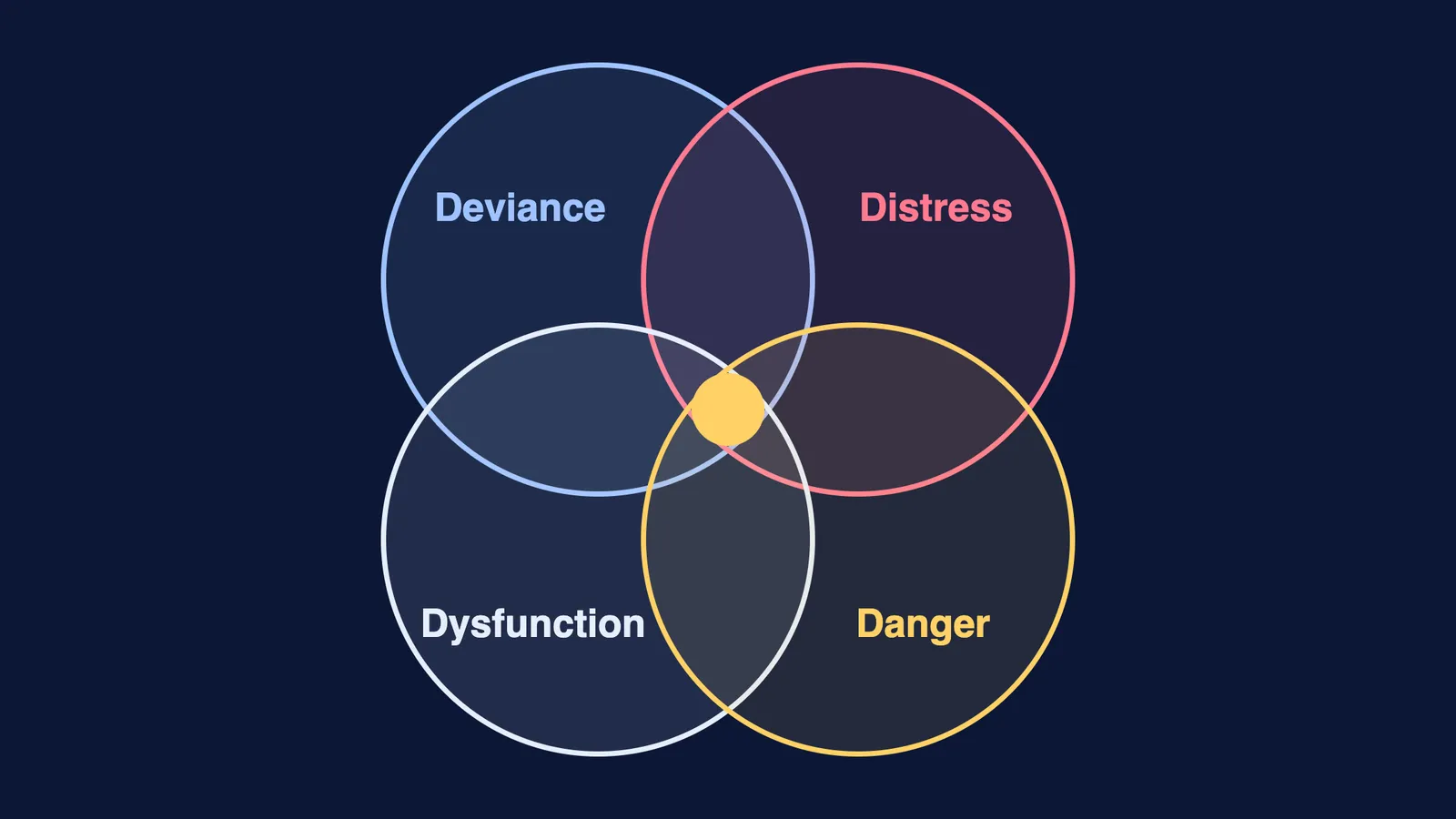
NCERT says most definitions of a psychological disorder share four common features, the four Ds: deviance, distress, dysfunction and danger (NCERT Chapter 4).
Deviance: behaviour that is different, extreme, unusual, even bizarre.
Distress: unpleasant and upsetting to the person and to others.
Dysfunction: it interferes with the person's ability to carry out daily activities.
Danger: possibly dangerous to the person or to others.
The chapter then gives two conflicting views. One treats abnormal behaviour as a deviation from social norms, which change with culture and time. The other treats it as maladaptive: abnormal if it gets in the way of well-being and growth, even when it conforms.
How are psychological disorders classified?
A classification groups disorders into classes by shared features, so professionals describe them in the same terms (NCERT). Learn two names:
DSM-5: the Diagnostic and Statistical Manual of Mental Disorders, 5th edition, published by the American Psychiatric Association.
ICD-10: the tenth revision of the International Classification of Diseases, prepared by the World Health Organization; NCERT calls it the scheme officially used in India.
For causes, the chapter covers biological factors (anxiety linked to low GABA activity, schizophrenia to excess dopamine, depression to low serotonin), psychological models, the socio-cultural model and the diathesis-stress model, in which a biological predisposition is set off by a stressful situation.
If synapses and neurotransmitters from Class 11 biology are hazy, the Fermi Concept Library has a lesson for every biology concept, so you can refresh the mechanism first.
What are the major psychological disorders in Class 12?
The NCERT chapter covers 12 groups (NCERT). Each line gives the core feature and examples to name.
Anxiety disorders: the most common category; generalised anxiety disorder, panic disorder, phobias, separation anxiety disorder.
Obsessive-compulsive and related: unstoppable thoughts, repeated acts; OCD, hoarding, trichotillomania.
Trauma- and stressor-related: after disasters, accidents or violence; PTSD with flashbacks.
Somatic symptom and related: physical symptoms without a physical cause; illness anxiety, conversion disorder.
Dissociative: links between ideas and emotions severed; dissociative amnesia, dissociative identity disorder.
Depressive: depressed mood or loss of interest; major depressive disorder.
Bipolar and related: mania alternating with depression; Bipolar I, Bipolar II, cyclothymic disorder.
Schizophrenia spectrum: positive, negative and psychomotor symptoms; delusions, hallucinations, flat affect.
Neurodevelopmental: appear early in development; ADHD, autism spectrum disorder, intellectual disability, specific learning disorder.
Disruptive, impulse-control and conduct: oppositional defiant disorder and conduct disorder.
Feeding and eating: anorexia nervosa, bulimia nervosa, binge eating.
Substance-related and addictive: alcohol, heroin and cocaine, with tolerance and withdrawal.
How common are psychological disorders?
The World Health Organization says nearly 1 in 7 people worldwide, 1.2 billion, were living with a mental disorder in 2023, with anxiety and depressive disorders the most common (WHO fact sheet).
In India, the National Mental Health Survey 2015-16 by NIMHANS found that 10.6% of adults aged 18 and over currently had a mental disorder, excluding tobacco use, and 13.7% had one at some point in their lives (NMHS 2015-16 Summary). The survey estimated that nearly 150 million Indians need active interventions.
How do you answer a case question on this chapter?
Try a three-step check on NCERT's own case of Deb (NCERT). While driving home, his heart raced, he sweated and felt short of breath; over the next few months the attacks increased, and he stopped leaving the house.
Run the four Ds. Deviance: sudden attacks of terror. Distress: he fears he is going crazy and will die. Dysfunction: he stays indoors. Danger: an attack at the wheel could put him or others at risk.
Find the group. An abrupt surge of intense anxiety points to anxiety disorders.
Name the disorder and one cause. Panic disorder; NCERT links anxiety disorders to low GABA activity and applies the diathesis-stress model to anxiety.
If you would rather not plan it alone, Fermi's AI tutor can work out what you already know and build a plan for the session, so you sit down to a clear next step.
What if this chapter feels personal?
Reading a list of symptoms can make anyone wonder about themselves. NCERT notes that anxiety before an exam is normal and expected, and can even motivate you to do well. The list is for answering questions, not for diagnosing yourself or a friend. If low mood, worry or poor sleep lasts and gets in the way of daily life, talk to a parent, a school counsellor or a doctor, or call the government's Tele MANAS helpline.
For calmer exam days, try this four-minute breathing routine for exam stress. If the chapter has you curious about the field, read whether to take psychology in Class 11 and how to become a clinical psychologist in India.