On this page
This guide to chapter 4 of NCERT's Class 11 Political Theory follows the current NCERT chapter (Reprint 2026-27).
How many marks is Social Justice in Class 11 for 2026-27?
The CBSE 2026-27 Political Science curriculum gives Social Justice 6 marks on its own, out of 40 for Political Theory and 80 for the theory paper. All five topics stay: what justice is, just distribution, Rawls' theory, pursuing social justice, and free markets versus state intervention.
What are the three principles of justice in Class 11?
The chapter opens with dharma, Confucius and Plato's The Republic, where Socrates ties justice to everyone's well-being and giving each their due. For Kant, dignity means each person is due the chance to develop their talents. NCERT gives three principles for deciding what is due:
Equal treatment for equals: equal rights, and no discrimination by class, caste, race or gender. Same work, same pay.
Proportionate justice: reward in proportion to effort, skill and risk, once everyone starts from equal rights.
Recognition of special needs: people unequal in some important respect, such as disability or no access to good education, may get extra help. NCERT says this extends equal treatment rather than contradicting it, and links it to reservations for Scheduled Castes and Tribes.
They can clash: equal treatment may ignore merit, and merit alone may leave marginalised groups behind. NCERT makes harmonising them a task for governments.
What is Rawls' veil of ignorance?
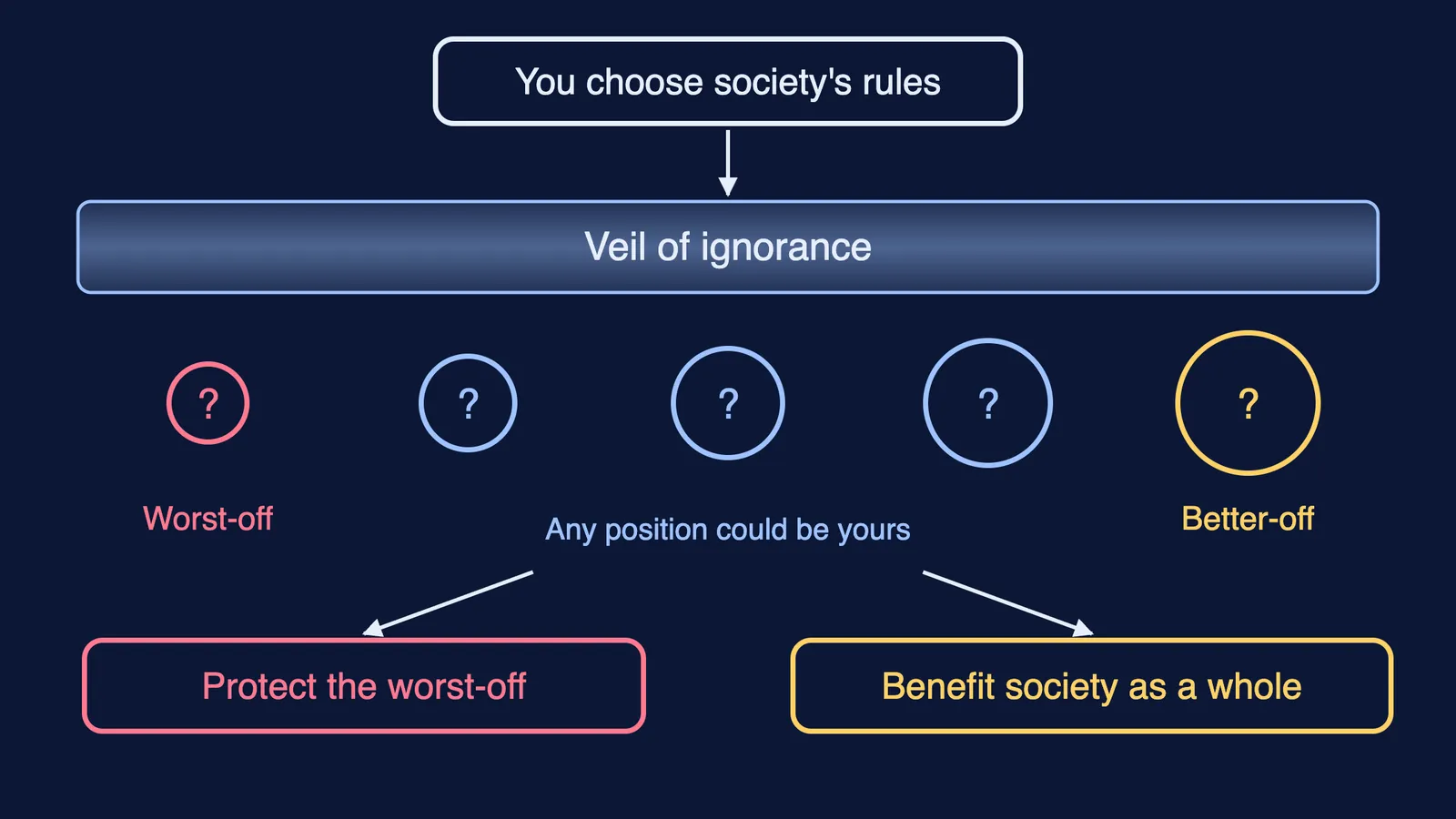
NCERT presents John Rawls' question: how can we choose fair rules when everyone favours themselves? Imagine deciding how society is organised without knowing your own place in it: your family, caste, wealth or privilege.
Behind this "veil of ignorance" you still act in your own interest. You could be born worst-off, so you would want education, health and shelter open to all. You could also be born better-off, so you would not weaken that group either: you aim for rules that benefit society as a whole.
The key point for exams: Rawls says fairness comes from rational thinking, not from morality, generosity or self-sacrifice.
Worked example (our own). Your school splits 20 lab hours a week among five sections, and you learn your section only after the rule is fixed. One section has no computers at home. Not knowing your section, you would guarantee each a minimum and give that one extra, without starving the others.
What does pursuing social justice need?
Just distribution goes beyond fair laws: deep inequalities may call for redistribution. NCERT's Indian examples are the Constitution's abolition of untouchability and land reforms by state governments (our Rights in the Indian Constitution Class 11 guide).
Justice does not demand sameness, but a society is unjust when rich and poor live in different worlds and the deprived cannot get ahead however hard they work. NCERT's basic minimum covers enough food to stay healthy, a home, safe water to drink, schooling and a minimum wage. Democratic governments are expected to provide it, though NCERT notes the cost weighs heavily in a country like India. For how caste shapes exclusion, see our Patterns of social inequality and exclusion guide.
Free markets or state intervention: what does NCERT say?
NCERT presents a live debate: people who agree the disadvantaged need help differ on how, and different political groups in India back different approaches.
For free markets: people should be free to own property, make contracts and compete. Supporters say merit is rewarded, the market ignores caste, religion and gender, and consumers get more choice. Many accept a basic minimum, delivered by private providers with the state helping people pay.
For state intervention: private firms may avoid unprofitable places such as remote villages, and better private services may cost too much for the poor.
NCERT notes there are arguments on both sides, observes that free markets often tend to favour the already privileged, which is why many argue the state should ensure basic facilities for all. It adds that in a democracy such disagreements are inevitable and even healthy.
How should you answer Social Justice questions?
The curriculum prints its question paper design (1, 2, 4 and 6-mark questions plus passage, map and cartoon items) for the Class 12 books, so check your school's Class 11 pattern. For a long answer: define justice, name the principle tested, add an Indian example, and give both sides of any debate.
Practice questions:
(2 marks) A student with a fractured wrist gets a writer for the exam. Which principle applies, and why is it not unequal treatment?
(4 marks) A mining company pays underground miners and office clerks the same wage. Which principle does this test, and is it fair?
(4 marks) Your class must set rules for sharing the library's few laptops before seats are drawn by lot. Use Rawls' veil of ignorance to suggest a fair rule.
(6 marks) Should a state leave basic services such as schooling and health care to private providers, or provide them itself? Present the arguments on both sides.
Fermi's AI tutor can work out what you already know and build a plan for the session, so you sit down to a clear next step.