

On this page
Chapter 2 of NCERT's Class 11 book Indian Constitution at Work is Rights in the Indian Constitution. Below: the Fundamental Rights, the writs that protect them, how they differ from the Directive Principles, and a test for case questions.
What are the Fundamental Rights in Class 11?
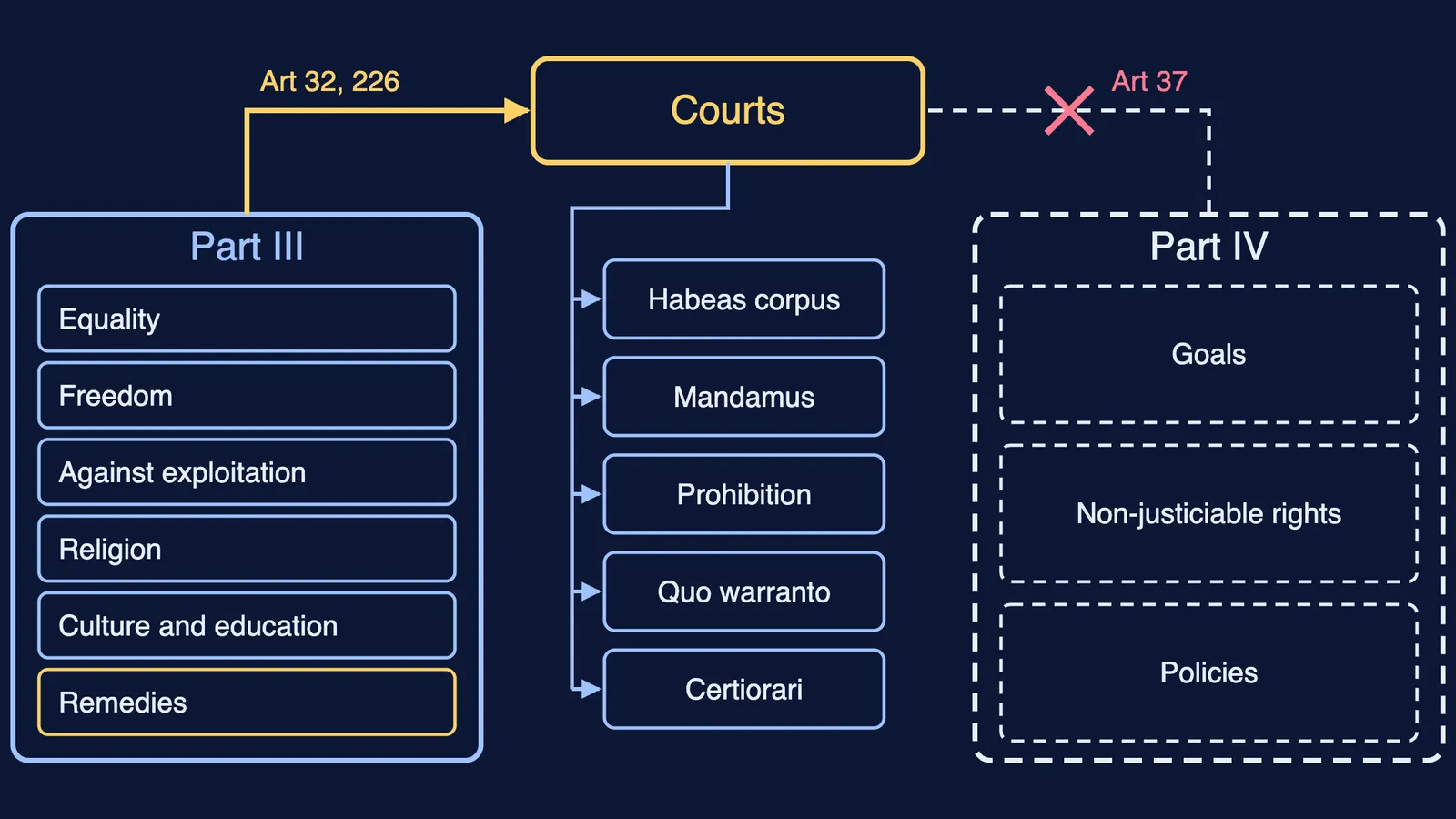
Part III of the Constitution lists the Fundamental Rights, and the NCERT chapter groups them into six rights:
Right to Equality: equality before law, no discrimination on religion, race, caste, sex or place of birth, no untouchability, no titles.
Right to Freedom: speech, assembly, association, movement, residence and profession, plus life, personal liberty and education.
Right against Exploitation: no traffic in human beings, no forced labour, no children in hazardous jobs.
Right to Freedom of Religion: freedom of conscience, and the freedom to profess, practise and propagate religion.
Cultural and Educational Rights: minorities may protect their culture and set up their own educational institutions.
Right to Constitutional Remedies: the right to go to court to enforce all the others.
Only a constitutional amendment, not an ordinary law, can change a Fundamental Right, and none is absolute: the government can put reasonable restrictions on them (NCERT, Chapter 2).
Article 21 says no person shall be deprived of life or personal liberty except according to procedure established by law. The Supreme Court has read this to include living with human dignity, shelter and livelihood (NCERT, Chapter 2). Article 21A requires the State to provide free and compulsory education to all children aged six to fourteen (Article 21A).
For the basics, see the six Fundamental Rights in Class 9 Democratic Rights.
What are the five writs, and who can issue them?
Article 32 guarantees the right to move the Supreme Court to enforce Part III, and lets it issue writs, naming five (Article 32). Article 226 gives every High Court the same writ power, for Part III rights and for any other purpose (Article 226). The NCERT chapter records that Dr Ambedkar called this right the heart and soul of the constitution, and defines the writs:
Habeas corpus: the court orders an arrested person to be presented before it, and can free them if the arrest was not lawful.
Mandamus: issued when an office holder is not doing a legal duty and so infringes someone's right.
Prohibition: a High Court or the Supreme Court acts when a lower court takes up a case beyond its jurisdiction.
Quo warranto: the court stops a person acting in an office they are not entitled to hold.
Certiorari: the court orders a lower court or authority to transfer a pending matter to a higher one.
How are Directive Principles different from Fundamental Rights?
Article 37 says the Directive Principles shall not be enforceable by any court, yet they are fundamental in the governance of the country and the State must apply them in making laws (Article 37). NCERT sorts them into goals (welfare of the people), non-justiciable rights (equal pay for equal work for men and women) and policies (a uniform civil code, village panchayats) (NCERT, Chapter 2). Side by side:
Place: rights in Part III; principles in Part IV.
Courts: rights are enforced through writs; principles are not.
Job: rights restrain the government; principles exhort it to act.
Focus: rights mainly protect individuals; principles aim at the well-being of society.
The two clashed when zamindari abolition laws were challenged under the right to property. In 1973 the Supreme Court held that right was not part of the basic structure; the 44th amendment in 1978 made it a legal right under Article 300A. The Kesavananda Bharati case held that Parliament cannot change basic features of the Constitution (NCERT, Chapter 2).
How do you answer a case question on rights?
Run three steps on every scenario:
Name the right and its group.
Place it: Part III can go to court; Part IV cannot.
Name the remedy: which court, which writ.
Worked example: police hold a man for three days without taking him to a magistrate. The chapter says an arrested person must reach the nearest magistrate within 24 hours, so his personal liberty under the Right to Freedom is violated (NCERT, Chapter 2). It is a Fundamental Right, so his family can seek habeas corpus from a High Court (Article 226) or the Supreme Court (Article 32).
Someone staying on as a municipal officer after their term ends calls for quo warranto.
Here is how to check an Article number against the Constitution.
How should you revise this chapter?
Write the six rights, five writs and three kinds of Directive Principles from memory, then check them against the chapter. If Political Science shares your week with physics or maths, Fermi's AI tutor can work out what you already know in those subjects and build a plan for the session. If this is your favourite chapter, read what Legal Studies in Class 11 covers.


