

On this page
Students ask two things about Legal Studies: is it a serious subject, and will it help me get into law school? The official documents answer both.
What is Legal Studies in class 11?
Legal Studies is a CBSE academic elective with subject code 074, taught as one module in class 11 and a second in class 12, according to the CBSE Legal Studies curriculum for 2026-27. The board says some familiarity with law improves your understanding of public affairs and of your rights and duties as a citizen, and can encourage talented students towards a career in law.
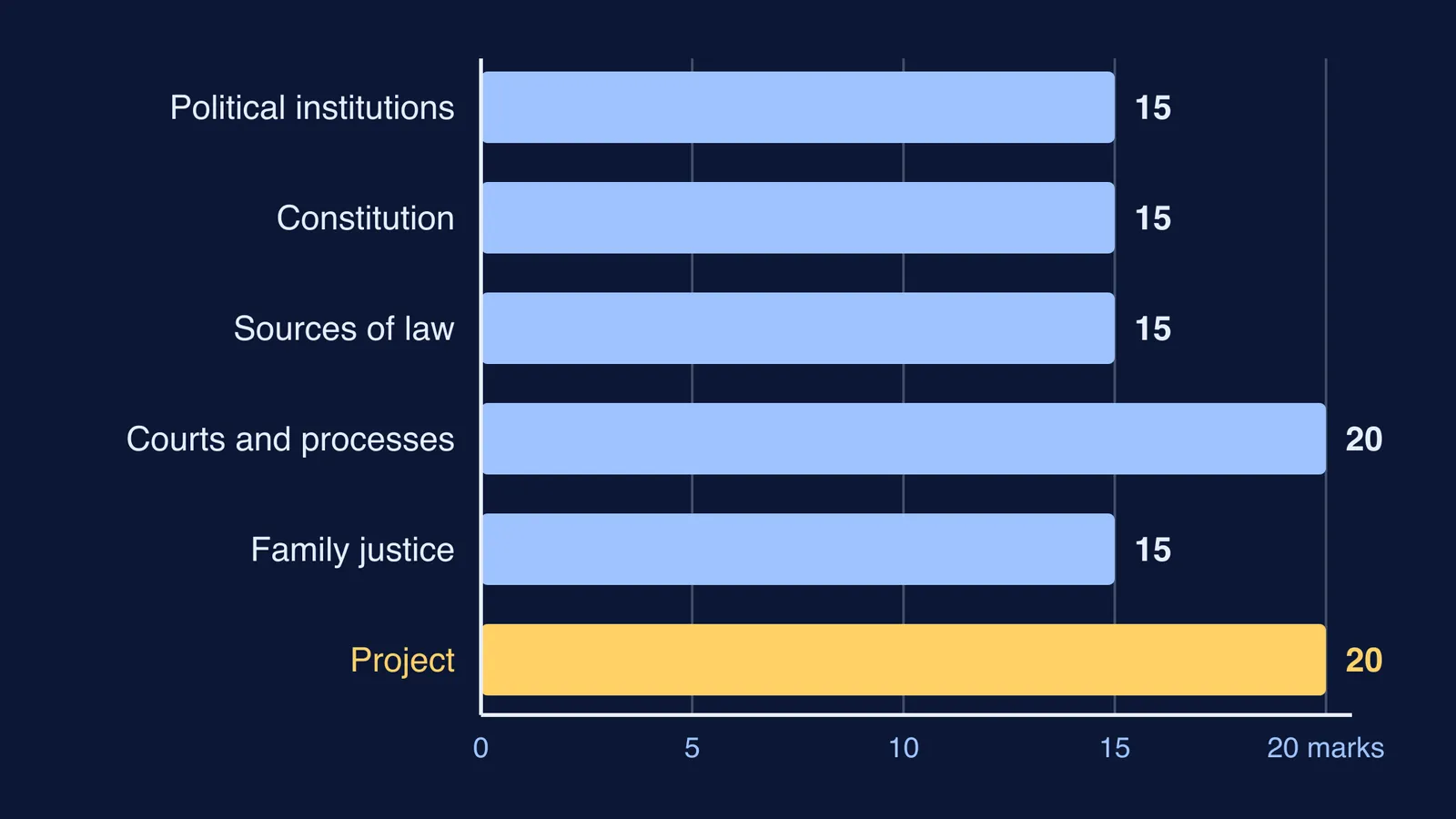
The same CBSE document splits the class 11 paper into five theory units and a project, 100 marks in all:
Introduction to Political Institutions (15 marks): the state, forms of government, separation of powers
Basic Features of the Constitution of India (15 marks): the Preamble, Fundamental Rights, Directive Principles, administrative law
Jurisprudence, Nature and Sources of Law (15 marks): custom, precedent, legislation, law reform, cyber law and the IT Act
Judiciary: Constitutional, Civil and Criminal Courts and Processes (20 marks): the court hierarchy, civil procedure, FIRs, investigation and prosecution
Family Justice System (15 marks): marriage and divorce, child rights, adoption, succession, laws on violence against women
Project (20 marks)
For the project you pick one option: research a legal issue such as juvenile justice, report on a recent law such as the Right to Information Act, or study five decided cases. It is marked on the file, research, understanding of legal concepts and a viva, 5 marks each. Class 12 moves on to contract, torts, property, criminal law, human rights and international law.
What is the subject actually like?
It is a reading subject. The skills CBSE lists include identifying legal issues from facts, analysing judgments and responding to legal fallacies. In practice, you apply a given rule to facts, as law entrance tests do. Try this example we wrote.
Principle (given in the question): A price label in a shop is an invitation to make an offer. The customer makes the offer at the counter, and the shopkeeper may accept or refuse it.
Facts: A shop labels a Rs 5,000 phone as Rs 500 by mistake. Riya insists on paying Rs 500 at the counter.
Question: Must the shopkeeper sell it for Rs 500?
Answer: No. Riya made the offer, and the shopkeeper is free to refuse it.
The trap is answering from what feels fair instead of from the principle on the page.
Does Legal Studies help with CLAT?
It helps, but it is not required. The CLAT 2027 UG syllabus describes a 2-hour test of 120 multiple-choice questions, with 0.25 marks deducted for each wrong answer. It has five sections: English Language, Current Affairs including General Knowledge, Legal Reasoning, Logical Reasoning and Quantitative Techniques.
On legal reasoning, the Consortium of NLUs states that "you will not require any prior knowledge of law", though candidates will benefit from a general awareness of contemporary legal and moral issues. So Legal Studies gives you vocabulary, context and reading practice for one section out of five.
The CLAT 2027 UG eligibility rules ask for 45% in class 12 (40% for SC, ST and PwD candidates), and the page names no required stream or subject. Science students can apply; our guide to taking CLAT after the science stream covers that route.
Quantitative Techniques is built on school maths. If your class 10 maths has gone rusty, the Fermi Concept Library has a lesson for every concept in mathematics, so you can fix a specific gap rather than rereading a whole textbook.
Is Legal Studies a CUET subject?
Not for 2026. The NTA's CUET (UG) 2026 syllabus page lists 23 domain subjects, and Legal Studies is not one of them. Your CUET domain papers must come from your other subjects. Our guide to CUET subject combinations for DU explains how to match them to courses.
Who should take Legal Studies?
It is a good fit if:
you enjoy long reading passages and arguing both sides of a question
you are seriously considering law or a career in public affairs
your school has a trained teacher for it; the CBSE curriculum itself notes the concern that a lack of experienced teachers can lead to a poor understanding of law
Think twice if:
you need it to count as a CUET domain paper
you want an easy extra subject, because most of the marks come from a theory paper built on reading
you are already stretched by JEE or NEET preparation and cannot find extra reading hours
A 10-minute check before you choose
Ask your school who teaches Legal Studies, and whether you can see last year's project files.
Read the first chapter of the class 11 textbook. If you finish it curious, that is a good sign.
Write down which exams you might take (CLAT, CUET, board only) and which of your subjects counts for each.
Tell your parents in one line why you want it.
For how this fits with your other choices, see our guide to choosing a class 11 optional subject.


