

On this page
CBSE lets a Class 11 student add one subject on top of the five main ones. It looks like a small decision, but it shapes two years of practical files and exam days. Here is what the rules say, what each choice asks, and a short way to decide together.
What is the optional sixth subject in Class 11?
In CBSE's Senior Secondary Curriculum 2026-27, subjects 1 to 5 are compulsory and subject 6 is an "Additional Subject Optional", chosen from the academic electives or languages. Three rules from the same document matter most:
Class 11 and 12 are a composite course, so the subjects your child picks in Class 11 must continue in Class 12.
If a student fails one of the first five subjects, the sixth subject replaces it, as long as Hindi or English stays among the main five.
Only one of Computer Science, Informatics Practices and Information Technology can be taken, and Mathematics and Applied Mathematics cannot be taken together.
The second rule is easy to miss: the sixth subject is partly a safety net, so pick one your child can pass comfortably.
How much work is computer science, PE or psychology?
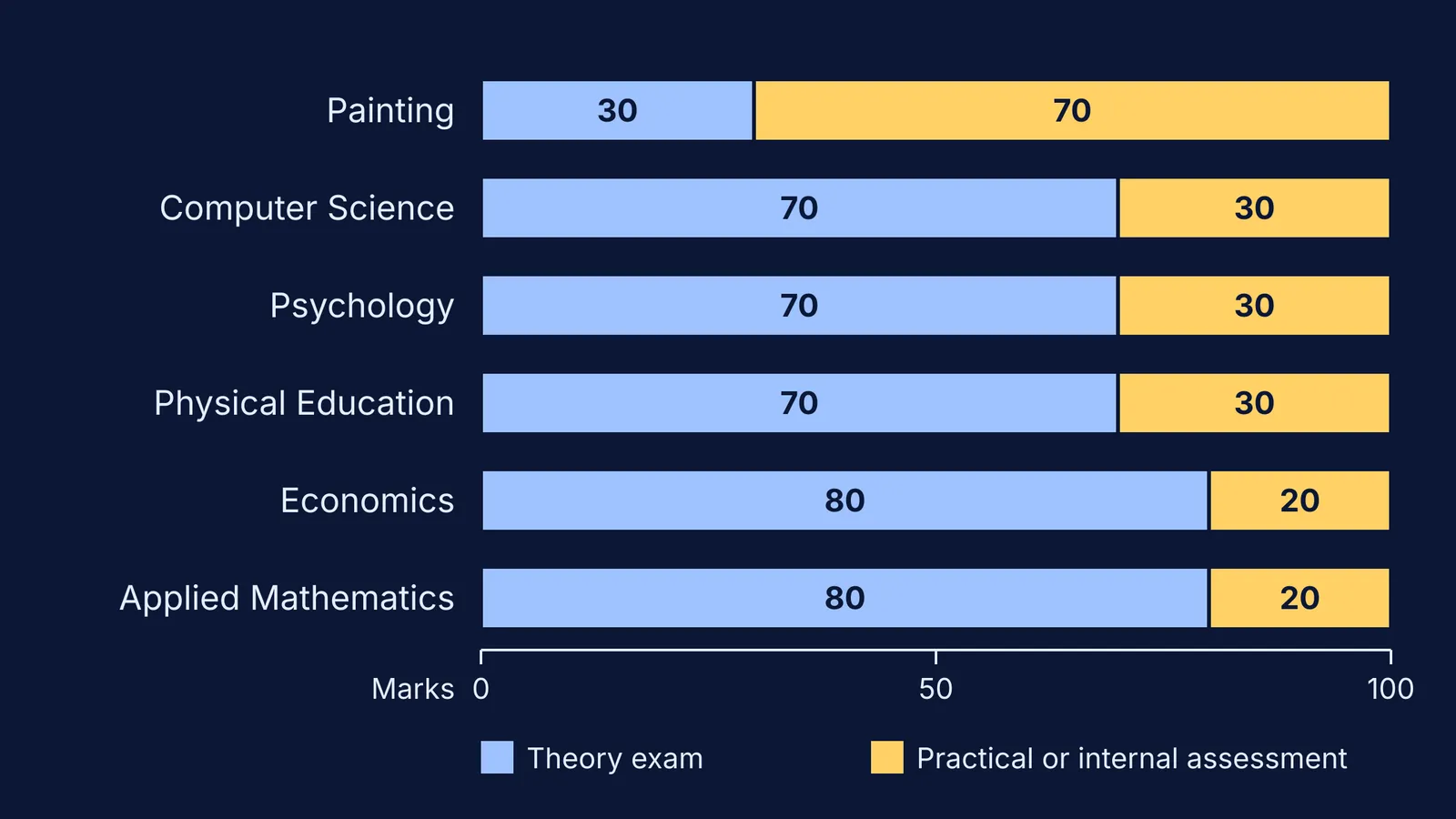
On paper all three look the same: the subject list in the CBSE curriculum document gives each 70 marks for theory and 30 for practicals. The work behind those 30 marks is different.
Computer science (083): computational thinking and programming in Python carries 45 of the 70 Class 11 theory marks, according to the CBSE computer science syllabus. The practical has a lab test, a report file of at least 20 Python programs, a viva and a project. It suits a student who enjoys fixing code.
Physical education (048): the CBSE physical education syllabus has 10 theory units in Class 11, including yoga, anatomy and physiology, biomechanics, sports psychology and training, plus 3 practicals. Students who already play a sport will recognise some of it.
Psychology (037): the CBSE psychology syllabus covers learning, memory, thinking, motivation and human development. For the practical, students conduct two experiments and do one project or small study, on topics such as sleep hygiene, peer pressure or the impact of social media on young people. Half of the Class 11 theory paper (35 of 70 marks) tests remembering and understanding, so steady reading and clear writing pay off.
Other sixth subjects split differently in the same CBSE list: Painting is 30 theory and 70 practical, while Applied Mathematics and Economics are 80 and 20.
Does the optional subject matter for college admission?
Sometimes. CBSE does not print an aggregate percentage; for students who take six subjects, the CBSE scheme of studies says the percentage is worked out by the norms of the college or institution they apply to. Check each target's rules, and if engineering is on the list, read our explainer on the 75 percent board marks rule for NIT and IIIT admission.
The subject can also open a door later. Computer Science/Information Practices, Physical Education (Yoga, Sports) and Psychology are all domain subjects in the CUET (UG) 2026 syllabus published by NTA. If your child is weighing computer science against informatics practices, our guide to choosing between CS and IP in Class 11 compares the two.
How do you choose the right optional subject?
Use a three-question score. With your school's list of electives, score each option from 0 to 2:
Interest: has your child done something like this by choice in the last year? (2 = often, 1 = once or twice, 0 = never)
Workload fit: can its practical work fit around the main five without crowding out the subject your child finds hardest?
Later use: does it connect to a course, entrance test or career they are considering?
Double the interest score, because interest is what carries a student through a two-year course. Pick the highest total and break ties on workload.
Worked example. Meera is in PCB and hopes to study medicine. She reads about how memory works for fun, has never coded and plays no school sport.
Psychology: interest 2 (doubled to 4), workload 1, later use 1, total 6
Computer science: interest 0, workload 0 (a new language plus a programming file), later use 1, total 1
Physical education: interest 0, workload 2, later use 0, total 2
Psychology wins clearly. For a PCM student who already writes small Python programs, the same score often tips towards computer science.
What if you and your child disagree?
Try saying: "Show me one topic in this syllabus you would enjoy, and one you would find boring." Then open the syllabus together from the CBSE curriculum page and talk about the practical work too. If your child wants to sample computing before committing, the Fermi Concept Library has a lesson for each concept in physics, chemistry, biology, mathematics and computing, so they can try a few ideas first.
If the bigger question is the stream itself, start with our guide to choosing a stream after Class 10.


