On this page
The last chapter of NCERT's Class 11 book *Understanding Society* asks what sociology should look like in India. The NCERT chapter Indian Sociologists (Reprint 2026-27) answers through four people: G.S. Ghurye, D.P. Mukerji, A.R. Desai and M.N. Srinivas.
In the CBSE Sociology curriculum for 2026-27, this chapter is Unit 10 and carries 12 marks, within the 36 marks for Part B, Understanding Society. The curriculum spells the second name "Mukherjee"; NCERT uses "Mukerji".
What did G.S. Ghurye say about caste and race?
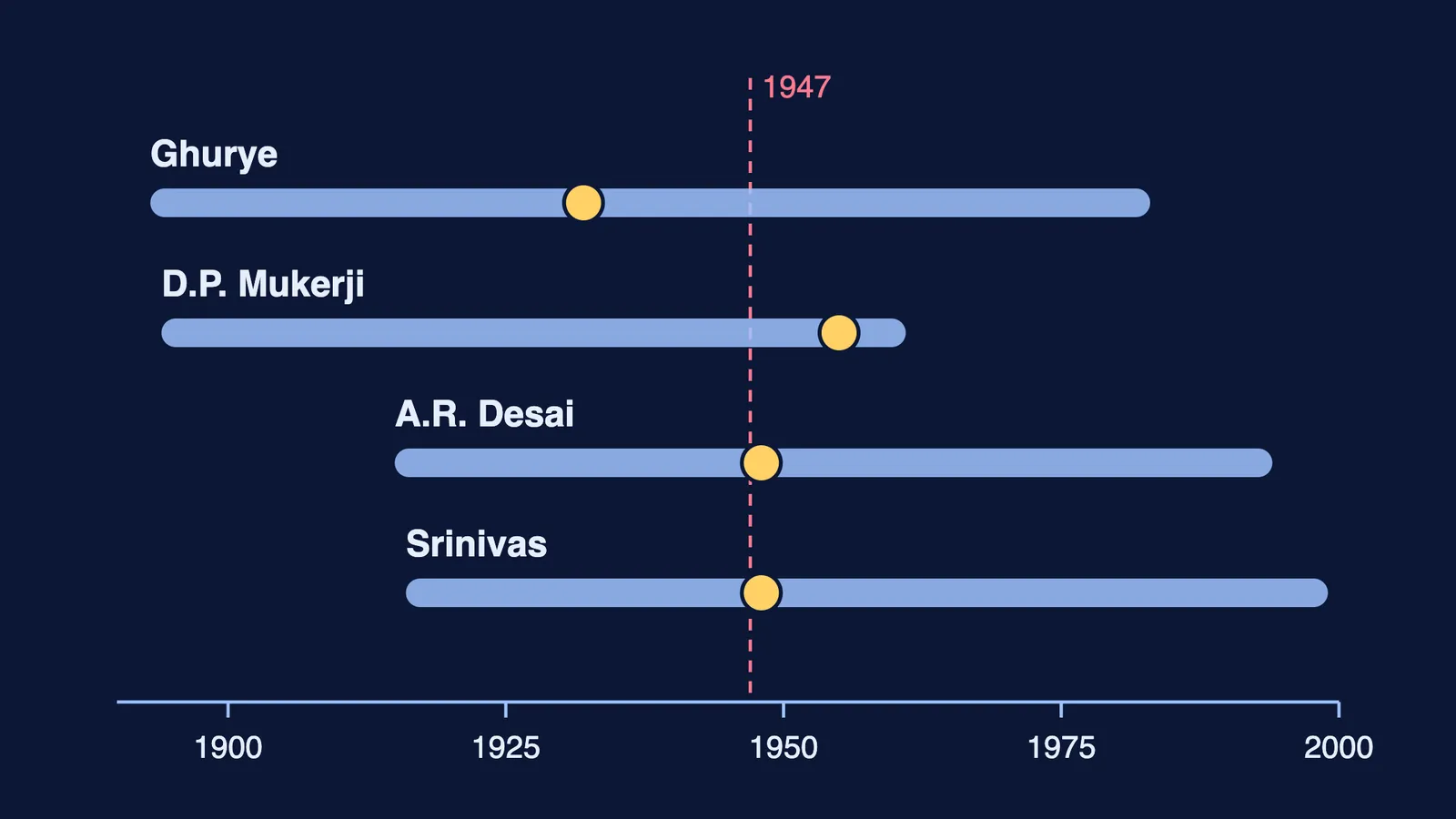
Ghurye (1893-1983) headed the sociology department at Bombay University for 35 years and founded the Indian Sociological Society in 1951 (NCERT). His book *Caste and Race in India* (1932) answered Herbert Risley, a British official who argued that caste originated in race, using average body measurements such as the length of the nose.
Ghurye thought Risley was only partly right. Averages hide how much a measurement varies inside each group. The pattern of "Aryan" upper castes and "non-Aryan" lower castes held broadly only in north India; elsewhere groups had mixed for a long time, and endogamy may have come to groups that were already varied. NCERT notes that scholars have since dropped the racial theory, though it was widely accepted before 1950.
An example of the averages point: two sections of Class 11 can share the same average height, yet in one section heights range widely and in the other they barely differ. The average alone hides that difference.
Ghurye's definition of caste has six features: segmental division, hierarchy, restrictions on social interaction (especially sharing food), differential rights and duties, restricted choice of occupation, and restrictions on marriage. NCERT notes it drew on classical texts; in practice these features were changing, though all persist in some form.
He also led the nationalist side in the debate on tribes, describing them as "backward Hindus", against the protectionist view that contact with mainstream society would harm them.
What is D.P. Mukerji's idea of living tradition?
D.P. Mukerji (1894-1961) taught at Lucknow (NCERT). He argued that India's distinctive feature was its social system: the social side was "over-developed" while history, politics and economics were less developed. So an Indian sociologist had first to know Indian social traditions.
For him tradition was living: it keeps links with the past and also adapts. Indian society, he argued, acts through groups more than individuals. He named three principles of change, shruti, smriti and anubhava (experience). Collective anubhava, seen in the bhakti movement and among the Sufis, mattered most. Change comes in cycles: popular challenges transform orthodoxy and are then absorbed into the changed tradition.
Example: a family wedding keeps its rituals but is streamed online for relatives abroad.
What was A.R. Desai's view of the welfare state?
A.R. Desai (1915-1994), a student of Ghurye and a Marxist, is probably best known for *Social Background of Indian Nationalism* (1948) (NCERT). In his essay "The myth of the welfare state" he names three features: a positive (interventionist) state, a democratic state, and a mixed economy.
He then sets five tests: freedom from poverty and discrimination, with security for all; reduced inequality of income; the profit motive made subservient to the community's needs; stable development without booms and depressions; and employment for all. Measuring Britain, the USA and much of Europe against them, he finds their claims greatly exaggerated. He also criticised the shortcomings of Communist states and stressed political liberties.
Why did M.N. Srinivas defend the village?
Srinivas (1916-1999) studied under Ghurye at Bombay and then at Oxford, then set up departments at Baroda (1951) and the Delhi School of Economics (1959) (NCERT). With S.C. Dube and D.N. Majumdar he made village studies the leading field of the 1950s and 1960s.
Louis Dumont argued that institutions such as caste matter more than the village, which is only people living in one place. Srinivas replied that villages had been a real unifying identity. He also rejected the British picture of unchanging, self-sufficient "little republics": villages had changed, and were always tied to regional economic, social and political relationships.
Example: a village whose farmers sell at a town market and whose young people commute to factories fits Srinivas's account, not the "little republic".
Which practice questions should you try?
State any three features of caste in Ghurye's definition.
Why did Ghurye think Risley's theory was only partly correct?
Explain "living tradition" with an example from your own family.
Which principle of change did D.P. Mukerji consider most important in India, and why?
List Desai's tests for a welfare state. Apply any two to a public service near you.
Dumont said caste goes with people when they leave a village. Give one point Srinivas would make in reply.
The question paper design gives 40% of the 80 theory marks to applying knowledge, so practise questions 3 and 5 with your own examples.
Next, read our guides to sociology and society in Class 11 and understanding social institutions, plus change and development in rural society.
Fermi's AI tutor can work out what you already know and build a plan for the session, so you sit down to a clear next step.