On this page
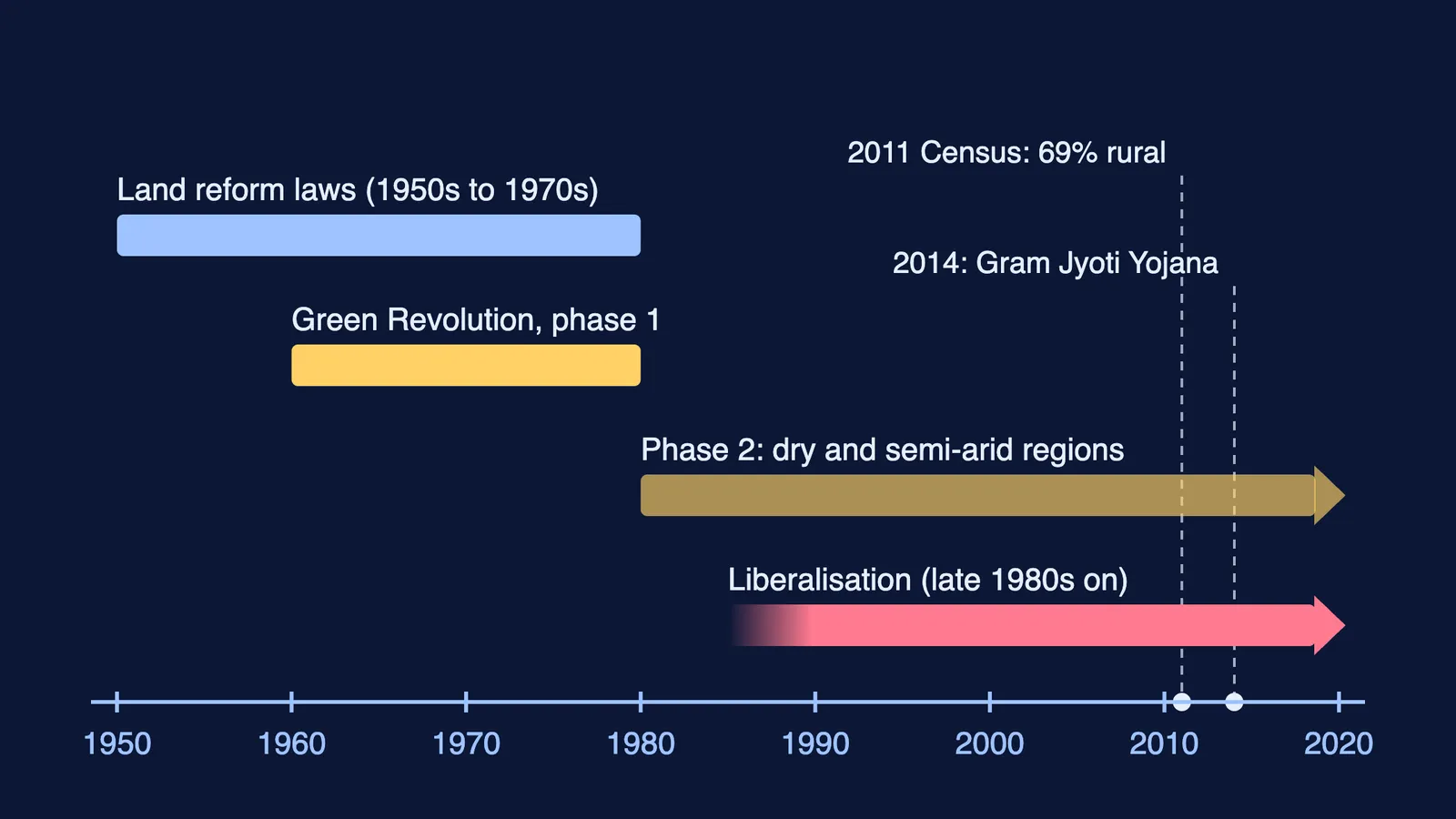
This chapter asks who owns village land, who works it, and how that changed after independence. It is chapter 4 of NCERT's Social Change and Development in India, and the current NCERT text (reprint 2026-27) notes that 69 per cent of Indians lived in rural areas at the 2011 Census. The CBSE Sociology curriculum for 2026-27 gives it 10 marks and keeps all six sub-topics, from agrarian structure to globalisation.
How are caste and class linked in rural India?
Agrarian structure is the pattern of who holds agricultural land, and because land is the main productive resource in villages, it shapes rural class structure (NCERT). In some regions 40 to 50 per cent of families own no land, and tenants may pay 50 to 75 per cent of the crop as rent. Patrilineal inheritance keeps most women from owning land.
Caste and class roughly match, but not exactly: Brahmins are mostly not major landowners. In each region one or two numerous landowning castes hold economic and political power; M.N. Srinivas called them dominant castes. NCERT's examples include Jat Sikhs in Punjab, Jats and Rajputs in Uttar Pradesh, and Lingayats and Vokkaligas in Karnataka. Marginal farmers and the landless are mostly SC, ST or OBC, and begar (unpaid labour for the landlord) outlived its legal abolition. For caste itself, revise our guide to caste, tribe and family in Class 12 sociology.
What did land reforms change, and why did they fall short?
Under colonial rule, zamindari areas stagnated, while raiyatwari areas, where the state dealt directly with cultivators, did better. Our notes on colonialism and the countryside cover that history.
From the 1950s to the 1970s, three kinds of laws followed:
Zamindari abolition removed the intermediaries and was the most effective.
Tenancy acts tried to ban tenancy or regulate rents; only West Bengal and Kerala restructured radically.
Land ceiling acts capped holdings, but loopholes and benami transfers let most owners keep surplus land.
NCERT's verdict: much changed, but the structure stays highly unequal.
What were the social consequences of the Green Revolution?
During its first phase, across the 1960s and 1970s, the programme gave high-yielding seeds, fertilisers and pesticides only to areas with assured irrigation, mainly wheat and rice belts. Punjab, coastal Andhra Pradesh, western U.P. and parts of Tamil Nadu got the first wave (NCERT). Output rose and India became self-sufficient in foodgrains. The social costs:
Medium and large farmers gained most, because inputs were expensive.
Landowners took land back from tenants once farming paid well.
Machines displaced service castes and sped up rural-urban migration.
Differentiation: the rich grew richer while many poor stagnated or grew poorer.
Regional gaps widened. In the second phase, from the 1980s, dry and semi-arid regions shifted to market crops, and livelihood insecurity rose.
How did rural labour change after independence?
Where farming commercialised, hired labour grew, pay shifted from grain to cash, hereditary bonds loosened and free wage labourers appeared. Jan Breman called this a shift from patronage to exploitation. Well-off farmers in coastal Andhra Pradesh, western U.P. and central Gujarat moved into business, eastern U.P. and Bihar changed little, and Kerala built a mixed economy with Gulf remittances.
Workers from drought-prone areas now circulate seasonally to farms, brick kilns and building sites. Breman's term footloose labour does not mean freedom: as a rule they do not even get the minimum wage. With men away, women do more farm work, the feminisation of the agricultural labour force. Since the late 1980s, liberalisation brought contract farming and company seed agents in place of state extension workers. Economics students: see our rural development Class 12 guide.
How is this chapter asked in the board exam?
The 2026-27 sample paper sets 2-mark answers within 30 words, 4-mark within 80 and 6-mark within 200. This chapter appears in a 2-mark question on caste and class and in 4-mark questions on rural modernisation (with globalisation as the choice) and footloose labour. The marking scheme credits separate points from the NCERT text, so write one point per line.
Worked case (invented, 4 marks): In a canal-irrigated village, a landowner switches to high-yielding wheat, ends his tenant's lease, buys a harvester and hires workers from another state at harvest. Identify the social consequences.
Tenant displaced as cultivation became profitable.
Mechanisation pushing out service castes and local labour.
Preference for migrants, who can be paid less.
Differentiation: the owner gains while tenant and labourers lose.
Practice questions to try
Define dominant caste with one regional example. (2 marks)
Distinguish between a peasant and a farmer. (2 marks)
Why were land ceiling acts largely ineffective? (4 marks)
Explain the feminisation of the agricultural labour force. (4 marks)
How did commercial agriculture change relations between landowners and labourers? (6 marks)
Time each answer to its word limit. Fermi is an AI-powered STEM learning platform, so if you also take maths or science, Fermi's AI tutor can work out what you already know and build a plan for the session.