

On this page
This chapter takes you to three places: the zamindari estates of Bengal, the Rajmahal hills where the Paharias and Santhals lived, and the villages of the Bombay Deccan. The NCERT chapter, Theme Nine of Themes in Indian History Part III, follows each through official archives: revenue records, surveyors' journals and enquiry commission reports. Here it is in one pass, with a frame for the long answers.
What was the Permanent Settlement and why did zamindars fail?
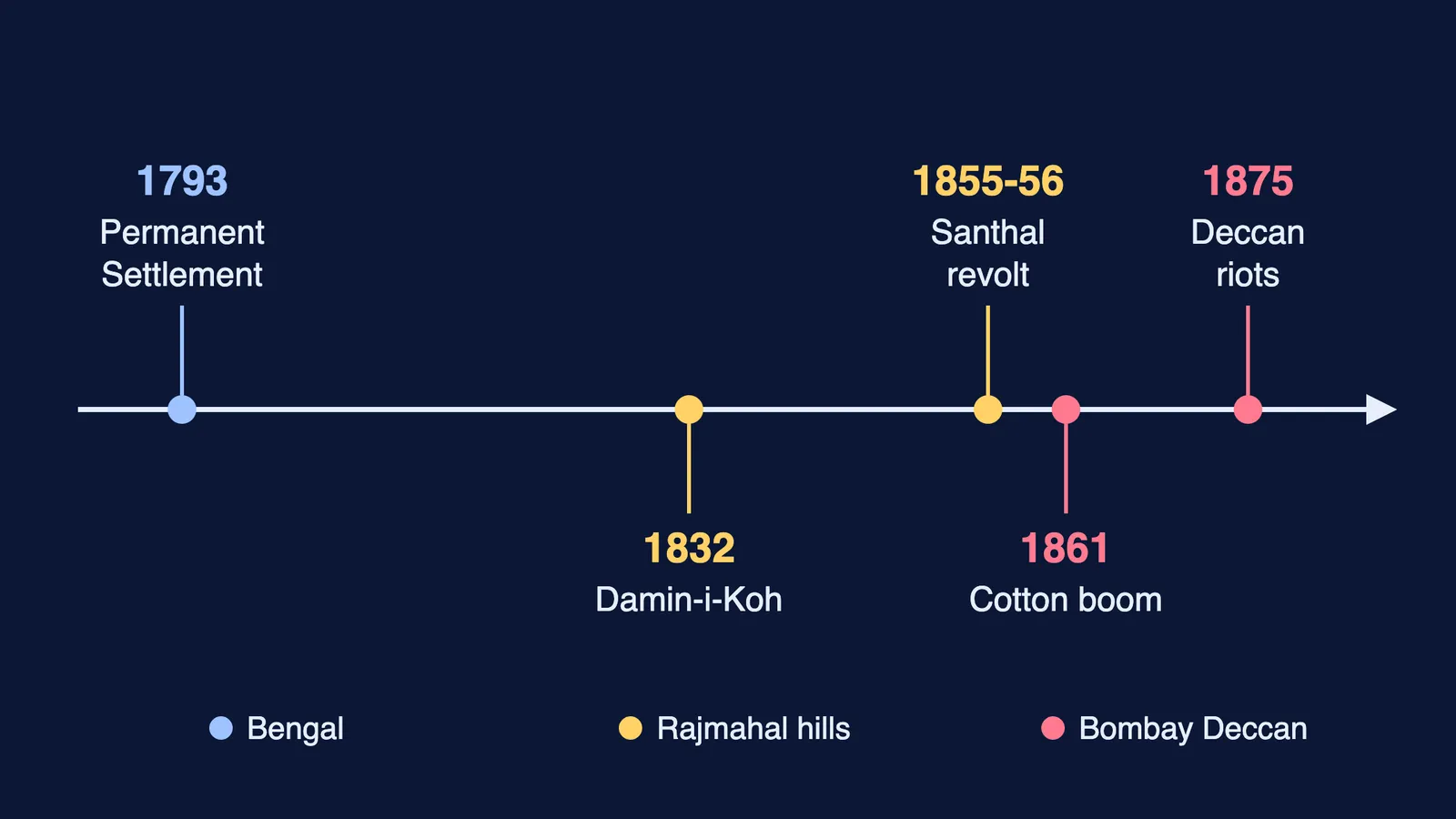
The Permanent Settlement, introduced in Bengal in 1793 when Charles Cornwallis was Governor General, fixed the revenue each zamindar paid the Company in perpetuity (NCERT, Theme Nine). The zamindar was treated not as a landowner but as a revenue collector for the state, sometimes over as many as 400 villages.
Many zamindars defaulted, for four reasons:
The initial demand was set very high.
It was imposed in the 1790s, when crop prices were depressed.
Under the Sunset Law, an estate could be auctioned if payment had not arrived by sunset on the due date.
The settlement at first limited the zamindar's power to collect rent from the ryot.
Over 75 per cent of the zamindaris changed hands after the Permanent Settlement, according to NCERT. Zamindars fought back: at the 1797 auction of the Raja of Burdwan's estates, over 95 per cent of the sale was fictitious, with the raja's own agents bidding. Meanwhile the jotedars, rich peasants in Francis Buchanan's survey of Dinajpur, came to hold sometimes several thousand acres and controlled trade and moneylending.
Why did the Santhals rebel in 1855-56?
The Paharias of the Rajmahal hills lived by hunting and shifting cultivation, symbolised by the hoe. The Santhals, hired by zamindars and invited by British officials to clear land, stood for the plough. By 1832 a large area was demarcated as Damin-i-Koh, declared the land of the Santhals (NCERT, Theme Nine).
Santhal villages in the area grew from 40 in 1838 to 1,473 by 1851, and the Santhal population from about 3,000 to over 82,000. Then the land began to slip away: the state levied heavy taxes, moneylenders (dikus) charged high interest and took land when debts went unpaid, and zamindars asserted control over the Damin.
In 1855-56 the Santhals rose against zamindars, moneylenders and the colonial state; NCERT names Sidhu Manjhi as a leader. Afterwards the Santhal Pargana was created, 5,500 square miles carved out of Bhagalpur and Birbhum. If you studied Birsa Munda in Class 8, the dikus and the vision of a golden age will feel familiar.
What caused the Deccan riots of 1875?
On 12 May 1875, ryots around Supa, a market village in Poona district, attacked moneylenders (sahukars) and burnt their account books and debt bonds (NCERT, Theme Nine). Four causes built up:
Ryotwari settlement: revenue was fixed directly with the ryot and raised at a resurvey every 30 years. The first settlement, in the 1820s, was so high that many peasants fled.
Cotton boom: when the American Civil War broke out in 1861, raw cotton imports from America into Britain fell to less than 3 per cent of normal. Deccan ryots were given Rs 100 advance for every acre of cotton, and cotton acreage doubled between 1860 and 1864.
Crash: by 1865 the war was over, sahukars stopped lending, and the next settlement raised revenue by 50 to 100 per cent.
Bonds: the 1859 Limitation Law made loan bonds valid for three years, so moneylenders made ryots sign a fresh bond, interest added, every three years.
The revolt spread over 6,500 square km and more than thirty villages, and 951 people were arrested. The Deccan Riots Commission's report went to the British Parliament in 1878.
How do you write a 150-word answer on this chapter?
Use one frame for all three regions: policy, pressure, response, record. Here it is applied to the textbook question "Why did the Santhals rebel against British rule?"
Policy: the British settled the Santhals in the Damin-i-Koh, demarcated by 1832, to clear forest and plough.
Pressure: heavy taxes, high interest from dikus, land lost for debt, zamindars claiming the Damin.
Response: the 1855-56 revolt against zamindars, moneylenders and the state, to build a world they would rule.
Record: the Santhal Pargana and its special laws, meant to conciliate them.
Give each step a sentence or two with a date or number, and the answer is complete. The same frame works for the zamindars and the Deccan ryots. For self-testing, close the book, draw three columns, fill all four steps for each region from memory and check against NCERT. The chapter's source boxes, such as the ryot's petition and the deed of hire, are good practice for case-based questions in CBSE board exams.
If science revision is eating your history time, Fermi's AI tutor can work out what you already know in physics or maths and build a plan for the session. Then try the frame on the Deccan ryots tonight.


