

On this page
This chapter of NCERT's Class 8 history book, Our Pasts III, asks three questions: how tribal groups lived, what British rule changed for them, and why thousands followed a young Munda named Birsa. Every fact below comes from the chapter itself (archived NCERT copy of Tribals, Dikus and the Vision of a Golden Age) unless another link is given.
How did tribal groups live in the nineteenth century?
The NCERT chapter describes four ways of life:
Jhum (shifting) cultivators cut treetops, burnt the vegetation, spread the ash to fertilise the soil, scattered seeds, then moved on and left the field fallow. They lived in the hilly, forested tracts of north-east and central India.
Hunters and gatherers such as the Khonds of Orissa went on collective hunts and cooked with oil from sal and mahua seeds. The Baigas of central India felt it was below their dignity to work as labourers.
Herders moved with the seasons: Van Gujjars of the Punjab hills and Labadis of Andhra Pradesh kept cattle, Gaddis of Kulu were shepherds and Bakarwals of Kashmir reared goats.
Settled cultivators such as the Mundas of Chottanagpur, where land belonged to the clan as a whole.
Who were the dikus, and why were tribal people angry with them?
In the chapter, dikus means outsiders (NCERT). Tribal people came to see traders and moneylenders as "evil outsiders and the cause of their misery". Birsa's movement also turned against Hindu landlords, missionaries and the British government.
The anger came from money. Moneylenders charged very high interest, so for tribal people "market and commerce often meant debt and poverty". Santhal cocoon growers in Hazaribagh were paid Rs 3 to Rs 4 for a thousand cocoons, which were sold in Burdwan or Gaya at five times the price.
What did colonial rule change for tribal people?
Four changes, all from the same chapter:
Chiefs kept their land titles but lost most administrative power, followed British laws and paid tribute.
Shifting cultivators were pushed to settle, because settled peasants were easier to control and tax. In the north-east, protests forced the British to allow jhum in some forests.
Forest laws made forests state property. In Reserved Forests people could not practise jhum, collect fruit or hunt. In forest villages, jhum cultivators got small patches of land on condition that they worked for the Forest Department, which needed labour to cut trees for railway sleepers.
The search for work took tribal people to the tea plantations of Assam and the coal mines of Jharkhand. In the 1920s about 50 per cent of miners in the Jharia and Raniganj mines were tribals.
Our guide to forest society and colonialism in Class 9 picks up these forest laws; how the Company went from trade to territory explains how British rule began.
What was Birsa Munda's vision of a golden age?
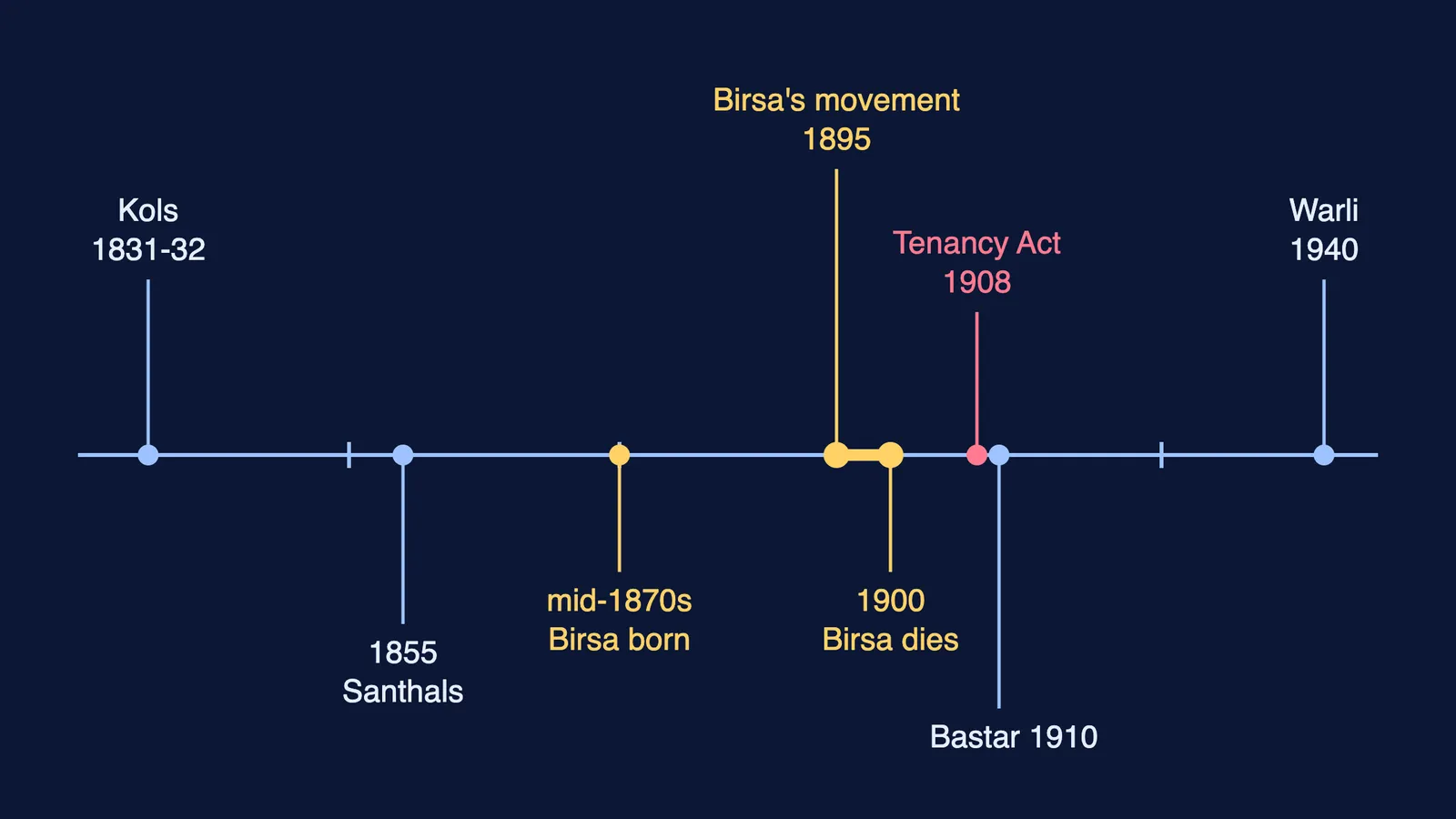
Birsa was born in the mid-1870s into a poor Munda family and grew up around the forests of Bohonda (NCERT). He studied at a missionary school and spent time with a Vaishnav preacher.
In 1895 he urged his followers to recover a satyug (age of truth), when Mundas built embankments, planted orchards and lived honestly. He asked them to give up liquor, clean their villages and stop believing in witchcraft. The political aim, which most worried the British, was to drive out missionaries, moneylenders, Hindu landlords and the government, and set up a Munda Raj with Birsa at its head.
The British jailed him in 1895 for two years. After his release in 1897 his followers attacked police stations and churches and raised a white flag as the symbol of Birsa Raj. The rising that broke out around Christmas 1899 is known as the Ulgulan, or Great Tumult (Wikipedia on Birsa Munda). Birsa died of cholera in 1900.
NCERT says the movement mattered in two ways: it forced laws so that tribal land could not easily be taken over by dikus, and it showed tribal people could protest on their own terms. The law usually named is the Chotanagpur Tenancy Act of 1908 (Wikipedia). Since 2021, 15 November, Birsa's birth anniversary, has been observed as Janjatiya Gaurav Divas (same page).
How do you write the golden age answer in an exam?
The chapter asks what Birsa's vision was and why it appealed. Use a four-line frame:
Define: a past satyug before the dikus.
Describe: good farming, honesty, no liquor or witchcraft, land back with the Mundas.
Explain the appeal: debt to moneylenders, land lost to landlords, forest laws, low wages far from home.
Link to a result: the land laws and the proof that tribals could resist.
A model answer: "Birsa spoke of a satyug when Mundas lived honestly, farmed their own land and were free of dikus. It appealed because forest laws, moneylenders and landlords had taken their land and pushed them into debt."
Check this chapter is still in your school's book with our guide to checking the rationalised NCERT syllabus.
For your science and maths chapters, Fermi's AI tutor works out what you already know and builds a plan for the session, so you start with a clear next step.


