

On this page
Forest society and colonialism is the story of how colonial governments in India and Java took control of forests that local communities had long used, and how those communities pushed back. It is a chapter in the older NCERT history book India and the Contemporary World I.
Is forest society and colonialism still in the Class 9 syllabus?
Check your book first. The CBSE Social Science curriculum for Class IX, 2026-27 prescribes two NCERT books, Social Science Part 1 and Part 2, organised by themes, and has no chapter called Forest Society and Colonialism. The closest match is the Part 2 theme Life on Earth, which covers forest dwellers, their livelihoods and challenges, and government efforts to support forest dwellers.
If your school still uses India and the Contemporary World I, learn the chapter as written. On the new CBSE books, this history explains why forest dwellers' rights became a question at all.
Why did colonial rulers take control of forests?
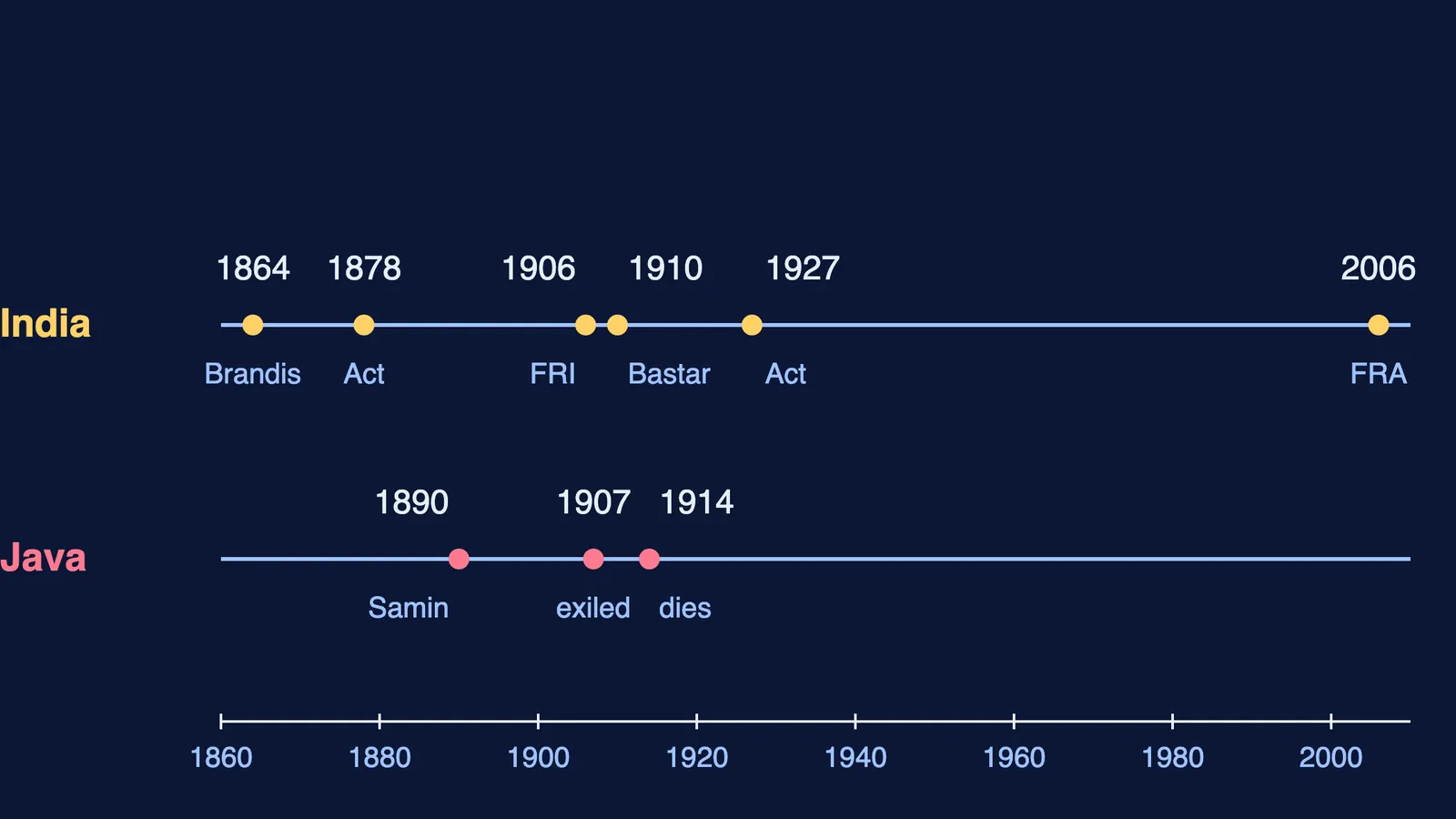
Colonial governments saw forests as a store of timber, minerals and revenue, and the people living in them as a problem to manage. In Bastar, the British began setting up reserved forests in 1871 and expanded the policy in 1908, handing outside interests the right to exploit iron, timber, tendu and other produce while charging Adivasis fees to graze cattle or collect produce, according to the account of the Bastar rebellion.
In Java, Dutch officials declared the teak forests of north-central Java colonial property and shut local people out (Saminism movement).
Three laws carry the Indian story (Indian Forest Act, 1927):
1865: the first Indian Forest Act, which Dietrich Brandis helped formulate.
1878: a stronger Act that cut back communities' traditional use of forests and secured government control.
1927: an Act built largely on the earlier ones, which sets out how land is declared a Reserved Forest, a Protected Forest or a Village Forest.
What was scientific forestry?
Dietrich Brandis, a German forester, became Inspector General of Forests in India in 1864 and held the post until 1883 (Dietrich Brandis). Earlier, in Burma, he introduced the taungya system: Karen villagers cleared and planted teak, grew their own crops between the young trees for a few years, then were moved to fresh land.
The Forest Research Institute in Dehradun has its roots in the Imperial Forest Research Institute and College, established in 1906 to organise forestry research (FRI Dehradun).
What happened in the Bastar rebellion of 1910?
Bastar was a princely state in central India; today it is the Bastar division of Chhattisgarh (Bastar rebellion). Anger over forest reservation, forced labour and outside moneylenders built through 1908 and 1909, and the plan was spread only as word of a coming bhumkal, an earthquake. In January 1910, red chillies, mango leaves, lumps of earth, and bows and arrows went from village to village as signals.
The rising began on 6 February 1910. Gunda Dhur, a Duruwa leader, led it openly; Lal Karendra Singh, a former diwan, led it behind the scenes. Rebels attacked forest officials, traders and moneylenders. By the end of February, troops from neighbouring Jeypore and Bengal had put down the revolt and arrested its leaders.
How did the Samin movement in Java resist Dutch forestry?
Surontiko Samin was a peasant born in 1859 in Randublatung, Blora (Saminism movement). In 1890, after Dutch officials declared the teak forests colonial property, he began teaching peaceful resistance. His followers refused to pay taxes and kept cutting teak for their own use, telling the village head first; they did not take up arms. When the following grew to about 5,000 people in 1907, the Dutch arrested Samin and exiled him to Padang in Sumatra, where he died in 1914.
How do you write a 5-mark answer on Bastar and Java?
Use this four-part plan, one or two lines each:
Context: which colonial power, which forest, which policy.
Grievance: what people lost, such as grazing, gathering, land or homes.
Resistance: an armed rising in Bastar; tax refusal and continued teak use in Java.
Outcome: crushed or exiled, but the question of forest rights stayed open.
A worked comparison you can adapt:
Bastar: British rule; reserved forests from 1871, expanded in 1908; armed bhumkal led by Gunda Dhur in 1910; put down by troops.
Java: Dutch rule; teak forests declared colonial property; non-violent refusal led by Surontiko Samin from 1890; leader exiled in 1907.
End with one sentence that links history to today. The Forest Rights Act, enacted on 29 December 2006, aims to address historical injustices faced by forest-dwelling communities, says the National Commission for Scheduled Tribes.
To revise, turn the four-part plan into a cause-and-effect chart for a history chapter, and if a summary tool hands you a date, check it against NCERT. Then time yourself on one long answer with this 20-minute board answer-writing drill.
If you are not sure where to start on a topic, Fermi's AI tutor can work out what you already know and build a plan for the session, so you sit down to a clear next step.


