

On this page
NCERT's Class 8 history chapter “From Trade to Territory: The Company Establishes Power”, in the textbook Our Pasts III, asks one question: how did a small trading company become the master of a vast empire? The answer comes in steps, each using a different tool.
NCERT launched a new Class 8 book, Exploring Society: India and Beyond, in July 2025, Careers360 reported; this guide follows Our Pasts III.
How did the East India Company come to India?
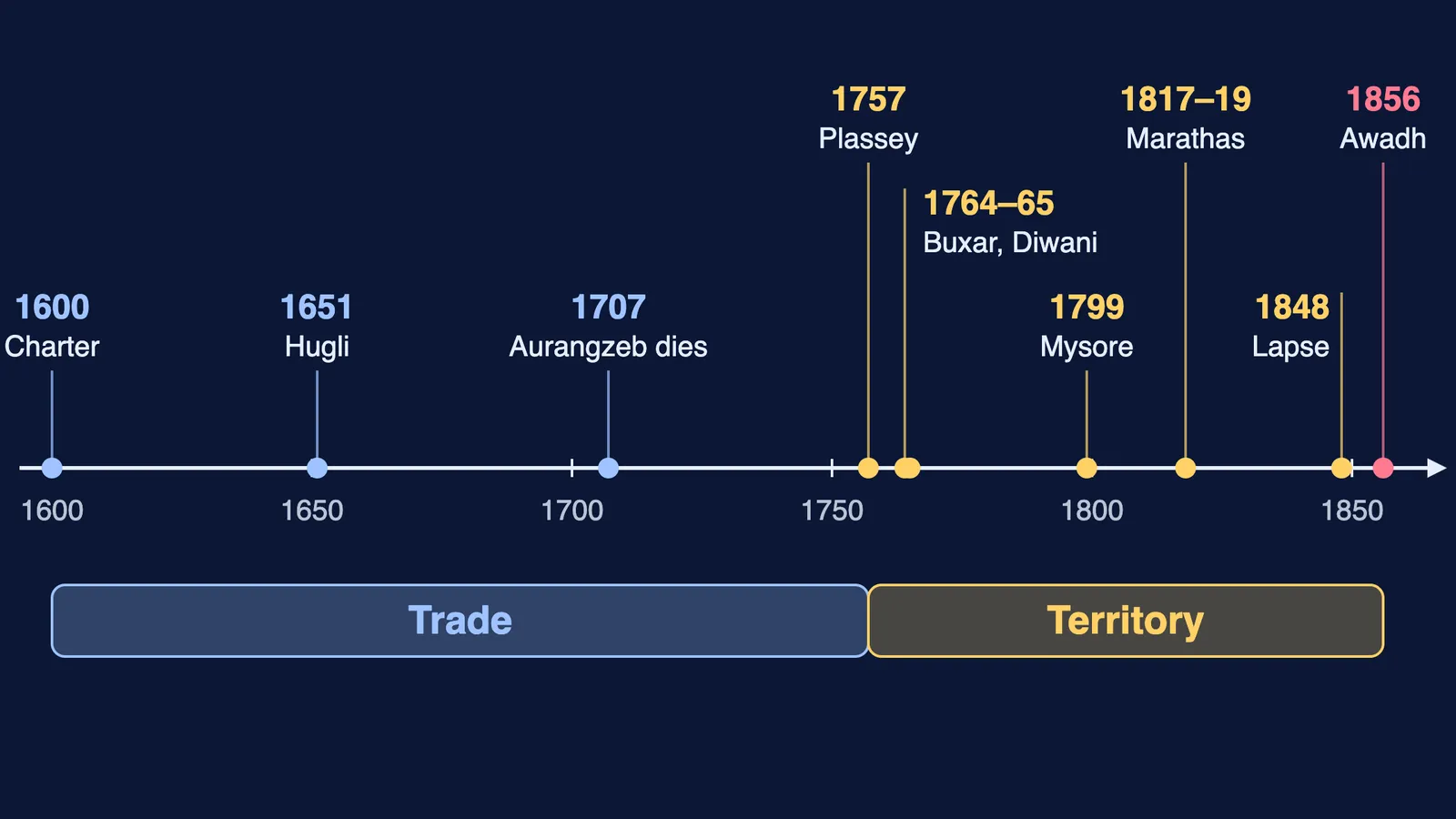
In 1600, Queen Elizabeth I gave the East India Company a charter granting it the sole right to trade with the East, according to the NCERT chapter. That kept out other English traders, but not the Portuguese, Dutch and French, who wanted the same cotton, silk and spices. Competition pushed prices up and cut profits, so the companies sank each other's ships and fortified their trading posts.
The first English factory was set up on the banks of the river Hugli in 1651. A factory here meant a warehouse with offices, run by traders called “factors”. By 1696 the Company was building a fort, and two years later it bribed Mughal officials for zamindari rights over three villages; one of them, Kalikata, grew into Kolkata.
Why did the Battle of Plassey happen?
After Aurangzeb died in 1707, the nawabs of Bengal asserted their power, as the chapter explains. Company officials also stretched Aurangzeb's farman (a royal order): it gave the Company duty-free trade, but officials refused to pay duty on their private trade too.
Sirajuddaulah became nawab in 1756. When the Company meddled in his politics, he marched with 30,000 soldiers to the English factory at Kassimbazar and then took Calcutta. In 1757 Robert Clive led the Company's army against him at Plassey.
NCERT names one of the main reasons the Nawab lost: the forces led by Mir Jafar, one of his commanders, never fought, because Clive had promised to make Mir Jafar nawab. Plassey was the first major victory the Company won in India.
What changed after Buxar and the Diwani?
According to NCERT, the Company replaced Mir Jafar with Mir Qasim, then defeated Mir Qasim at Buxar in 1764. In 1765 the Mughal emperor appointed the Company as the Diwan of the provinces of Bengal. The Diwani let the Company use Bengal's vast revenue to buy cotton and silk and pay for troops and forts, instead of shipping gold and silver from Britain.
What are subsidiary alliance and doctrine of lapse in Class 8?
After Buxar, the Company appointed Residents, its political or commercial agents, in Indian states; through them Company officials interfered in who would succeed to a throne, says the NCERT chapter.
Subsidiary alliance: an Indian ruler could not keep independent armed forces; the Company protected him, and he paid for its “subsidiary forces”. If he could not pay, part of his territory was taken as a penalty. Under Governor-General Richard Wellesley, the Nawab of Awadh had to give over half his territory to the Company in 1801 for this reason.
Where the Company saw a threat to its interests, it went to war. Tipu Sultan of Mysore was killed defending his capital, Shrirangapatnam, in 1799, and a subsidiary alliance was imposed on Mysore. Maratha power ended with the Third Anglo-Maratha War of 1817 to 1819.
Doctrine of lapse: Lord Dalhousie, Governor-General from 1848 to 1856, devised a policy that if an Indian ruler died without a male heir, his kingdom would “lapse” and become Company territory. Satara (1848), Sambalpur (1850), Udaipur (1852), Nagpur (1853) and Jhansi (1854) were annexed this way.
Awadh was different. In 1856 the British took it over saying they were “obliged by duty” to end the Nawab's “misgovernment”, and the people of Awadh joined the revolt of 1857. Our freedom struggle timeline for Class 8 picks up the story from there.
How do you write a good answer on this chapter?
Use a four-step chain, naming the tool at each step.
Trade (1600 to 1756): charter, factory, fort, farman.
Battle (1757 and 1764): Plassey, then Buxar.
Revenue (1765): the Diwani of Bengal.
Control (after 1765): Residents, subsidiary alliance, wars, doctrine of lapse.
Worked example, for “Explain the system of subsidiary alliance” (3 marks): “Under subsidiary alliance, an Indian ruler was not allowed to keep independent armed forces. The Company protected the state, and the ruler paid for the subsidiary forces kept for this. If he failed to pay, part of his territory was taken as a penalty, as when the Nawab of Awadh gave over half his territory in 1801.”
Two slips that cost marks:
Mixing up Plassey (1757, against Sirajuddaulah) and Buxar (1764, against Mir Qasim).
Calling the 1856 takeover of Awadh a lapse case. The reason given was “misgovernment”.
To revise, draw the dates on one line and hang each tool under its year; our guide to making a mind map for one chapter shows how.
If science is next on tonight's list, Fermi's AI tutor can work out what you already know and build a plan for the session, so you start with a clear next step.


