

On this page
Class 8 history asks not only when something happened but what changed because of it. Below are ten events in order, each with the change to remember, then a worked answer and a three-session plan.
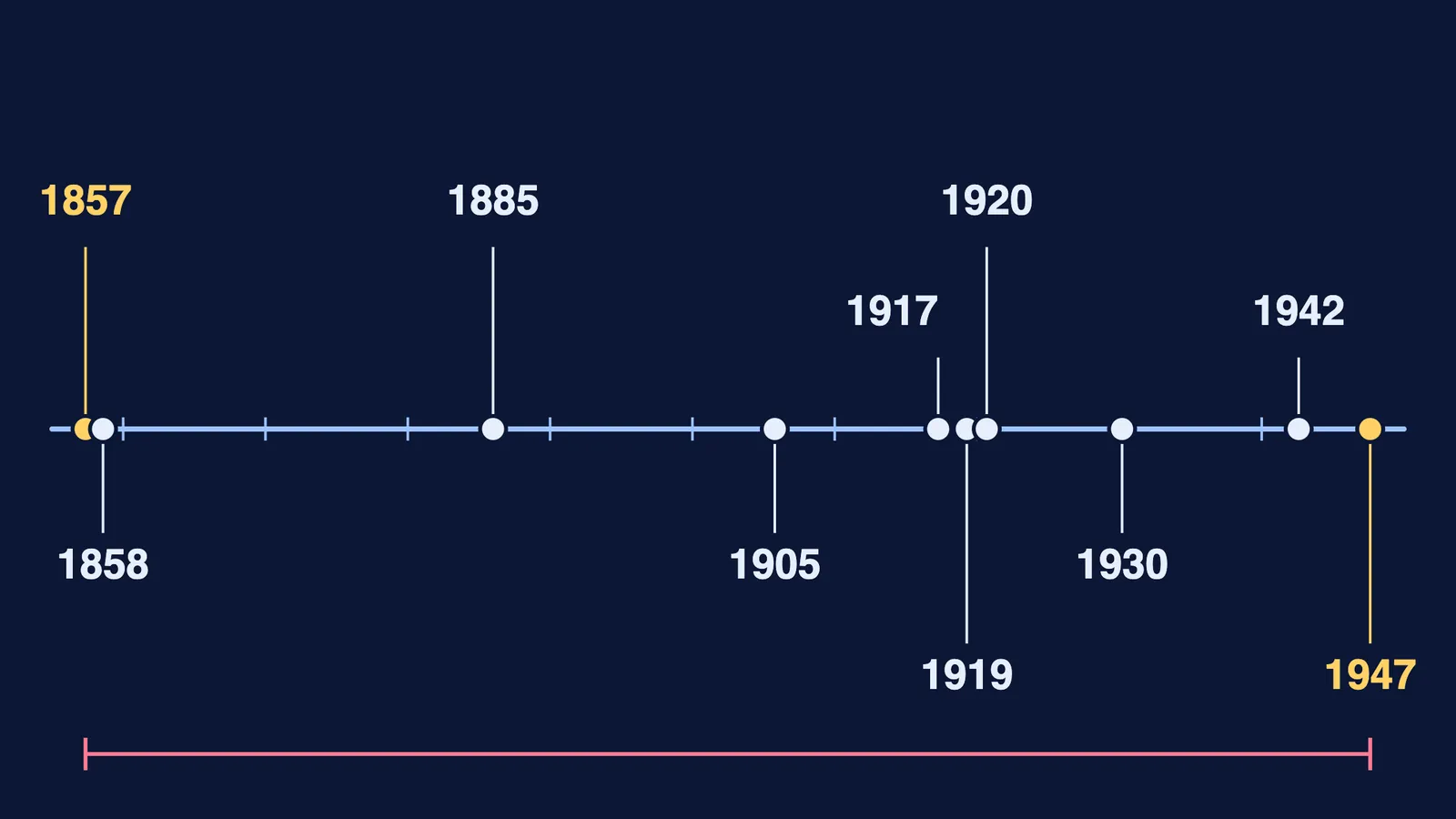
What are the 10 key events of India's freedom struggle?
Each date comes from the article linked beside it. Check it against your NCERT chapter too, because the textbook is what your examiner marks against.
1857, the Revolt. It began on 10 May 1857 as a mutiny of sepoys at Meerut (Indian Rebellion of 1857). What changed: it led to the end of the East India Company.
1858, Crown rule. The Government of India Act, passed on 2 August 1858, transferred the Company's functions to the British Crown (Government of India Act 1858). What changed: India was now governed in the Queen's name, directly from Britain.
1885, the Indian National Congress. Its first session met in Bombay from 28 to 31 December 1885, attended by 72 delegates (Indian National Congress). What changed: Indians from different provinces had one platform for their demands.
1905, the Partition of Bengal. Lord Curzon's partition took effect on 16 October 1905, and the protest grew into the Swadeshi movement; Bengal was reunited in 1911 (Partition of Bengal)). What changed: protest moved from petitions to boycotting British goods.
1917, Champaran. Gandhi's first satyagraha in British India backed indigo farmers in Bihar who were paid barely anything for their crop (Champaran Satyagraha). What changed: non-violent resistance won a concrete result for farmers.
1919, Jallianwala Bagh. On 13 April 1919 in Amritsar, troops under Brigadier-General Reginald Dyer fired on a crowd gathered during the Baisakhi fair, many of them to protest the Rowlatt Act and the arrest of two independence activists (Jallianwala Bagh massacre). What changed: the Rowlatt Act and the massacre pushed the Congress to stop cooperating with British reforms.
1920, Non-Cooperation. Gandhi launched it on 4 September 1920, asking Indians to boycott British goods and institutions, and called it off in February 1922 after the violence at Chauri Chaura (Non-cooperation movement)). What changed: the struggle became a mass movement, not a meeting of leaders.
1930, Purna Swaraj and the Salt March. The Congress declared complete independence on 26 January 1930, the date later chosen for Republic Day (Purna Swaraj). The 24-day Salt March from Sabarmati Ashram to Dandi ran from 12 March to 6 April 1930 (Salt March). What changed: the goal became full independence, and anyone could join by making salt.
1942, Quit India. Gandhi called for "Do or Die" in Bombay on 8 August 1942, and almost the entire Congress leadership was imprisoned within hours (Quit India Movement). What changed: the demand was no longer reform but that the British leave.
1947, independence. The Indian Independence Act received royal assent on 18 July 1947 and created two dominions, India and Pakistan, from 15 August 1947 (Indian Independence Act 1947). What changed: British rule ended, and partition displaced between 12 and 20 million people (Partition of India).
How do you write a timeline answer in the exam?
A short-answer question often reads: "Explain how the Partition of Bengal changed the national movement." Answer it in three parts, the same way the list above is built.
Event and date: Lord Curzon partitioned Bengal in 1905.
What people did: the protest became the Swadeshi movement, a boycott of British goods.
What changed: protest spread beyond petitions to ordinary buyers and sellers, and the British reunited Bengal in 1911.
That shape, event, response, change, works for nearly every event here. If you want to see the links between events on one page, try a cause-and-effect chart for a history chapter. Notice how often one event's change becomes the next event's cause: the Rowlatt Act led to Jallianwala Bagh, which fed into Non-Cooperation.
How can a Class 8 student remember freedom struggle dates?
Rereading the list feels productive but tests nothing. Writing it from memory does. Use three short sessions.
Day 1, build it (20 minutes): write the ten years on a blank page. From memory, add each event and its What changed line. Check against the list and mark gaps in another colour.
Day 3, retrieve it (10 minutes): blank page again. Write the years, then the events. Then reverse it: from the events alone, write the years.
Day 7, connect it (10 minutes): draw arrows where one event caused the next, and write one answer in the three-part shape above.
This spacing follows the same idea as a board revision calendar with 1-3-7-14 day gaps; add a day-14 check before your test.
If you use AI for history homework, here is how to check a wrong date in your history answer against NCERT. When history is done and science or maths is next, Fermi's AI tutor can work out what you already know and build a plan for the session, so you sit down to a clear next step.


