On this page
Six weeks before the board exams, many students reread their notes from page one. A paper calendar with growing gaps tells you which chapter to test yourself on today, using one sheet and a pen.
Why do expanding gaps work for board revision?
Two habits do most of the work: spreading study out over days, and testing yourself rather than rereading. In a review of 10 common study techniques, Dunlosky and colleagues (2013) rated practice testing and distributed practice as the only two of high utility.
In Karpicke and Roediger's 2008 study in Science, repeated studying after students had learned the words had no effect on delayed recall, while repeated testing produced a large positive effect.
The gap size matters too. Cepeda and colleagues (2008) taught more than 1,350 people a set of facts, reviewed them after a gap of up to 3.5 months, and tested them up to a year later. The best gap grew as the test moved further away, but as a share of the time to the test it shrank: from about 20 to 40% of the delay for a test one week later to about 5 to 10% for a test one year later.
That study tested one review, not a series, so treat 1, 3, 7 and 14 days as a simple pattern in the range it suggests for an exam six weeks away. If you want the history behind this, read our piece on what Ebbinghaus measured with his forgetting curve.
One honest caveat. In Karpicke and Roediger's 2007 experiments, expanding gaps helped 10 minutes after learning, but equal gaps gave better retention 2 days later, and expanding the gaps had little effect on long-term retention across three experiments. What mattered was delaying the first test to make it harder; your first test comes a day after study.
How do you draw the calendar on paper?
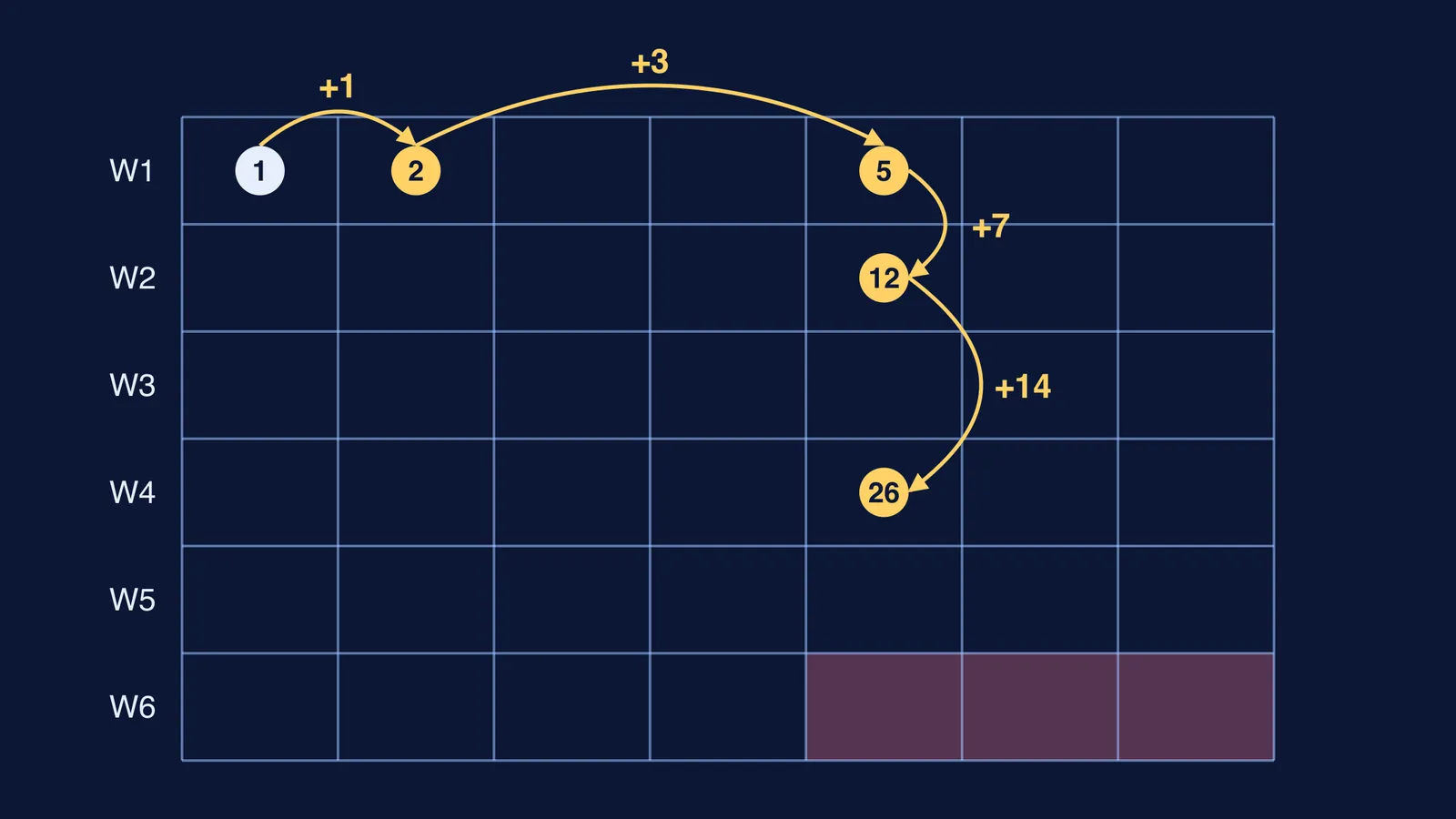
Turn an A4 sheet sideways. Draw 6 rows (weeks) and 7 columns (days), and number the boxes 1 to 42.
List your chapters in the margin as C1, C2, C3 and so on.
Write a chapter's code in the box of the day you first study it.
Count forward 1 day and write it again, then 3 more days, then 7, then 14. A chapter started on day 1 lands on days 2, 5, 12 and 26.
Keep days 40 to 42 for full timed papers.
To review, close the book, write everything you remember on a blank page, then check it against the chapter. Tick the box.
What does a 12-chapter plan look like?
Here is a worked plan for one subject with 12 chapters. New chapters start on days 1 to 4, 6 to 9 and 11 to 14; days 5 and 10 are lighter catch-up days with reviews only.
C1 starts day 1: reviews on days 2, 5, 12, 26
C2 starts day 2: reviews on days 3, 6, 13, 27
C3 starts day 3: reviews on days 4, 7, 14, 28
C4 starts day 4: reviews on days 5, 8, 15, 29
C5 starts day 6: reviews on days 7, 10, 17, 31
C6 starts day 7: reviews on days 8, 11, 18, 32
C7 starts day 8: reviews on days 9, 12, 19, 33
C8 starts day 9: reviews on days 10, 13, 20, 34
C9 starts day 11: reviews on days 12, 15, 22, 36
C10 starts day 12: reviews on days 13, 16, 23, 37
C11 starts day 13: reviews on days 14, 17, 24, 38
C12 starts day 14: reviews on days 15, 18, 25, 39
The busiest days, 12 and 13, each hold one new chapter and three short reviews. After day 14, weeks 3 to 6 hold only reviews, which leaves room for a second subject's calendar in another colour, started a few days later. The last review falls on day 39.
What if you miss a day or fail a review?
Missed a day? Do that review tomorrow and count the next gap from the day you actually did it. Do not try to do two days' reviews at once.
Failed a review? As a rule of thumb, if you could recall less than half the chapter, review it again the next day, then restart its gaps at 3, 7 and 14. If the same chapter fails twice, the problem is usually understanding, not memory. Fermi's AI tutor works out what you already know and builds a plan for the session, so you can rebuild that chapter before it goes back on the calendar. For a single idea that won't stick, the Fermi Concept Library gives each concept its own lesson.
Still choosing between paper and an app? Our comparison of spaced repetition apps and paper flashcards explains how each schedules reviews. For a shorter run, try our four-week spaced revision schedule.