On this page
Most students make a mind map once, colour it in, pin it up and never look at it again. That's a poster. A map earns its place when you use it to test yourself. This guide covers when a map does better than linear notes, how to build one for a single chapter, and a weekly routine that keeps you redrawing it.
When do mind maps beat linear notes?
The research is mostly about concept maps, which are node-link diagrams where lines join related ideas. Mind maps are a looser version that branches out from one central topic. A meta-analysis by Nesbit and Adesope in Review of Educational Research pooled 55 studies with 5,818 participants, from Grade 4 to postsecondary level. It found that using concept maps was associated with increased knowledge retention. The size of the benefit varied a lot depending on how the maps were used.
For mind maps in particular, a 2002 trial with 50 medical students in Medical Education found that the mind-map group recalled about 10% more a week later than students who used their usual methods. But the 95% confidence interval (-1% to 22%) included zero, and the mind-map group reported lower motivation.
There's a catch. In a 2011 study in Science, Karpicke and Blunt found that practising retrieval produced more learning than elaborative studying with concept mapping. That held even when the final test asked students to draw a concept map. So the map works best as something you rebuild from memory, not just something you make once.
Here's a simple way to decide:
Use a mind map when a chapter is a web of linked ideas: human physiology, periodic trends, the laws in a physics chapter, causes and effects in history.
Use linear notes for sequences: derivations, multi-step reaction mechanisms, long worked solutions and anything you must reproduce in order.
Use both for most science chapters. Put the map on one page and keep the derivations and method steps in your notebook.
How do you make a mind map for one chapter?
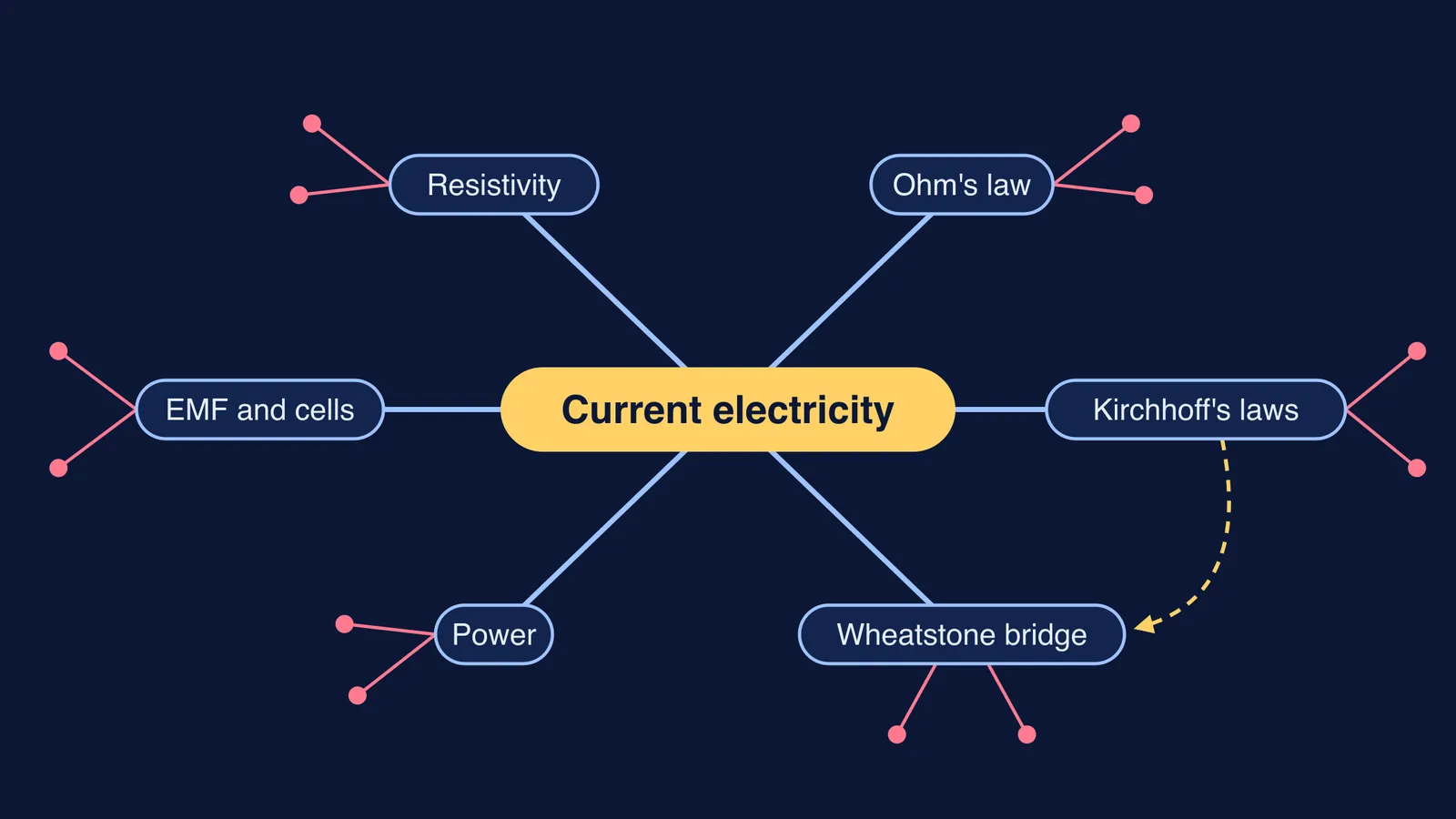
Here's how it works for Class 12 current electricity. Use one A4 sheet in landscape, two pens and 30 minutes.
Close the book first. Write the chapter name in the centre. For 10 minutes, draw every main idea you can remember as a branch, such as Ohm's law, resistivity, EMF and cells, Kirchhoff's laws, the Wheatstone bridge and power.
Add twigs with keywords, not sentences. Under resistivity, write things like "depends on material and temperature" and the formula R = ρl/A. Keep each twig to one formula or a few words.
Open the NCERT chapter and fill gaps in a second colour. Anything you add in this colour is something you didn't recall, so it's your revision list.
Draw cross-links. Join ideas that explain each other. For example, the balance condition of a Wheatstone bridge comes from Kirchhoff's laws. These links are what linear notes find hard to show.
Mark one question per branch. Put a small "Q" with the number of a textbook or module problem that tests that branch.
If you like adding small sketches, our guide to dual coding notes with words and diagrams shows how to keep them quick.
What does a weekly revision routine with mind maps look like?
Spacing out your reviews matters. A review of 317 experiments by Cepeda and colleagues in Psychological Bulletin found that the best gap between study sessions gets longer the longer you need to remember something. For one chapter a week, the routine looks like this:
Day 1: finish the chapter in class, then build its map using the five steps above.
Day 3: redraw it on a blank sheet in 10 minutes without looking. Compare it with the original and circle the missing branches in red.
Day 6: solve the "Q" problems for the red branches only.
Weekend: redraw the maps from one and two weeks ago, 10 minutes each. Then put them away.
For longer gaps before board exams, fit these redraws into a six-week revision calendar with 1-3-7-14 day gaps.
Sometimes a branch stays red after two redraws, and you can't explain it even with the book open. That usually means a concept gap, not a memory gap. The Fermi Concept Library gives each concept in physics, chemistry, biology, mathematics and computing its own lesson and shows where it fits in the map, so you can fix the idea before you redraw it.
What mistakes make a mind map useless?
Copying the textbook into bubbles. If a twig is a full sentence, cut it down to a few words.
Spending your time on decoration. Colour should show what you forgot, not make the page pretty.
Never redrawing it. Looking at a finished map feels like revision, but the Karpicke and Blunt result suggests that recalling it is what builds learning.
Forcing derivations into branches. Keep step-by-step working in linear notes and link to it with a page number.
For a second opinion on your first map, try getting AI feedback on your mind map of a chapter. Then start this week's chapter with the book closed.