On this page
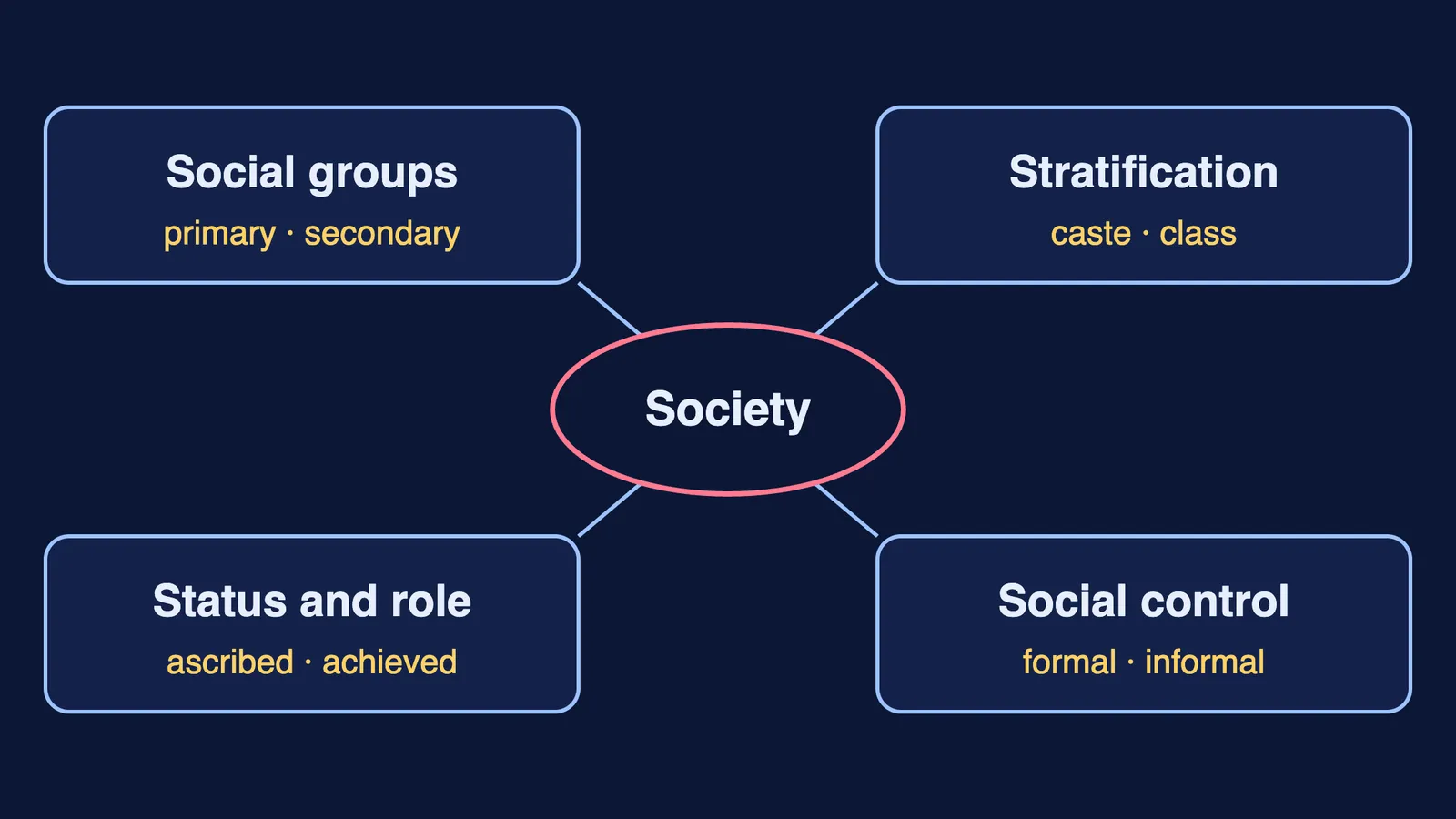
Chapter 2 of the NCERT textbook Introducing Sociology, Terms, Concepts and their Use in Sociology, gives you the vocabulary the rest of the course runs on. The CBSE Sociology curriculum for 2026-27 lists four topics under this unit (social groups and society, social stratification, status and role, and society and social control) and gives the unit 10 of the 80 theory marks.
Why does sociology need special terms and concepts?
Because the subject matter is familiar, we assume we already understand families or status; precise terms separate sociology from common sense (NCERT, Chapter 2). NCERT calls concepts keys to society: entry points, not final answers, to be modified when they stop fitting. Two ideas recur:
Micro and macro: status and role begin with the individual; stratification and social control begin with the larger structure an individual is already placed in.
Functionalist and conflict views: society as broadly harmonious, like an organism, against society as unequal and marked by competing interests.
What is a social group, and what are its types?
An aggregate is people in one place at one time with no definite connection, like passengers at a bus stop (NCERT, Chapter 2). A quasi group lacks structure, and members may barely know it exists (social classes, age groups, crowds); over time it can become a social group, as when castes and classes gave rise to political parties.
A social group is continuously interacting people who share interests, culture, values and norms. Its six marks: persistent interaction, a stable pattern, a sense of belonging, shared interest, common norms and values, and a definable structure. The types:
Primary and secondary: small, face-to-face, person-oriented (family) against large, formal, goal-oriented (a hospital).
Community and association: close, enduring ties against impersonal, contract-based ones.
In-group and out-group: "us" against "them".
Reference group: one you do not belong to but whose lifestyle you copy.
Peer group: people of similar age or profession, the source of peer pressure.
What is social stratification? Caste and class compared
Social stratification is structured inequality between groups in access to material or symbolic rewards, like layers of rock with the favoured on top (NCERT, Chapter 2). Four historical systems: slavery, caste, estate and class.
Caste: position ascribed at birth, ranked by purity and pollution; the four-fold varna is the model, the many occupation-based jatis the reality. Urbanisation and democracy changed caste, yet discrimination persists.
Class: Marx ties it to the means of production; Weber speaks of life-chances, adding prestige and power; functionalists see stratification as filling key positions with qualified people.
The traditional caste hierarchy is fixed across generations, modern class open and achievement-based, though real mobility falls well short of perfect.
What is the difference between status and role?
A status is a position with defined rights and duties; a role is its behavioural side. In NCERT's phrase, "status is occupied, but roles are played" (NCERT, Chapter 2).
Status set: all the positions you hold at once.
Status sequence: positions you move through over a lifetime.
Ascribed status: from birth or involuntary (age, caste, kinship). Achieved status: earned by ability and choice (education, expertise).
Prestige: value attached to a position, not the person.
Role conflict: contrary expectations from two roles, as for the working woman or men in Khasi matriliny.
What is social control: formal, informal, sanctions and deviance?
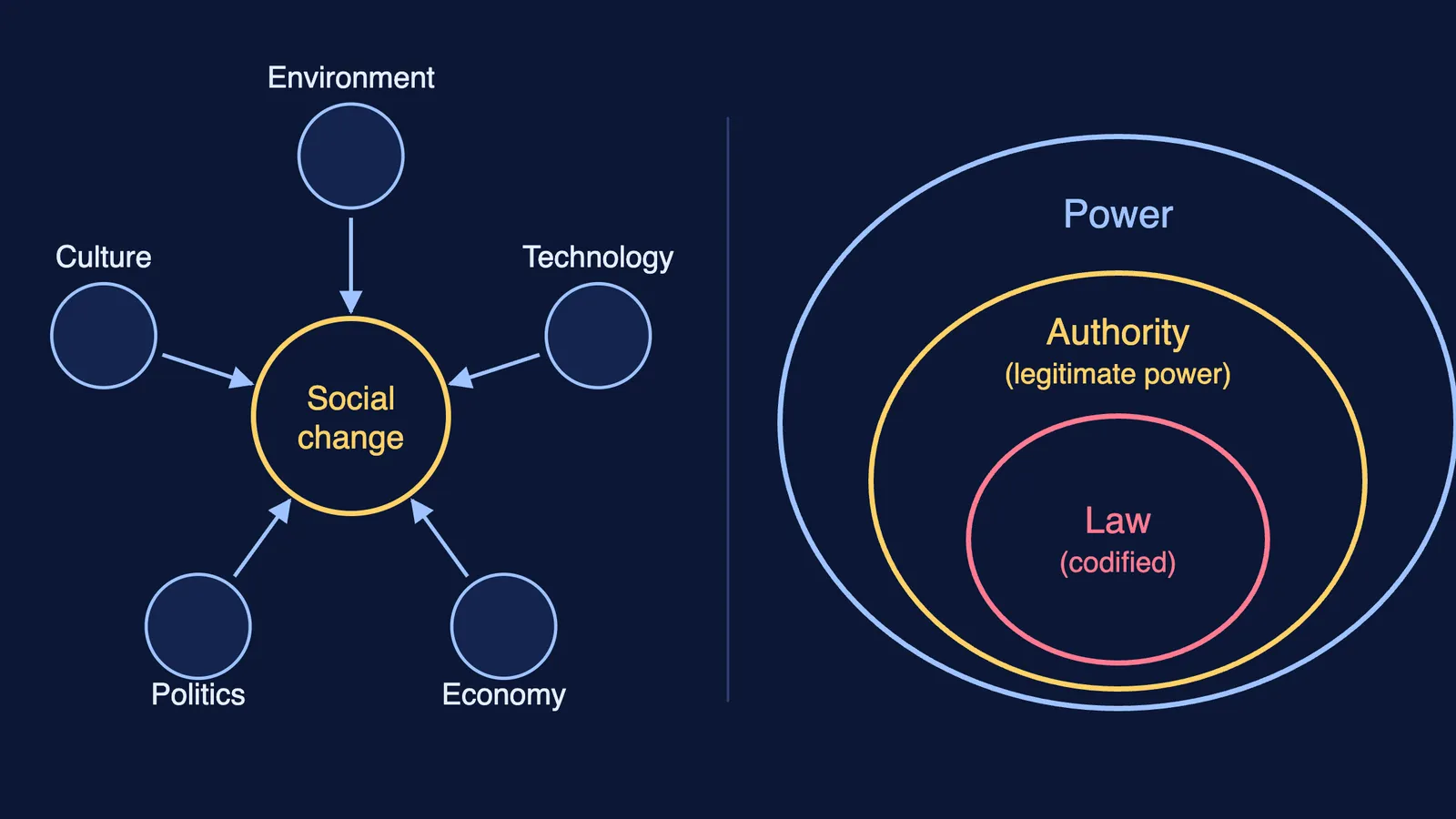
Social control is the means a society uses to bring unruly members back into line (NCERT, Chapter 2). Formal control is codified: law and the state. Informal control is personal: a frown, ridicule, laughter, through family, religion and kinship. A sanction rewards or punishes to reinforce expected behaviour. Deviance is action outside a group's norms, and its meaning changes over time. Functionalists see control as keeping order; conflict theorists see dominant groups imposing their will.
How do you apply all four ideas to one example?
Meera, an imagined 16-year-old in Nagpur, captains her school kabaddi team.
Groups: family is primary; the district sports association secondary; her team an in-group against a rival school; state players her reference group.
Stratification: affording coaching and kit depends on her family's class.
Status and role: daughter, student and captain form her status set; daughter is ascribed, captain achieved. A match on a family wedding day is role conflict.
Social control: teasing for missed practice is informal; eligibility rules are formal; a medal is a positive sanction.
Practice questions (our own):
Distinguish a quasi group from a social group, with an example of each.
Explain the difference between ascribed and achieved status using your own life.
How would a functionalist and a conflict theorist each explain social control?
Revise Chapter 1 with our guide to Sociology and society for Class 11, then read on to understanding social institutions.
Fermi's AI tutor can work out what you already know and build a plan for the session, so you sit down to a clear next step.