On this page
Structural Change opens the NCERT book *Social Change and Development in India* with one idea: British colonialism was capitalist, so it reshaped how India produced goods and where Indians lived. Learn that idea and its cases, and the answers follow.
What does the Structural Change chapter cover in 2026-27?
The CBSE Sociology curriculum 2026-27 lists Unit 8, Structural Change, as "Understanding Colonialism, Industrialization, Urbanization" and gives it 5 marks out of the 40 for Part B. The current text is the NCERT chapter (Reprint 2026-27).
The 2026-27 sample paper uses it for a 1-mark assertion-reason item on nationalists and economic exploitation, and a 4-mark question on how colonialism lives on today. The marking scheme rewards everyday examples such as British-model legal and police systems and driving on the left. Word limits: 30 words for 2 marks, 80 for 4, 200 for 6.
How was colonialism different from earlier conquests?
Earlier conquerors mostly took tribute and left the economy alone. British rule, says the NCERT chapter, interfered directly to profit British capitalism: it changed land laws, decided which crops were grown, cleared forests for tea and passed Forest Acts that kept pastoralists out of old grazing land.
It also moved people: workers from present-day Jharkhand to Assam's tea gardens, and, between 1834 and 1920, labourers recruited largely in Bihar to plantations in Mauritius.
Two definitions to learn:
Capitalism: private owners hold the means of production and run them to build up profit through a market.
Nation state: a sovereign government over a defined territory whose people are citizens of one nation.
The key irony: colonial rule denied Indians the nationalism and democratic rights that modern ideas taught them to want.
Why did industrialisation in India not follow Britain's path?
In Britain, industry pulled people into cities. Well under 20% of Britons lived in towns of over 10,000 in 1800, and 74% did by 1900, as the NCERT chapter reports from Giddens.
In India the same British industry caused deindustrialisation: cotton and silk exports fell before Manchester competition. Surat and Masulipatnam declined while Bombay and Madras grew. Thanjavur, Dhaka and Murshidabad lost their royal courts, and with them some of their artisans and court gentry. The 1911 Census, quoted in the chapter, shows artisans leaving their crafts for farming: in India, people at first moved *into* agriculture, not out of it.
What was the colonial city, and what happened on tea plantations?
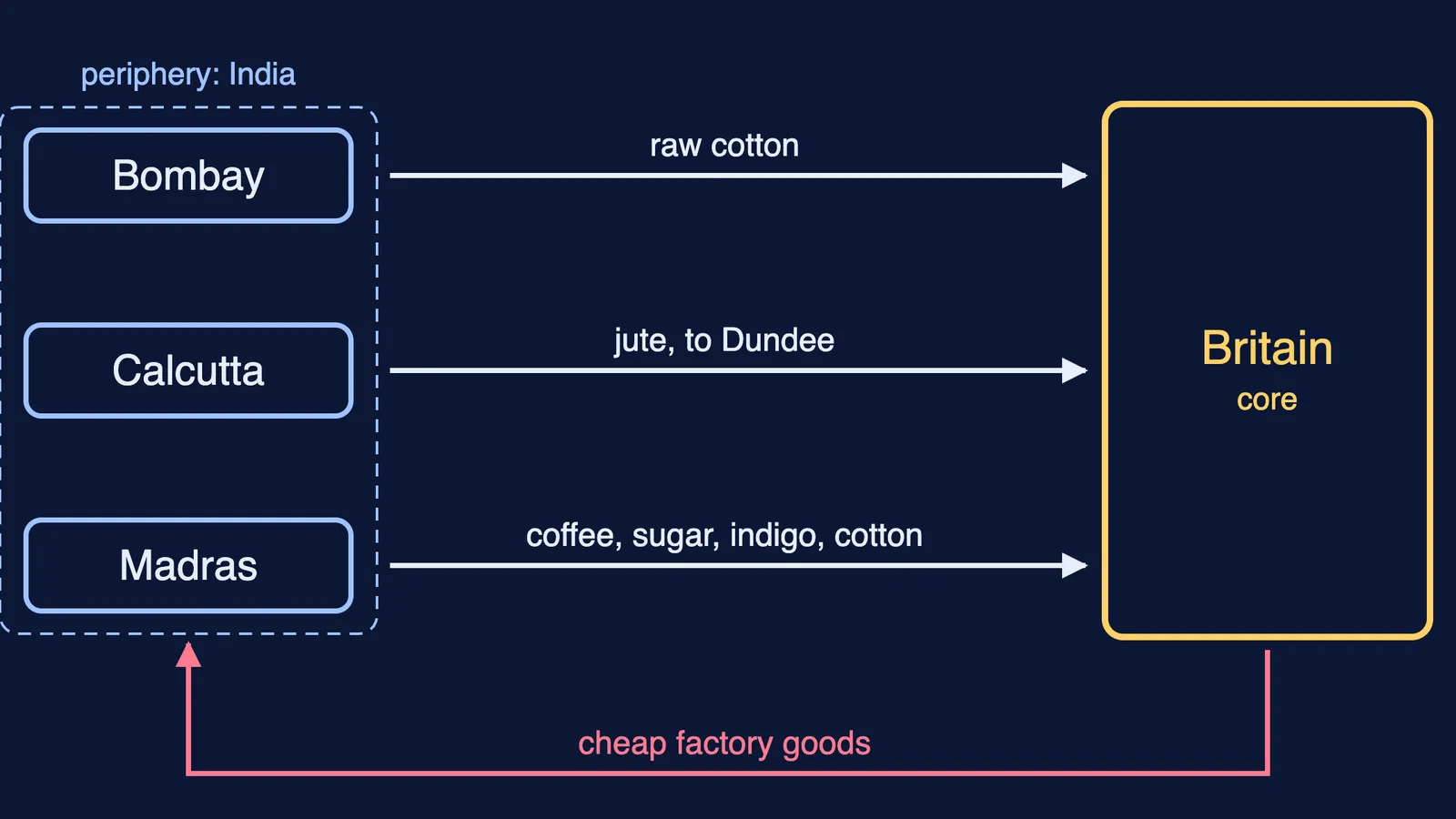
Colonial port cities linked the core (Britain) to the periphery (India): raw materials out, cheap factory goods in. By 1900 more than three-quarters of India's raw cotton was shipped through Bombay; Calcutta sent jute to Dundee; Madras sent coffee, sugar, indigo and cotton to Britain (NCERT).
In Kolkata, Job Charnock arranged to lease three villages by the Hugli in 1690, Fort William followed in 1698, and the fort and its open Maidan became the city's core. The chapter's model colonial city has a spacious European town with full services and a native town with restricted ones.
The tea industry began in 1851, mostly in Assam. In 1903 it had 4,79,000 permanent workers, plus 93,000 temporary ones. Planters refused to pay incentives to bring workers so far, so contractors recruited them under the Transport of Native Labourers Act of 1863, through fraud and coercion backed by penal laws. Set beside the planters' bungalows and servants, it shows colonial law serving planters.
What changed after independence?
Nationalists saw rapid industrialisation, through heavy industry, a large public sector and cooperatives, as the route to growth and equity. Industrial towns such as Bokaro, Bhilai, Rourkela and Durgapur followed.
Sociologist M.S.A. Rao described three urban impacts on villages: migrants sending money home from distant cities, villages beside an industrial town like Bhilai, and villages absorbed by a growing metropolis.
India was 17.29% urban in 1951, with 62.44 million people in 2,843 towns; by 2011 it was 31.16%, with 377.10 million in 7,935 towns (NCERT).
How do you write answers on this chapter?
Use three moves: Britain's pattern, India's colonial case, the social result.
Worked example (4 marks, "Why did British industry make Britain more urban but not colonial India?"): In Britain, factories and cities grew together, from under 20% urban in 1800 to 74% in 1900 (NCERT). In colonial India they did not: imports ruined crafts, Surat and Dhaka declined and artisans turned to farming, while Bombay grew to export raw cotton. After 1947, planned towns like Bhilai joined them again.
Practise with these:
(1 mark) Name one city that declined and one that grew under colonial rule.
(2 marks) Why were coastal cities favoured under colonial rule?
(4 marks) How did the colonial state help Assam tea planters get labour?
(6 marks) Using M.S.A. Rao's three situations, explain how cities change villages, with one example of each.
Read next: change and development in rural society, change and development in industrial society and social movements. If a science subject is eating your revision time, Fermi's AI tutor works out what you already know and builds a plan for the session, so you get back to this chapter sooner.