On this page
"Change and Development in Industrial Society" is Chapter 5 of the NCERT book *Social Change and Development in India*, and the current file carries the label Reprint 2026-27 (NCERT chapter PDF). It asks how the work you do shapes who you meet, how safe you are and how you live.
How many marks is this chapter worth in 2026-27?
The CBSE 2026-27 curriculum lists "Change and Development in Industrial Society" at 10 marks, inside Part B, which carries 40 of the 80 theory marks (CBSE Sociology curriculum 2026-27). Its topics run from planned industrialisation to liberalisation, how people find jobs, and work processes, including home-based work, strikes and unions.
The 2026-27 sample paper has three questions from this chapter: a 1-mark assertion-reason item on overwork in outsourced IT projects, a 2-mark question on the social features early sociologists linked with industry, and a 6-mark question on how people find jobs (CBSE sample paper 2026-27). Word limits are 30, 80 and 200 words for 2-, 4- and 6-mark answers.
What makes Indian industrialisation different?
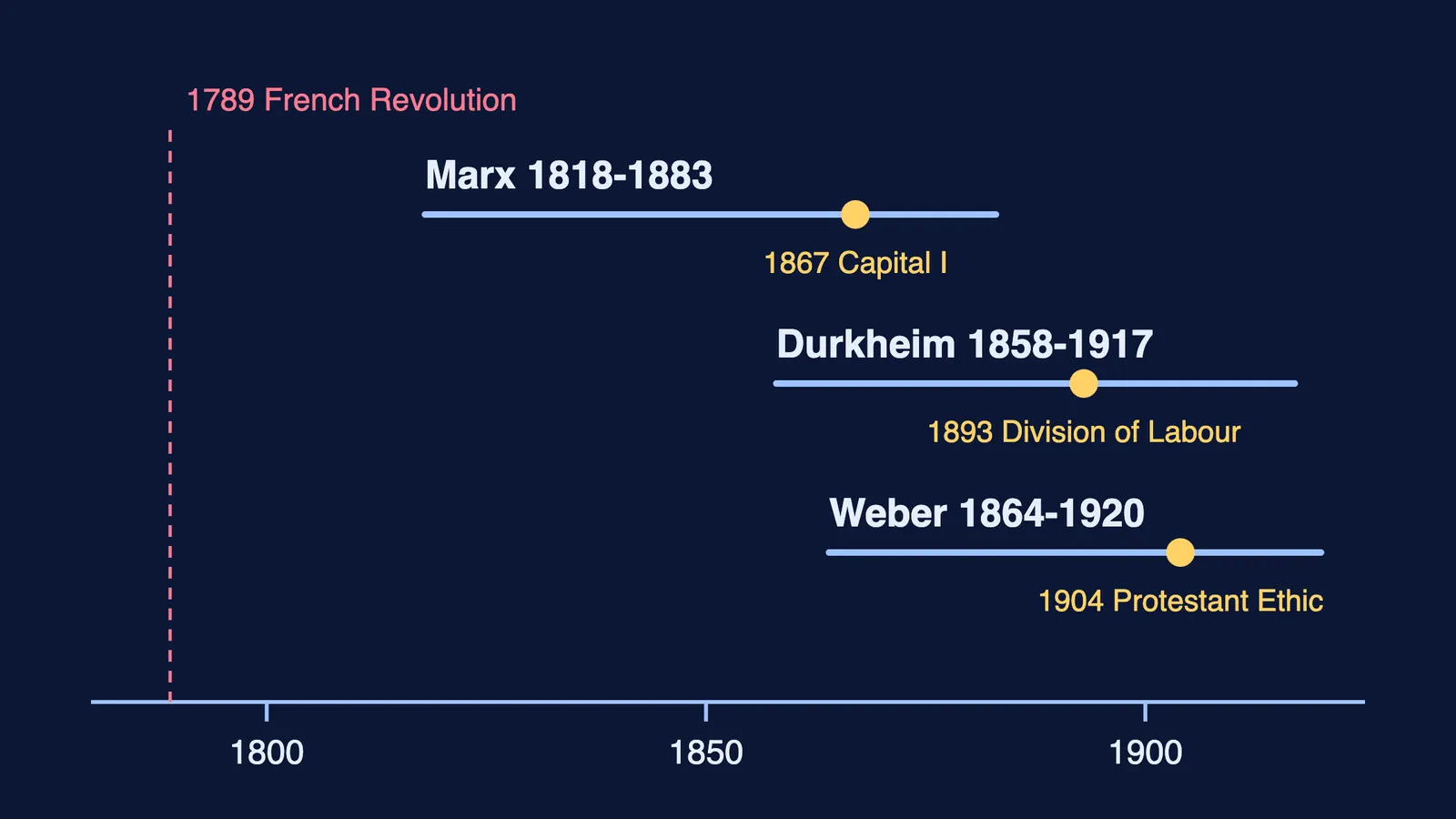
Marx, Weber and Durkheim tied industry to cities, detailed division of labour and impersonal work relations. Marx's word for work done only to survive, with no joy in it, is alienation.
India then breaks the western pattern in three ways (NCERT chapter PDF):
Where people work. In 2018-19 about 43% of workers were in the primary sector, yet services produce over half of growth, so the biggest employer earns the least.
What kind of job. Over 52% of workers are self-employed, about 24% are regular salaried and about 24% are casual labourers.
How formal it is. Over 90% of work is in the unorganised sector. One definition counts a unit as organised if it employs ten or more people all year.
So few Indians have secure jobs with benefits (two-thirds of those who do work for the government), and few belong to unions.
How did liberalisation change work in India?
Since the 1990s, India has opened sectors such as telecom, civil aviation and power to private and foreign firms and dropped industrial licences. NCERT's examples: Coca-Cola bought Parle drinks, and after Modern Foods became the first privatised company, 60% of its workers were made to retire within five years (NCERT chapter PDF). Firms increasingly outsource to smaller units or homes, where wages are lower and unions find it harder to organise. Adivasis are about 40% of those displaced by land acquisition for industry.
How do people find jobs, and how is work carried out?
Few jobs come through advertisements or employment exchanges. The self-employed, from plumbers to tutors, rely on personal contacts. Factory hiring once ran through jobbers, called mistris in Kanpur's mills. Badli workers stand in for permanent staff on leave, sometimes for years without the same security. On construction sites and brickyards, a contractor advances a loan, and the worker works it off before seeing wages.
Managers raise output by lengthening hours or speeding work up. NCERT's cases are the Maruti assembly line, IT firms where 10-12 hour days are common (Carol Upadhya's study), and Harry Braverman's argument that machinery deskills workers. Mines and fish-processing plants show unsafe, crowded conditions.
What do home-based work and the Bombay textile strike show?
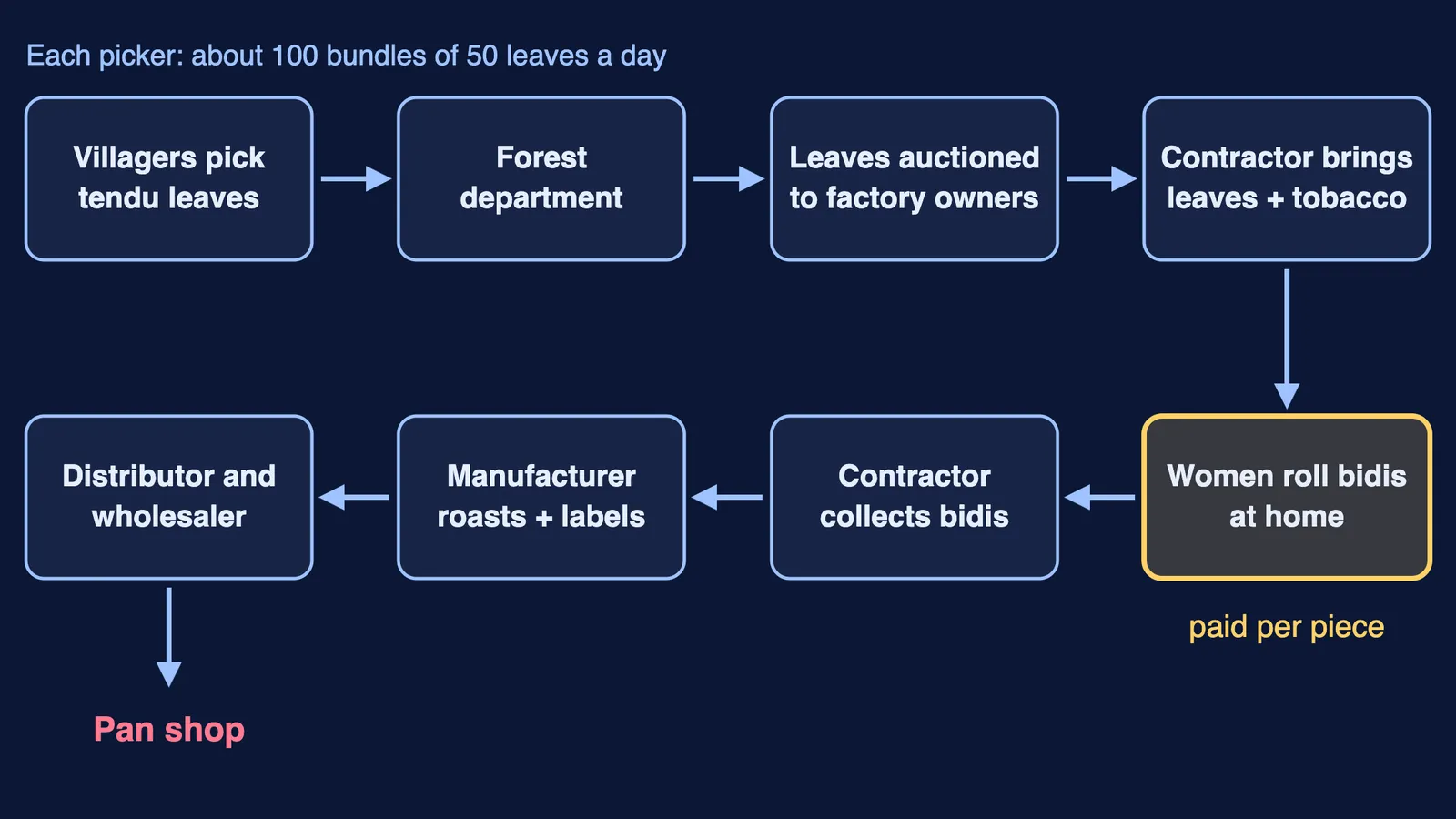
Home-based work (lace, zari, carpets, bidis, agarbattis) is done mostly by women and children and paid by the piece. The diagram above traces NCERT's bidi chain from tendu leaves in the forest, through women rolling bidis at home, to the pan shop.
The Bombay textile strike of 1982, led by Dr Datta Samant, lasted almost two years and touched nearly a quarter of a million workers, plus their families. Workers demanded higher pay and a union of their own choosing. Nearly one lakh lost their jobs; some moved to powerloom towns such as Bhiwandi, Malegaon and Ichalkaranji (NCERT chapter PDF).
How should you write answers on this chapter?
Use a three-part frame for any 4- or 6-mark answer: concept (name and define it), Indian case from NCERT, social effect (on caste, gender, family or security). The 2026-27 marking scheme's jobs answer lists jobbers, badli workers and schemes like MUDRA (CBSE marking scheme 2026-27).
Practise with these:
(2 marks) Why can a debt to a contractor leave a worker freer than a debt to a landlord?
(4 marks) Explain how outsourcing changes job security, using one NCERT example.
(4 marks) A woman in your town makes agarbattis at home. Describe her work using the terms piece rate, agent and home-based work.
(6 marks) "India is still largely an agricultural country." Use employment data and the size of the organised sector to discuss this.
For linked chapters, read our guides to patterns of social inequality and exclusion and social institutions: caste, tribe and family; for the economics view, see employment growth and informalisation. If physics or maths revision is eating into time for this chapter, Fermi's AI tutor works out what you already know and builds a plan for the session, so you sit down to a clear next step.