

On this page
Employment is one of the four topics in Unit 7, "Current challenges facing Indian Economy", which carries 20 marks in the CBSE Class XII Economics curriculum for 2026-27. The prescribed book is NCERT's Indian Economic Development, whose chapter Employment: Growth, Informalisation and Other Issues is the main source below.
What is the worker-population ratio, and what is it now?
The worker-population ratio (WPR) is the percentage of employed persons in the population, as defined in the PLFS Annual Report 2023-24 press note from the Ministry of Statistics and Programme Implementation.
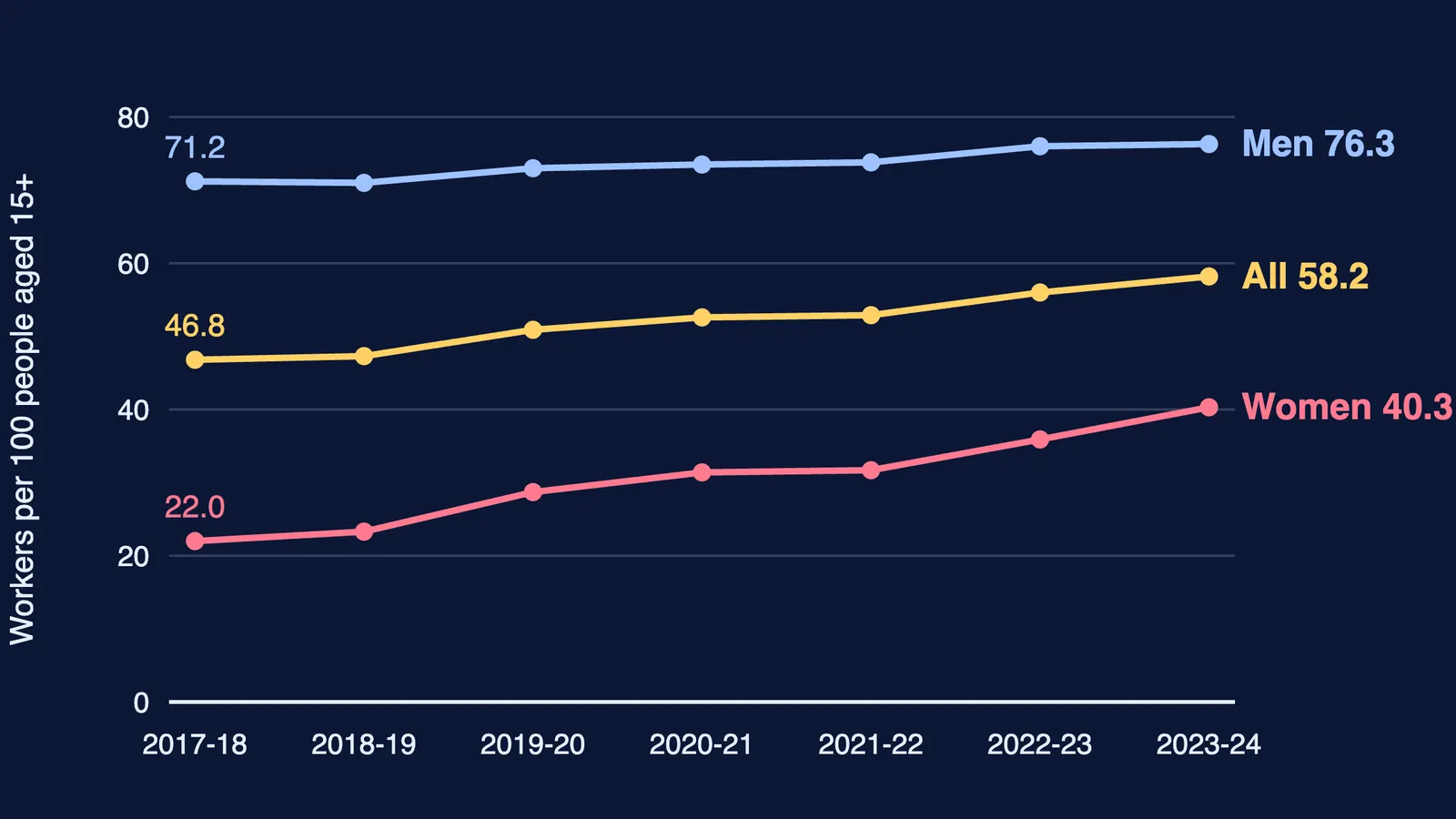
For people aged 15 and above, WPR was 58.2% in July 2023 to June 2024, up from 56.0% a year earlier and 46.8% in 2017-18. For men it was 76.3% and for women 40.3%. Rural WPR (62.1%) was higher than urban WPR (49.4%).
Table 6.1 of the NCERT chapter gives India's WPR for 2023-24 as 43.7, well below the PLFS headline. The PLFS figure counts only people aged 15 and above; NCERT's table states no age limit, so the two are not directly comparable.
How do you calculate LFPR, WPR and the unemployment rate?
The same survey defines the labour force participation rate (LFPR) as the share of people working or seeking work, and the unemployment rate as the share of the labour force that is unemployed. Take 1,000 people aged 15+, using the national 2023-24 figures from the PLFS press note:
Labour force: 601 people are working or looking for work, so LFPR = 601 / 1,000 x 100 = 60.1%.
Workers: 582 have work, so WPR = 582 / 1,000 x 100 = 58.2%.
Unemployed: 601 - 582 = 19, so unemployment rate = 19 / 601 x 100 = 3.2%.
Notice the denominator changes in step 3. For the survey's method in more depth, see our explainer on how India's PLFS calculates the unemployment rate.
Self-employed, regular or casual: how has work changed?
NCERT's Table 6.3 in the same chapter tracks India's workforce over five decades:
Self-employed: 61.4% in 1972-73, 58.4% in 2023-24.
Regular salaried employees: 15.4% to 21.7%.
Casual wage labourers: 23.2% to 19.9%.
Primary sector share of workers: 74.3% to 46.1%.
Casualisation is the movement of workers from self-employment and regular salaried jobs into casual wage work, which makes them highly vulnerable. Jobless growth is what scholars call producing more goods and services without generating employment; NCERT points to a widening gap between GDP growth and employment growth from the late 1990s. If the three sectors feel hazy, revise how the primary, secondary and tertiary sectors are classified first, and our plain guide to GDP for the output side.
What is informalisation of the workforce?
In the NCERT chapter, the formal sector is all public sector establishments plus private sector establishments that employ 10 or more hired workers; everyone else works in the informal sector. Formal-sector workers get social security benefits and can form trade unions and use labour laws to protect their rights; informal workers have no such protection or regulation.
In 2019-20, about 59 million of India's roughly 535 million workers were in the formal sector, about 11%, so about 89% worked informally. NCERT's Ahmedabad case study shows how this happens: as textile mills closed, over 80,000 permanent and over 50,000 non-permanent workers lost their jobs and were driven into the informal sector (from Jhabvala, Sudarshan and Unni, cited in the chapter).
Use this two-question test on any job in an exam:
Is it a public sector establishment? If yes, formal.
If private, does it have 10 or more hired workers? If yes, formal; if not, informal.
Try it on items from NCERT's exercise: a police constable is formal; the owner of a textile shop employing nine workers is informal; a civil engineer at a construction company with 10 workers is formal; a cycle-rickshaw puller is informal.
What are the types of unemployment in India?
The NCERT chapter describes three:
Open unemployment: people visibly looking for work and not finding it.
Disguised unemployment: more people work on a task than it needs. NCERT's example is a farmer with four acres who needs only two workers and himself but employs five workers plus family members such as his wife and children. A study from the late 1950s found about one-third of agricultural workers in India disguisedly unemployed.
Seasonal unemployment: farm work is seasonal, so villagers migrate to towns and return when the rains begin.
On policy, write about direct and indirect job creation by government, with the Mahatma Gandhi National Rural Employment Guarantee Act 2005 as the main example: it promises 100 days of guaranteed wage employment to rural households who volunteer for unskilled manual work.
If you're not sure where to start on this unit, Fermi's AI tutor can work out what you already know from a problem set or scanned assignment and build a plan for the session. Begin with the worked example: once you can get all three ratios without looking, the rest is reading, not memorising.


