

On this page
Chapter 2 of the NCERT Class 10 economics book sorts the same jobs in three different ways. Students rarely lose marks on the definitions; they lose them by mixing up which question each classification asks. A three-question test at the end fixes that.
What are the primary, secondary and tertiary sectors?
This split asks one question: what is the nature of the activity? The definitions below are from the NCERT chapter Sectors of the Indian Economy.
Primary sector: activities that produce a good by directly using natural resources, such as farming, dairy, fishing, forestry and mining. It is called primary because it forms the base for all the products made later, and it is also called the agriculture and related sector.
Secondary sector: activities that change natural products into other forms through manufacturing, such as spinning cotton into yarn or turning sugarcane into gur. It is also called the industrial sector.
Tertiary sector: activities that do not produce a good themselves but support production, such as transport, storage, communication, banking and trade, plus services like teaching, medicine and IT. It is also called the service sector.
The three are interdependent. The chapter's example: if farmers refuse to sell sugarcane to a sugar mill, the mill has to shut down.
Which sector is the largest in India?
It depends on whether you count output or people. By 2017-18, the tertiary sector had become the largest producing sector in India, replacing the primary sector, according to NCERT's Class 10 economics chapter.
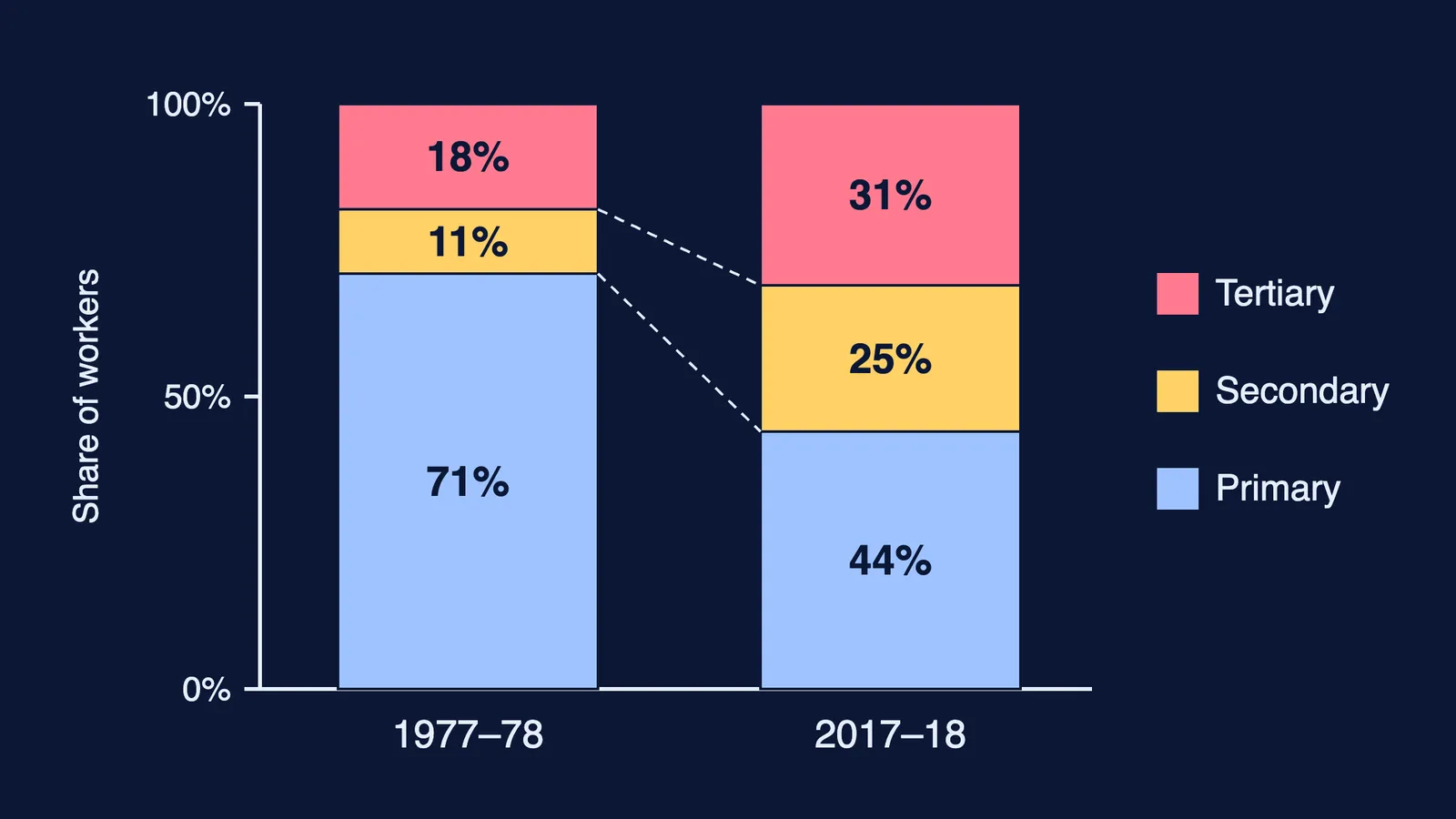
Jobs did not follow. The primary sector's share of employment fell from 71% in 1977-78 to 44% in 2017-18, and it is still the largest employer. Over those forty years, industrial output rose more than nine times while industrial employment rose about three times; service output rose 14 times while service employment rose about five times.
So the primary sector, mainly agriculture, still holds the largest share of India's workers while producing only about one sixth of GVA, the chapter says. It calls this underemployment, or disguised unemployment: everyone appears to be working, but each person works less than their potential. Its example is Laxmi, whose family of five works about two hectares of unirrigated land; two of them could take other work without the farm producing less. If GVA and GDP feel fuzzy, our guide to what GDP means, with India's numbers sets them out.
As a short-term fix, MGNREGA 2005 guaranteed 100 days of rural work a year; NCERT's 2026-27 reprint notes it was replaced in 2025 by Viksit Bharat-G RAM G 2025.
What is the difference between organised and unorganised sectors?
This split asks a different question: what are the conditions of work? In the NCERT chapter, the organised sector covers places of work registered by the government, where terms of employment are regular and workers get benefits such as paid leave, provident fund and overtime pay. The unorganised sector is made up of small and scattered units largely outside the control of the government, where jobs are low-paid, often irregular and not secure.
The textbook's pair: Kanta works in an office with an appointment letter and provident fund, so she is in the organised sector. Her neighbour Kamal is a daily-wage labourer at a grocery shop with no paid leave who can be asked to leave at any time, so he is in the unorganised sector.
What is the difference between public and private sectors?
The third split asks: who owns the assets? In the public sector the government owns most of the assets and provides the services, as with the railways or the post office. In the private sector, individuals or companies own the assets, and their activity is guided by the motive to earn profits.
The NCERT chapter explains why governments step in: building roads, bridges, railways, harbours and dams, or generating electricity, needs more money than the private sector can spend, and private firms that did provide them would charge a high rate for their use.
A three-question test for any job
Ask these in order. Each job gets one answer from each line.
What does the work do? Takes a good from nature: primary. Makes something: secondary. Provides a service: tertiary.
Is the job registered and regular, with benefits? Yes: organised. No: unorganised.
Who owns the place of work? The government: public. A person or a company: private.
Six worked examples:
Ticket clerk at a railway station: tertiary, organised, public.
Teacher at a government school: tertiary, organised, public.
Worker on the payroll of a large registered steel company: secondary, organised, private.
Handloom weaver working at home: secondary, unorganised, private.
Small farmer on their own land: primary, unorganised, private.
Vegetable vendor on the street: tertiary, unorganised, private.
Then try ten jobs done by people you know.
The habit of naming the criterion first also helps in the geography chapter on resources and development and in how the Human Development Index is calculated. For maths and science revision, Fermi's AI tutor works out what you already know and builds a plan for the session, so you start where you actually are.


