On this page
Social Movements is the last chapter of Social Change and Development in India, and it carries real weight: the CBSE Sociology curriculum for 2026-27 gives this unit 10 of the paper's 80 marks. This guide follows the current NCERT chapter (Reprint 2026-27).
How many marks is Social Movements in Class 12 sociology?
In the 2026-27 sample paper, the chapter shows up as two 1-mark MCQs on a passage, a 2-mark question on why sociology studies social movements, and a 6-mark question (Q35) split into three 2-mark parts: instances of counter movements, why movements cannot change society easily, and modes of protest. That adds up to the unit's 10 marks. The marking scheme accepts "any other relevant example", so learn a few well.
What makes something a social movement?
NCERT gives four features. A social movement needs sustained collective action over time, some organisation (leadership and a structure for decisions), shared objectives and ideology, and a general orientation towards bringing about, or preventing, change. Spontaneous, disorganised protest on its own is not a movement.
Two contrasts come up often:
Social change versus social movement. Social change is continuous and the sum of countless actions; a movement is directed at specific goals. Sanskritisation is a change; the 19th-century reformers' campaigns were movements.
Counter movements. These defend the status quo. When Raja Rammohun Roy campaigned against sati, its defenders formed the Dharma Sabha.
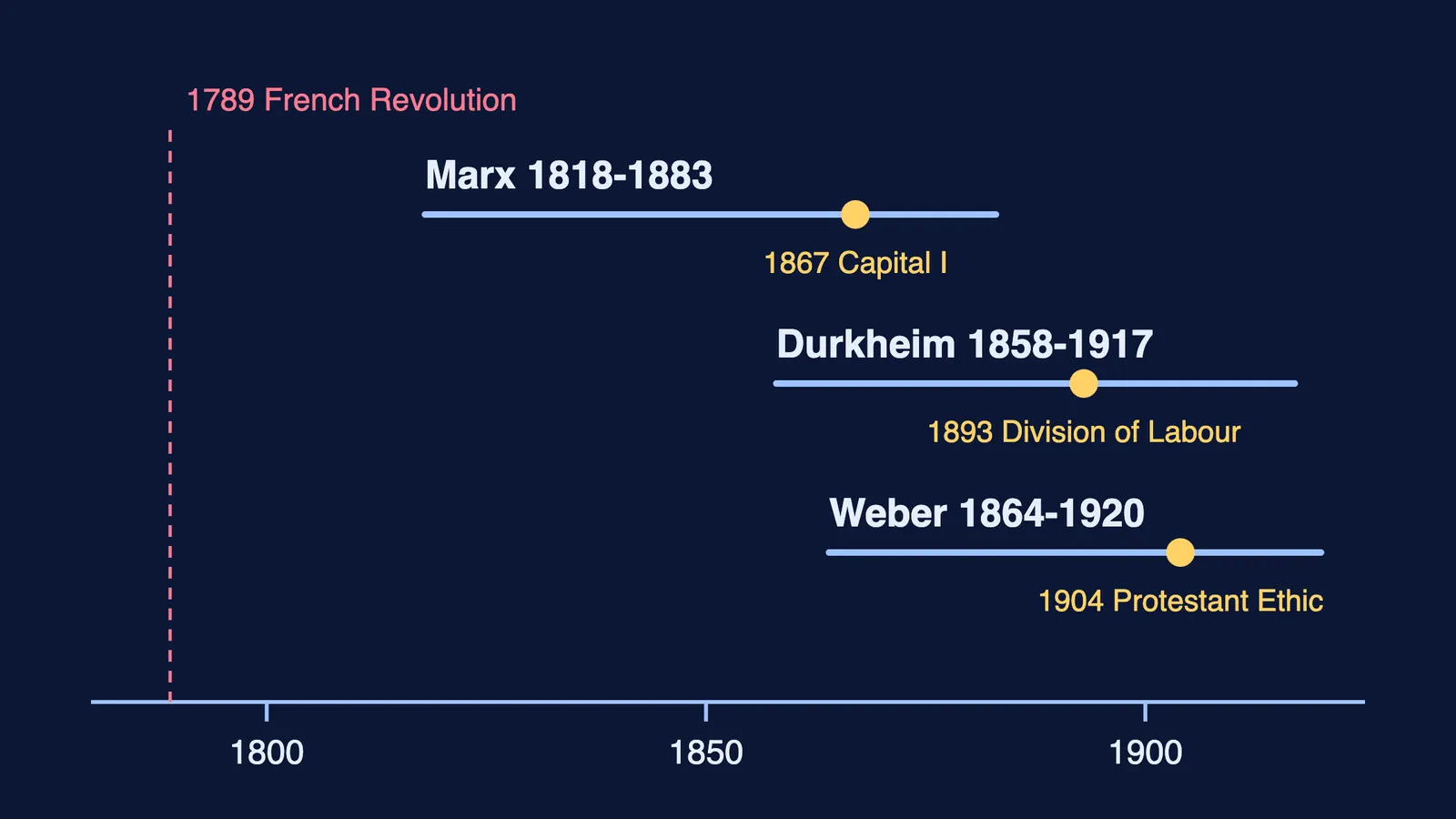
Why does sociology care? Emile Durkheim's work reflects a concern with social integration, and movements were seen as disorder. Historians influenced by Karl Marx, such as E. P. Thompson, showed that crowds had a "moral economy", a shared sense of right and wrong.
What are the types of social movements, and how are old and new ones different?
NCERT classifies movements three ways:
Redemptive: changes the consciousness and actions of members. Example: the Ezhava community in Kerala, led by Narayana Guru.
Reformist: changes arrangements step by step. Examples: the movement for linguistic reorganisation of states, and the Right to Information campaign.
Revolutionary: aims to remake social relations, often by taking state power. Examples: the Bolshevik revolution and the Naxalite movement.
Most movements mix all three.
Old social movements worked through political parties and aimed to reorganise power, such as the Indian National Congress in the national movement. New social movements focus on quality-of-life issues like a clean environment, cut across class lines and are often international. Political scientist Rajni Kothari linked the surge of movements in India in the 1970s to dissatisfaction with parliamentary democracy. NCERT's point for your answer: in India the line between old and new is blurred.
Which examples should you use in answers?
All examples are from the NCERT chapter.
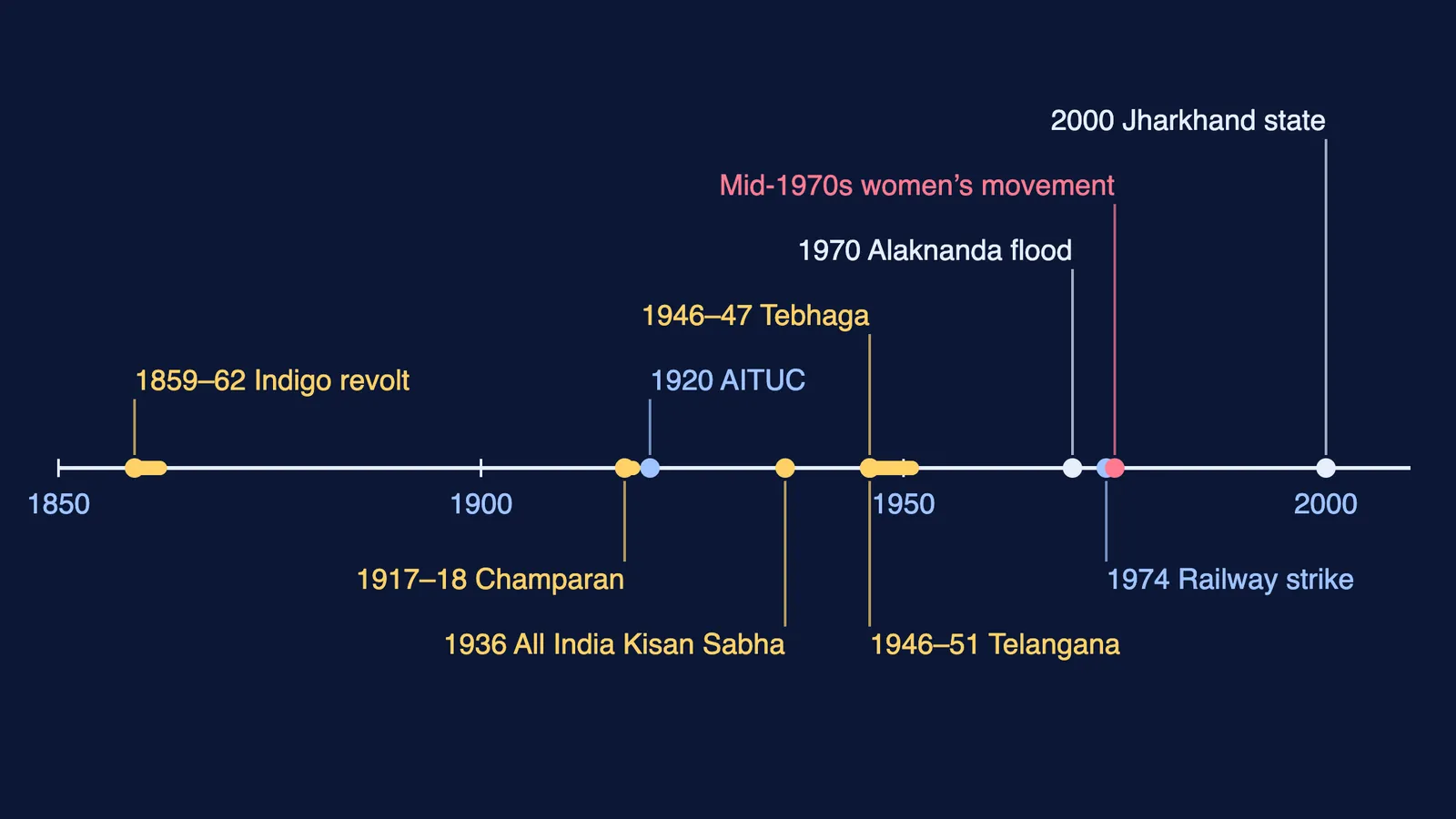
Chipko (ecological). Villagers, many of them women, hugged trees to stop government contractors felling forests they depended on for firewood and fodder. It shows "red" (livelihood) and "green" (ecology) issues overlapping. After the 1970 Alaknanda valley flood, villagers began to see links between deforestation, landslides and floods.
Peasant movements. The Bengal indigo revolt of 1859-62, Champaran (1917-18), the All India Kisan Sabha (1936), Tebhaga (1946-47), in which sharecroppers demanded two-thirds of the produce instead of half, and Telangana (1946-51).
New farmers' movements. From the 1970s in Punjab and Tamil Nadu: non-party, anti-state, anti-urban, focused on prices, using road and rail blockades.
Workers' movements. The first trade union in 1918 in Madras, AITUC in 1920, INTUC in 1947 and the 1974 railway strike.
Dalit movement. A struggle for recognition and dignity, with no single unified movement. Name the Satnami, Adi Dharma or Mahar movements.
Tribal movements. Jharkhand became a state in 2000 after more than a century of resistance, with Birsa Munda as its icon and anger at *dikus* (outside traders and moneylenders). In the North East, demands moved towards autonomy within the Constitution.
Women's movement. Early organisations include the WIA (1917) and AIWC (1926). A renewal in the mid-1970s took up new issues such as violence against women.
For caste and tribe background, revise Patterns of Social Inequality and Exclusion alongside this chapter.
Practice questions to try
Keep to the sample paper's limits: 30 words for 2 marks, 80 for 4, 200 for 6.
Give two features that separate a social movement from a spontaneous protest. (2)
Using one Indian example, explain a reformist social movement. (2)
Trace two stages in the growth of the trade union movement in India before Independence. (4)
Why did Rajni Kothari link India's 1970s surge of movements to dissatisfaction with parliamentary democracy? (4)
Explain how identity, economic and ecological concerns combine in the Jharkhand movement. (6)
For question 5, give identity (Birsa, a shared Jharkhandi identity), economy (land loss, *dikus*) and ecology (forest rights), then conclude that one movement carries both old and new concerns. See also how to write sociology board answers with Indian examples.
If you are not sure where to start, Fermi's AI tutor works out what you already know and builds a plan for the session, so you sit down to a clear next step.