

On this page
In the CBSE Class 12 Sociology board exam, knowing your NCERT textbook is only half the battle. The marking scheme heavily rewards how you present your knowledge, particularly in the long answers.
Writing a comprehensive essay under time pressure can seem daunting, but the official CBSE marking scheme reveals a clear pattern. By combining the right structure with specific Indian examples, you can elevate your answers from average to excellent.
How do you structure a 6-mark sociology answer?
The theory paper for Sociology is out of 80 marks, with three long-answer questions in Section D carrying 6 marks each (CBSE). These questions demand a word limit of around 200 words.
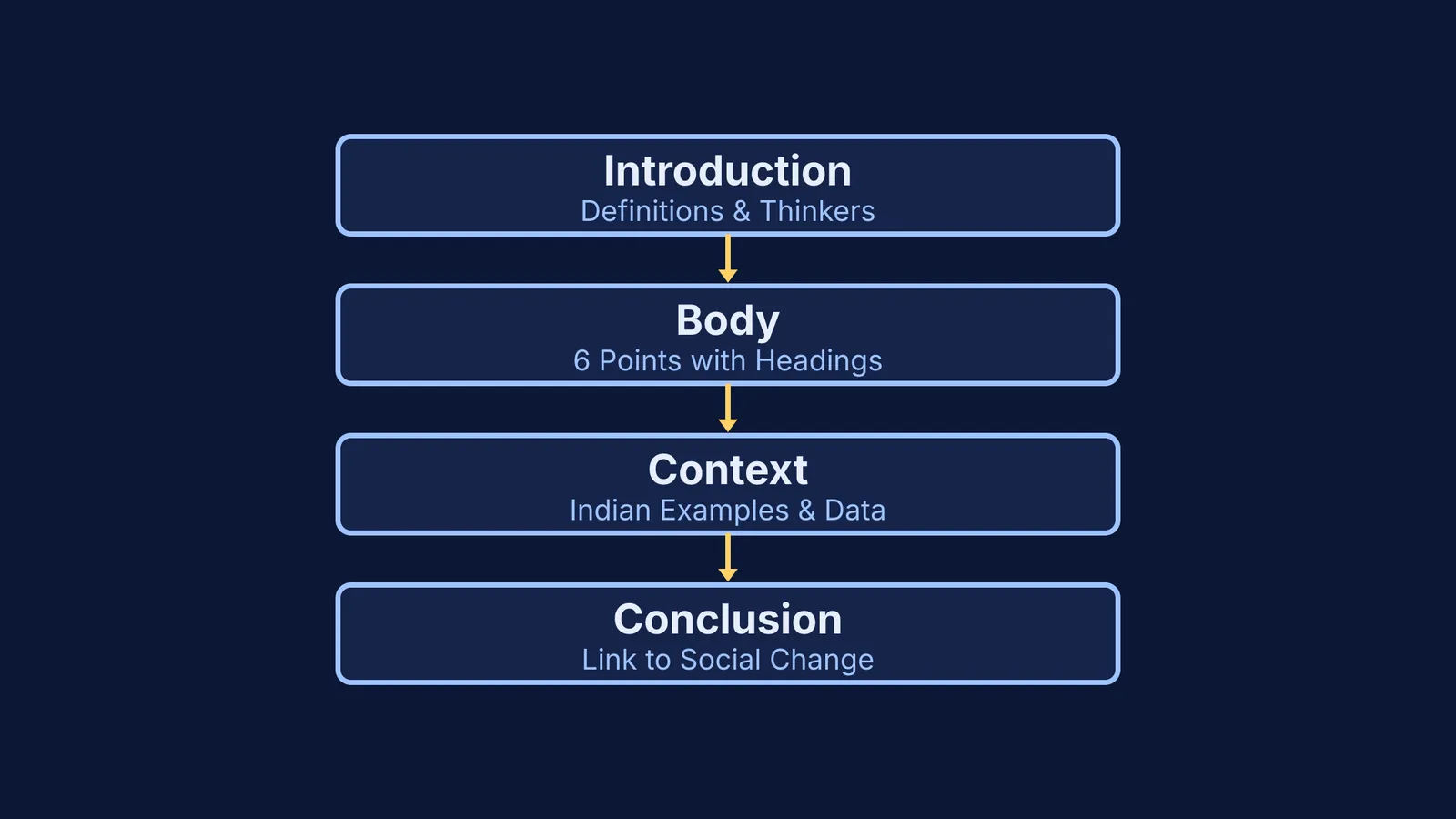
To score full marks, do not write a single block of text. Instead, break your answer into a predictable framework:
Introduction: Define the core sociological concept in one or two sentences.
Body: Provide exactly six distinct points. Give each point a clear, underlined sub-heading, followed by a brief two-to-three line explanation.
Indian Examples: Dedicate a specific section or integrate concrete examples from the Indian context to prove you understand the local application.
Conclusion: End with a one-line summary linking the concept to contemporary social change or a broader trend.
When you sit down to write, take a moment to plan your headings. If you also use the first moments of the exam to strategise, you might find our guide on how to use the 15 minutes reading time in board exams helpful.
Why is sociological vocabulary important?
Examiners look for precise sociological terms rather than everyday language. Using common sense phrasing often results in lost marks, even if the underlying idea is correct. Instead of writing "rich and poor," use "social stratification." Instead of "being left out," use "social exclusion."
Whenever possible, name the sociologist who coined or developed the concept. Naming thinkers adds immense credibility to your answers.
For instance, the eminent Indian sociologist M.N. Srinivas introduced two crucial concepts you will likely encounter:
Sanskritisation: The process by which a "low" Hindu caste or tribal group changes its customs, rituals, and way of life to emulate a "high" or "twice-born" caste.
Dominant Caste: A caste that wields significant economic and political power in a region, such as the Jats in Punjab or the Vokkaligas in Karnataka, even if it is not at the top of the ritual hierarchy.
How should you use Indian examples in your answers?
General definitions will only get you so far. The CBSE curriculum expects you to apply theoretical frameworks to the real world.
If a question asks about the Green Revolution, do not just list the use of high-yielding variety (HYV) seeds, modern irrigation, and chemical fertilisers. Explain its social consequences in India. Discuss the regional imbalances it created, noting how the benefits were concentrated in Punjab, Haryana, and Western Uttar Pradesh. You can also mention how this agricultural wealth led to the rise of dominant castes who gained immense local political influence.
If you are faced with a choice between a direct theoretical question and an applied one, knowing how to choose between internal choice questions can save you valuable time.
How do you solve case studies and graphic-based questions?
The question paper typically includes passage-based questions in Section A and a graphic-based question in Section D (Question 33). These require distinct approaches.
For passage-based questions, use the "reverse reading" strategy. Read the questions before reading the passage. This allows you to scan for relevant keywords and connect the text to specific NCERT chapters immediately. Do not simply copy lines from the passage; link the events to sociological concepts like "new social movements," "secularisation," or "structural change."
For graphic-based questions, contextualise the image immediately. If you see a population pyramid, identify the demographic trend—a wide middle suggests a demographic dividend, while a narrow base indicates a declining birth rate. Always quote specific data points or years shown in the graphic to justify your reasoning.
Structuring complex arguments takes deliberate practice. If you are also studying STEM subjects alongside the humanities and want to refine how you tackle difficult problems, Fermi's AI tutor works out what you know and builds a plan for the session. It holds a line of reasoning across a session, checks your understanding as it goes, and decides whether to explain, ask or show to help you build a complete answer.
By practising this structured approach, you will walk into the exam hall ready to present your knowledge exactly how the examiners want to see it. And once the paper is done, remember to step away—our advice on why you should not discuss answers after an exam can help keep your mind clear for the next paper.


