

On this page
You walk out of the hall and someone at the gate asks, "What did you get for question 14?" Within a minute you have discovered you might have lost four marks. Nothing said at that gate can change your answer sheet, but it can change how you spend the evening before your next paper.
Should you discuss answers after an exam?
Not until the whole exam series is over. Your marks are already decided, so discussing answers only adds information you cannot act on. If a friend's answer differs, you usually won't know who is right, and the doubt stays anyway.
The exception is a mock or class test, where reviewing mistakes is the point. Do it calmly a day later, not in the corridor; our guide on how to analyse a mock test shows how.
Why can talking about the paper affect the next one?
Psychologists call replaying a finished event "post-event processing": rumination and self-critical thinking after the event is over. A 2024 study of three university student samples (35, 146 and 37 students) found that post-event processing happened to a meaningful extent after exams and was positively linked with test anxiety (Möcklinghoff, Rapoport and Neidhardt, International Journal of Educational Research Open). The authors suggest it might help keep test anxiety going over time. It is a small pilot study showing a link, not proof of cause.
Replaying may also cost you sleep. In a lab study of 70 participants who gave a 5-minute speech to an evaluating panel, those who kept thinking about the speech during a 10-minute rest afterwards reported taking longer to fall asleep that night (Zoccola, Dickerson and Lam, Psychosomatic Medicine, 2009). A speech is not an exam, but both involve being judged.
Worry may also compete for the working memory you need while solving. In a Science study, college students under pressure who wrote about their test worries for 10 minutes before a maths test improved their accuracy by about 5%, while a control group that sat quietly dropped by 12% (Ramirez and Beilock, 2011; university summary). Treat that result with care: a 2018 replication attempt did not reproduce it (Camerer and colleagues, Nature Human Behaviour), and it tested writing before an exam, not after. Still, a page is a calmer place for worries than a group chat; see our post on writing about exam worries before a paper.
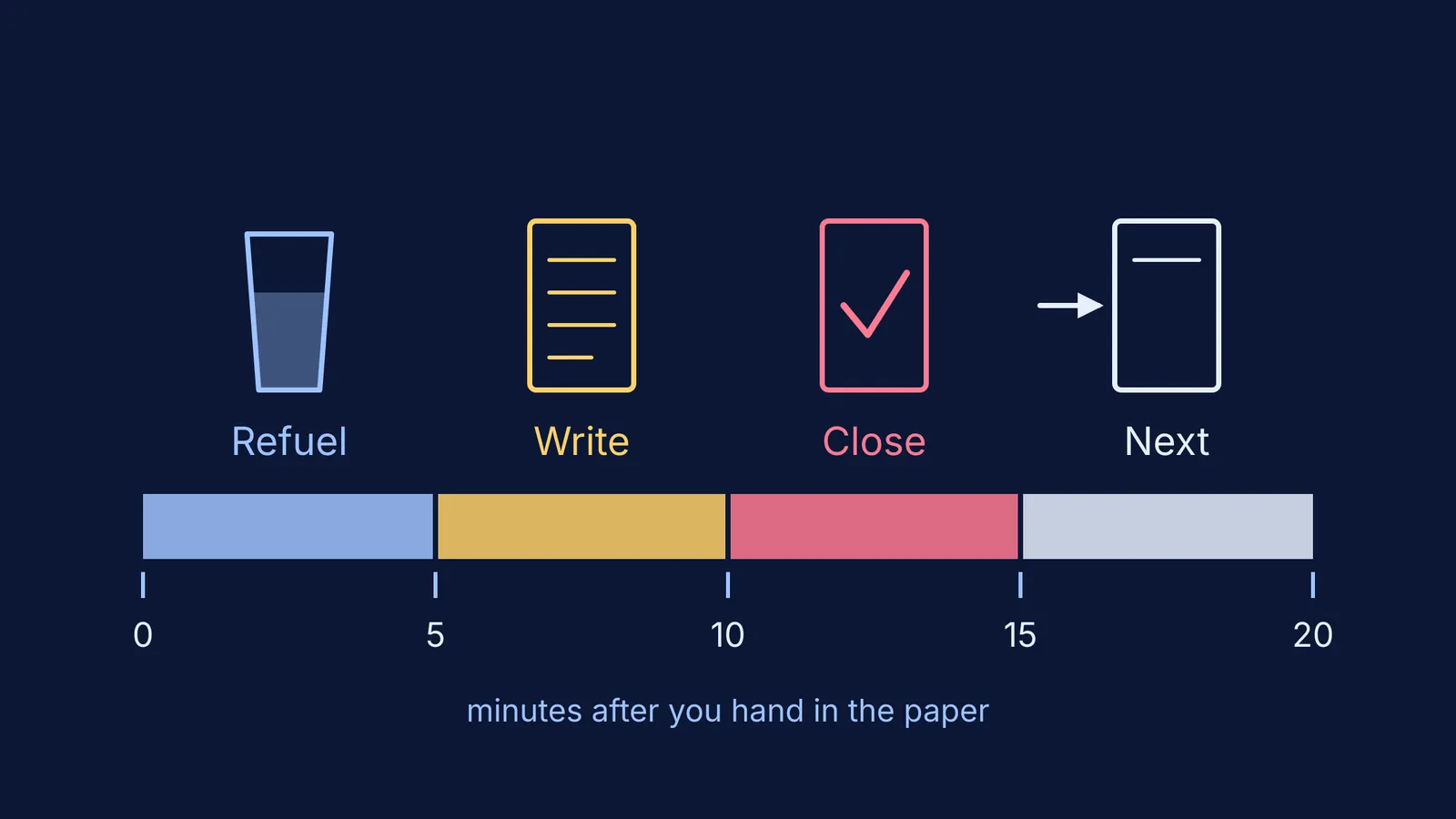
What should you do in the 20 minutes after an exam?
Minutes 0-5: Leave and refuel. Walk out, drink water and eat something small. If the answer discussion starts, have a line ready: "I'm not checking answers till the last paper. How was the journey here?"
Minutes 5-10: Write it down, once. On one sheet, list every question you are worried about and how you feel about the paper. Fold the sheet and put it away; this is your parked list for after the series.
Minutes 10-15: Close the paper. Write one line: "Paper done. These marks are decided." If there was a lesson about how you took the exam (you ran short of time, misread an instruction, filled the OMR sheet late), write that one lesson for the next paper. Process, not answers.
Minutes 15-20: Open the next paper. Choose the first study block for the next subject, to do after lunch and rest, and leave that book on your desk.
A made-up but typical case: Riya finishes board Physics at 1:30 pm, with Chemistry two days later. By 1:50 she has eaten, parked three worrying questions, noted one lesson ("leave time for the long answers") and opened her Chemistry plan. That night she sleeps on time instead of replaying a ray diagram she can't change.
What if you're sure you got a question wrong?
Then it goes on your parked list. Checking it won't give the marks back. If your exam has an official answer key or re-evaluation process, use it in the window the exam body sets, not at the gate.
After your last paper, open the list and work through each question properly. The Fermi Problem Library has worked problems with a step-by-step solver that explains the reasoning rather than printing an answer, so you can see where your method slipped. If one paper went badly and is weighing on you, read our guide on bouncing back after a bad test.
How can parents help after an exam?
The first question at the gate sets the evening. "How was it?" invites a replay; "Have you eaten? What's next?" does not. If your child wants to talk, listen to the feeling rather than checking answers together, and don't call other parents to compare.
Tele MANAS is the Ministry of Health and Family Welfare's national mental-health helpline (Tele MANAS).
Close today's paper in 20 minutes, and give the next one your whole evening.


