On this page
The Crisis of Democratic Order is Chapter 6 of *Politics in India since Independence*. Every date and figure below comes from the current NCERT chapter (Reprint 2026-27), and any judgement is NCERT's own.
How many marks is The Crisis of Democratic Order worth?
The CBSE Political Science curriculum for 2026-27 gives the chapter 4 marks out of the 40 for Part B. Its topics run from the background to the Emergency to the Janata government.
The 2026-27 sample paper asks a 4-mark question (Q23) on the judiciary-executive conflict of the early 1970s. Its marking scheme lists four points: the Fundamental Rights and property cases, the basic structure ruling, the 1973 appointment of the Chief Justice, and the Allahabad High Court verdict.
What led to the Emergency in 1975?
NCERT groups the background into three strands (NCERT, Chapter 6).
Economic context. About eight million people crossed into India during the Bangladesh crisis, and after the war with Pakistan the US stopped all aid. Prices rose by 23 per cent in 1973 and by 30 per cent in 1974. After the monsoons failed in 1972-1973, food grain output fell by 8 per cent.
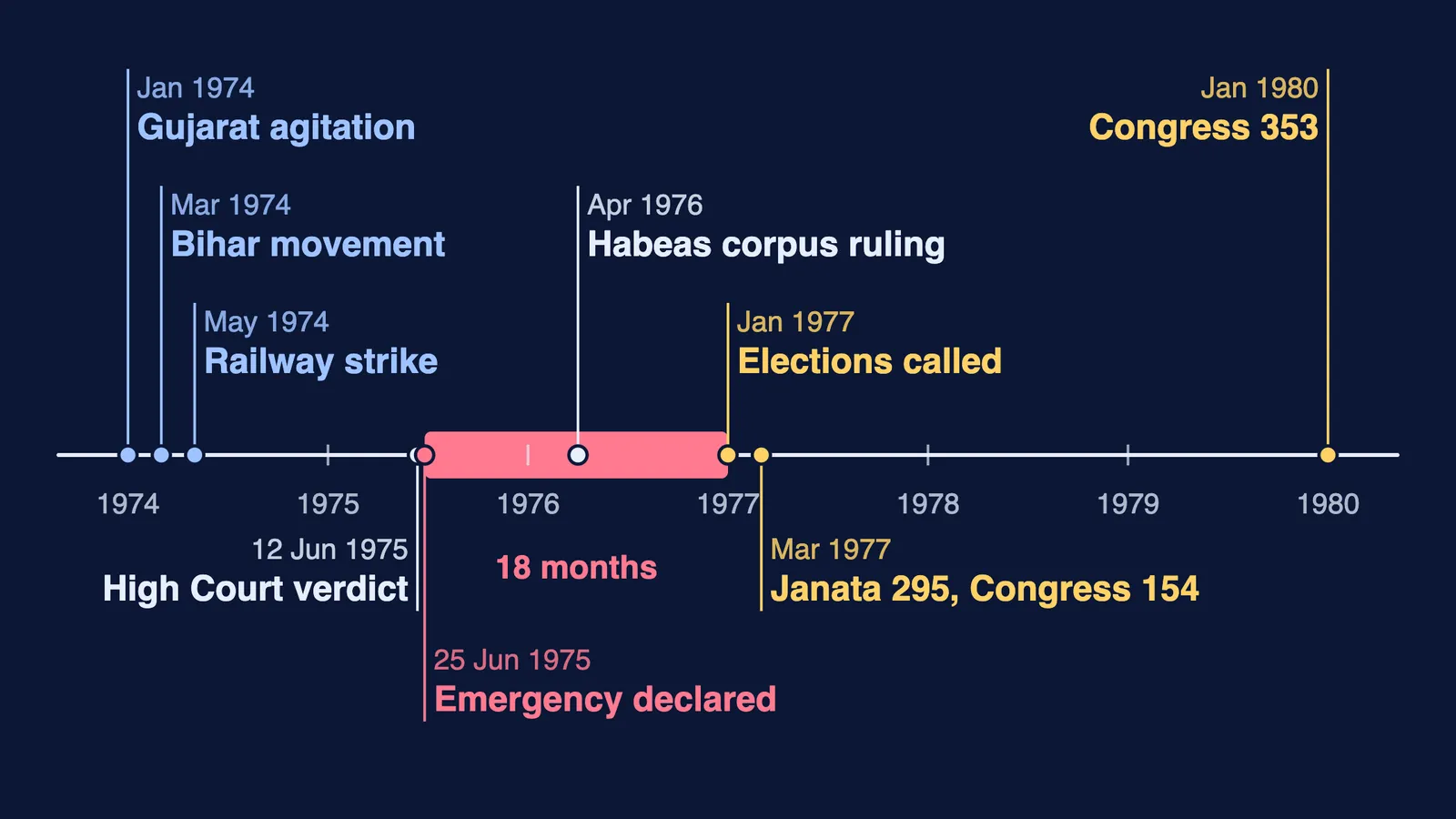
Gujarat and Bihar movements. In January 1974 students in Gujarat protested against rising prices and corruption; President's rule followed, and assembly elections were held in June 1975, which the Congress lost. In March 1974 students in Bihar protested on similar issues and invited Jayaprakash Narayan (JP) to lead them. JP called for "total revolution". In May 1974 a railway strike led by George Fernandes was declared illegal and called off after twenty days.
Conflict with the judiciary. After the 1973 Kesavananda Bharati ruling that Parliament cannot amend the basic features of the Constitution, the government passed over three more senior judges and made Justice A. N. Ray Chief Justice of India, an appointment NCERT says became politically controversial.
How was the Emergency declared?
12 June 1975: the Allahabad High Court (Justice Jagmohan Lal Sinha) held Indira Gandhi's 1971 Lok Sabha election invalid, on a petition filed by Raj Narain.
24 June 1975: the Supreme Court granted a partial stay; she could remain an MP but not take part in Lok Sabha proceedings.
25 June 1975: opposition parties led by JP held a demonstration at Delhi's Ramlila grounds, and JP announced a nationwide satyagraha for her resignation. The government invoked Article 352, citing a threat of internal disturbances; that night, on the Prime Minister's recommendation, President Fakhruddin Ali Ahmed issued the proclamation.
26 June 1975, 6 a.m.: the Cabinet was informed at a special meeting, after the proclamation and arrests (NCERT).
What were the consequences and lessons of the Emergency?
According to NCERT, strikes and protests were banned, the press was censored, and the RSS and Jamait-e-Islami were banned, which the government linked, NCERT says, to fears of communal disharmony. Preventive detention was used for large-scale arrests. In April 1976 a constitution bench of the Supreme Court accepted the government's plea on detentions, a judgement NCERT describes as among the Supreme Court's most controversial. Some newspapers left blank spaces where news had been censored. The forty-second amendment extended the term of legislatures from five to six years.
NCERT draws three lessons: democracy proved hard to remove in India; internal Emergency can now be proclaimed only on grounds of "armed rebellion", on written advice of the Union Cabinet; and awareness of civil liberties grew. It also cites the Shah Commission's finding that the administration and police became vulnerable to political pressures.
What happened in the 1977 elections and after?
The government called elections in January 1977, eighteen months after the Emergency began, and they were held in March 1977. Opposition parties formed the Janata Party, and Jagjivan Ram's Congress for Democracy later merged with it (NCERT).
Congress won 154 seats, under 35 per cent of the vote.
The Janata Party and allies won 330 of 542 seats; the Janata Party alone won 295.
Congress won many seats in Gujarat, Maharashtra and Orissa and, in NCERT's words, virtually swept the southern States.
Morarji Desai became Prime Minister. His government lost its majority in under 28 months; Charan Singh's lasted about 4 months. In January 1980 the Congress won 353 seats.
How do you answer exam questions on this chapter?
Give one date or name per point:
Explain any two economic reasons for public dissatisfaction in 1973-74. (2 marks)
Arrange in order: the railway strike, the Allahabad High Court verdict, the Bihar movement, the Supreme Court's partial stay. (2 marks)
How did the government use preventive detention during the Emergency, and what did the Supreme Court decide about it in April 1976? (4 marks)
Why did the Congress lose in north India in 1977 but hold seats in the south, according to NCERT? (6 marks)
For question 4, NCERT notes that forced sterilisations and relocations were concentrated in the north, where middle castes were moving away from the Congress.
Revise the era of one-party dominance and challenges of nation building.
Fermi's AI tutor can work out what you already know and build a plan for a study session, so you sit down to a clear next step.