

On this page
Challenges of Nation Building is the first chapter of Politics in India since Independence, the second Class 12 Political Science book. This guide gives you the facts as NCERT states them, one timeline, and a worked frame for long answers.
What are the three challenges of nation building in Class 12?
The chapter uses "three challenges" in two ways, and both come from the NCERT chapter, Challenges of Nation Building.
The broad three challenges facing independent India were shaping a nation that was united yet accommodated diversity, establishing democracy, and ensuring the development and well-being of the whole society.
This chapter deals with the first of these, unity, and splits it into three events:
Partition, which brought large-scale violence and displacement and challenged the idea of a secular India.
The integration of the princely states into the Indian union.
Redrawing internal boundaries so that states matched the languages people spoke.
Democracy and development get the next two chapters. So read the question: "challenges faced by independent India" points to the broad three; a long answer on this chapter wants the three events with examples.
How did Partition challenge the new nation?
Partition followed the principle of religious majorities: Muslim-majority areas would form Pakistan, according to the NCERT chapter. It names four difficulties: Muslim-majority areas lay in two belts, west and east; not all wanted Pakistan (Khan Abdul Gaffar Khan of the North Western Frontier Province opposed the two-nation theory); Punjab and Bengal had to be split at district level or lower; and minorities on both sides were trapped.
By the estimate NCERT cites, Partition forced about 80 lakh people to migrate across the new border, and that between five and ten lakh people were killed in Partition-related violence.
Even after this migration, Muslims made up 10 to 12 per cent of India's population in 1951, the chapter notes. That is why it presents secularism as part of nation building: all citizens would be equal whatever their religion.
How were the princely states integrated?
When British rule ended, paramountcy over the princely states lapsed, and as many as 565 states became legally independent, according to the NCERT chapter. The choice to join India or Pakistan, or stay independent, was left to the rulers, not the people.
Sardar Patel, as Deputy Prime Minister and Home Minister, negotiated with the rulers "firmly but diplomatically". Most rulers signed the Instrument of Accession, a document by which their state agreed to become part of the Union of India. Four cases were harder:
Junagadh: resolved after a plebiscite confirmed people wanted to join India.
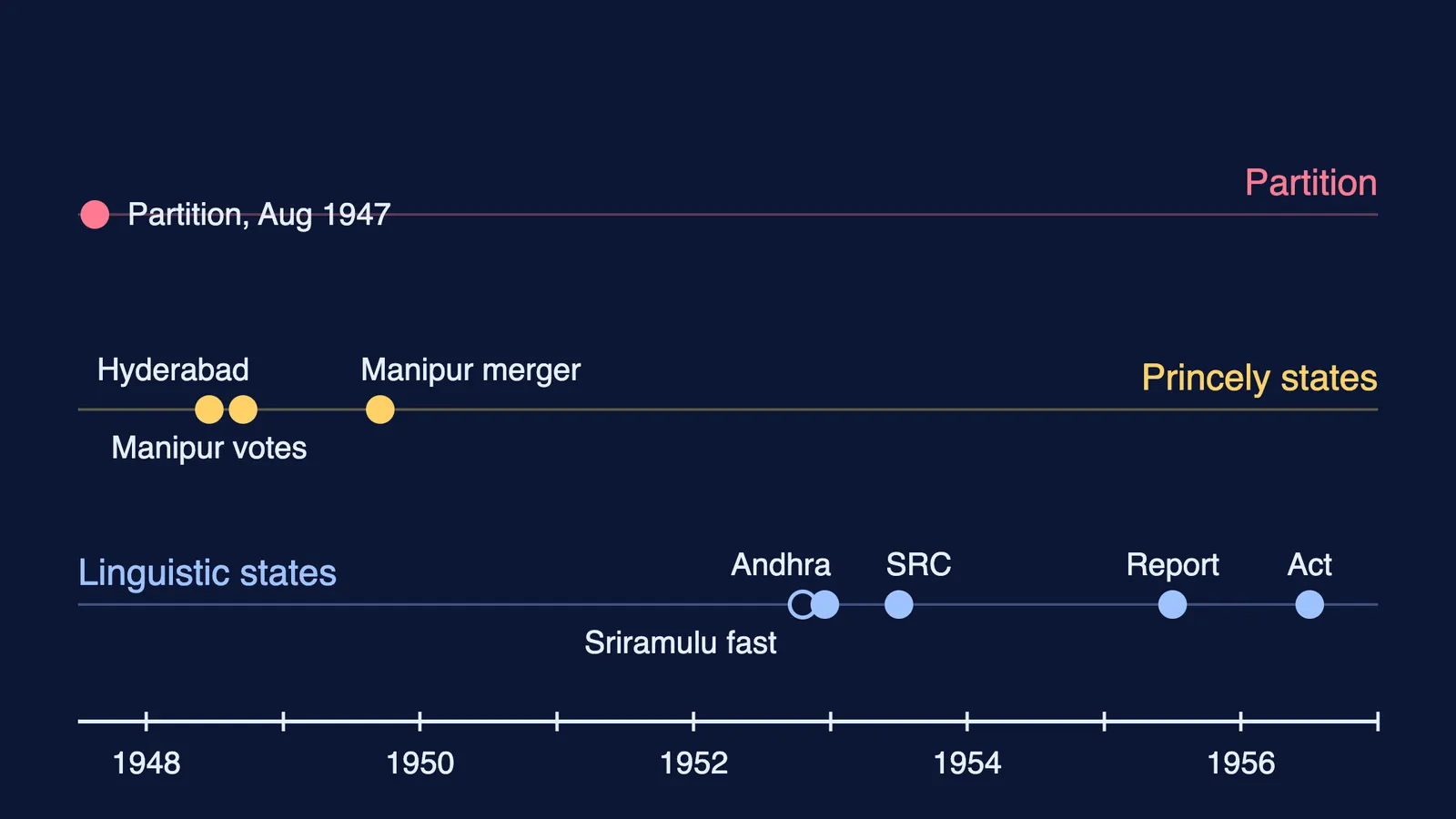
Hyderabad: the Nizam signed a Standstill Agreement in November 1947; after Razakar violence, the Indian army moved in in September 1948 and the Nizam surrendered.
Manipur: elections under universal adult franchise were held in June 1948, and the Maharaja signed a Merger Agreement in September 1949.
Kashmir: NCERT covers it in a later chapter.
Why were states reorganised on linguistic lines?
The national movement had promised linguistic states, but after Partition leaders feared that carving states by language might cause disintegration, so they postponed the decision. Telugu speakers in the old Madras province pushed back. Potti Sriramulu began a fast unto death on 19 October 1952 and died on 15 December 1952, after 56 days; the Prime Minister announced a separate Andhra state that December, as the NCERT chapter records.
The States Reorganisation Commission was appointed in 1953; it accepted that state boundaries should reflect the boundaries of different languages, and the States Reorganisation Act of 1956 created 14 states and six union territories.
NCERT's verdict: linguistic states did not break the country apart, as many feared; they strengthened national unity.
How do you write a board answer on this chapter?
Use the same frame for any long question here: Problem, Response, Result, Meaning. Here it is for an exercise question from the NCERT chapter, "What was the task of the States Reorganisation Commission? What was its most salient recommendation?"
Problem: colonial boundaries followed administrative convenience, not language; after Andhra (December 1952), other regions demanded linguistic states.
Response: the Centre appointed the Commission in 1953 to look into redrawing state boundaries.
Result: its key recommendation was that boundaries should reflect languages; the 1956 Act created 14 states and six union territories.
Meaning: accepting regional demands was expected to reduce the threat of separatism, and was seen as more democratic.
Then learn the dates as one line, not three lists: Partition in 1947, Hyderabad and Manipur settled by 1949, linguistic states from 1952 to 1956. Turn that line into a cause-and-effect chart for a history chapter or a one-chapter mind map for revision. If an AI chatbot wrote your notes, check its dates against NCERT before you memorise them.
If physics, chemistry or maths also share your evening, Fermi's AI tutor can work out what you already know and build a plan for the session, so that half starts with a clear next step.


