

On this page
Chapter 2 of the NCERT book *Politics in India since Independence* covers the first decade of electoral politics: how India held free elections, why the Congress dominated them, and what the opposition did. Every fact below is from the NCERT chapter itself.
How was India's first general election held?
The Election Commission of India was set up in January 1950, with Sukumar Sen as the first Chief Election Commissioner (NCERT, Chapter 2).
17 crore eligible voters elected about 3,200 MLAs and 489 members of the Lok Sabha.
Only 15 per cent of those voters were literate, so every booth had a box for each candidate, marked with their symbol.
More than 3 lakh officers and polling staff were trained.
Polling ran from October 1951 to February 1952, but it is called the 1952 election because most of the country voted in January 1952.
More than half the eligible voters turned out, and even the losers accepted the results as fair.
The Commission also refused to accept the entries of nearly 40 lakh women listed not by name but as "wife of ..." or "daughter of ...", and ordered a revision.
What were the results of the first three general elections?
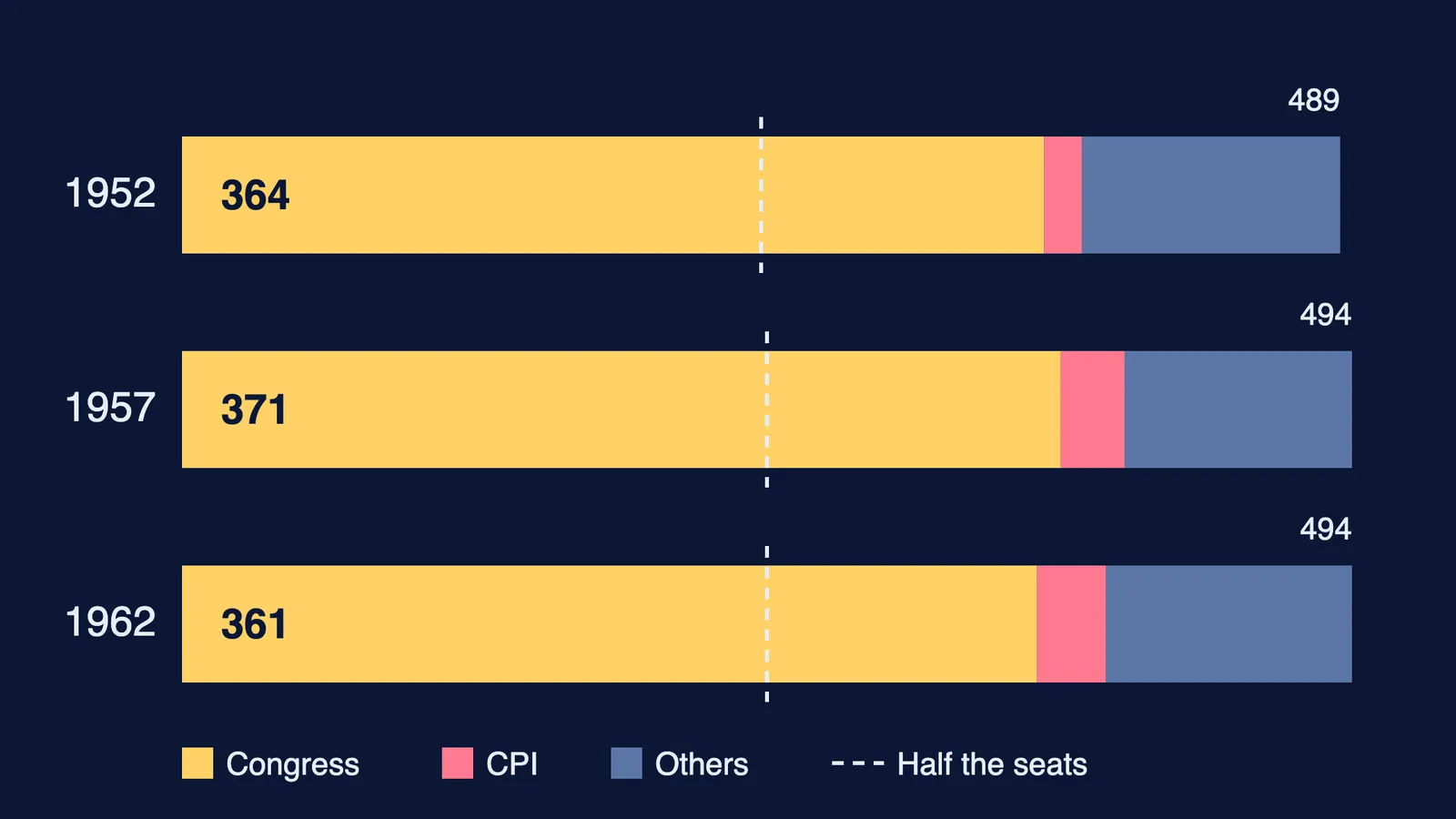
According to the NCERT chapter, Congress won about three-fourths of Lok Sabha seats in each election, and no opposition party won even one-tenth of the number Congress won.
1952: Congress 364 of 489 seats; the Communist Party of India (CPI) came next among parties with 16.
1957: Congress 371 of 494; CPI 27.
1962: Congress 361 of 494; CPI 29.
The big exception was Kerala. In March 1957 the Communist Party won 60 of 126 seats there and, backed by five independents, E. M. S. Namboodiripad formed what the textbook calls the world's first Communist government to come to power through democratic elections. In 1959 the Centre dismissed it under Article 356, a decision the textbook says was widely cited as a misuse of constitutional emergency powers.
Why did the Congress dominate, and what was the Congress system?
The textbook gives three reasons for dominance (NCERT, Chapter 2): the legacy of the national movement, an organisation reaching down to the local level that was campaigning before many rivals had formed, and an all-inclusive character. India differed from one-party states elsewhere because its dominance happened under free and fair elections.
The Congress system is the textbook's name for how politics worked inside one party. Congress was a social and ideological coalition: peasants and industrialists, workers and owners, left, right and centre all found space in it. Groups inside it, called factions, fought each other instead of leaving. Opposition parties mostly influenced policy "from the margins" by trying to influence these factions. So in the first decade Congress acted as both the ruling party and the opposition.
Which opposition parties should you know?
The opposition won only token representation, but the chapter says it helped keep the system democratic by criticising Congress and keeping democratic alternatives alive.
Socialist Party: formed in 1948 by the Congress Socialist Party (founded within Congress in 1934); socialist leaders included Jayaprakash Narayan, Rammanohar Lohia and Acharya Narendra Dev.
Communist Party of India: decided in 1951 to take part in elections and became the largest opposition party in 1952; it split in 1964 into the CPI and CPI(M).
Bharatiya Jana Sangh: formed in 1951 with Shyama Prasad Mukherjee as founder-President; it won 3 Lok Sabha seats in 1952 and 4 in 1957.
How do you revise this chapter for the board exam?
Use this plan with the NCERT chapter open, about 20 minutes a day for three days.
Day 1, the number grid. From memory, write the three years, Congress seats, total seats and the largest opposition party. Check against the list above and redo the rows you missed.
Day 1, the votes-seats calculation. Explain in three lines why 45 per cent of votes gave 74 per cent of seats.
Day 2, a 6-mark answer on "nature of Congress dominance". Use the frame: definition, three reasons, how it differs from one-party states, the Congress system with factions, and one line on its decline.
Day 3, opposition and Kerala. Match each party to its leaders and one belief, then write a short answer on Kerala 1957 and Article 356.
To practise source-based questions, this guide to answering case-based questions in CBSE board exams shows the method. If party types feel shaky, go back to political parties in Class 10 and how an Indian election works from Class 9.
If you are not sure where to start across the whole book, Fermi's AI tutor can work out what you already know and build a plan for the session, so you begin with the chapter that needs you most.


