

On this page
Political Parties is Chapter 4 of the NCERT Class 10 textbook Democratic Politics, and it has a reassuringly fixed shape: a definition, seven functions, three party systems, the rules for national and state parties, four challenges and a set of reforms. Learn those six blocks in order and most board questions become a matter of picking the right one.
What is a political party, according to NCERT?
The NCERT chapter on political parties defines a political party as "a group of people who come together to contest elections and hold power in the government." Parties agree on policies and programmes and try to persuade voters theirs are better.
The same chapter gives a party three components: the leaders, the active members and the followers.
What are the functions of political parties?
NCERT lists seven functions. It is easier to remember them in three groups, by when they happen.
Around elections:
Contest elections. In India, top party leaders choose candidates.
Put forward policies and programmes, turning many opinions into a few positions.
In power:
Make laws. Most legislators follow the party leadership's direction.
Form and run governments.
All the time:
Play the role of opposition when they lose, criticising the government's failures and wrong policies.
Shape public opinion by raising issues and launching movements.
Give people access to government machinery and welfare schemes.
How does a party become a national or state party?
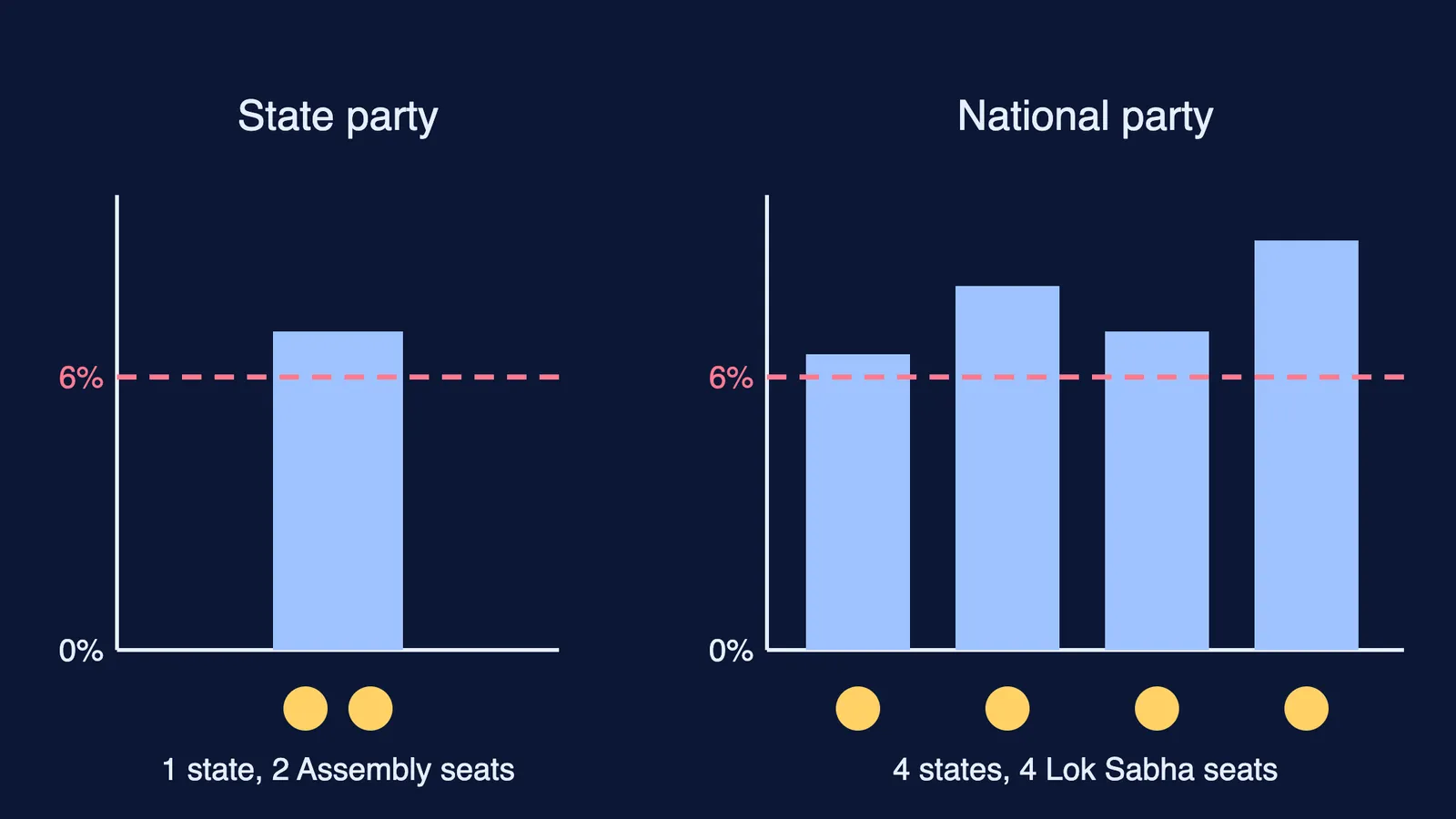
Every party has to register with the Election Commission, which gives "recognised" parties a reserved election symbol. Under the rule in your NCERT textbook, a party that wins at least 6 per cent of the votes in a State Assembly election and at least two seats is recognised as a state party. A party that wins at least 6 per cent of the votes in Lok Sabha or Assembly elections in four states, and at least four Lok Sabha seats, is recognised as a national party.
As of 9 August 2025, the Election Commission recognised 6 national parties, 67 state parties and 2,854 registered unrecognised parties, according to its press release on PIB. The six national parties it listed are the Aam Aadmi Party, Bahujan Samaj Party, Bharatiya Janata Party, Communist Party of India (Marxist), Indian National Congress and National People's Party. Recognition can change after any election, so check the Election Commission's list of political parties if a question asks for the current position.
Try three quick cases using the textbook rule:
Party A wins 7 per cent of the votes and 3 seats in one State Assembly election: state party.
Party B crosses 6 per cent in four states and wins 4 Lok Sabha seats: national party.
Party C wins 12 per cent in one state but only 1 seat: it misses the two-seat condition.
What challenges do political parties face?
NCERT names four:
Lack of internal democracy: power sits with one or a few leaders, without membership registers, meetings or regular internal elections.
Dynastic succession: top posts stay with one family, leaving ordinary workers little route to the top.
Money and muscle power: parties field candidates who can raise money, and sometimes back criminals who can win.
No meaningful choice: ideological differences between major parties have narrowed.
How can political parties be reformed?
Reforms already made: the Constitution was amended so an MLA or MP who changes parties loses the seat; a Supreme Court order requires every candidate to file an affidavit about property and pending criminal cases; and the Election Commission requires parties to hold organisational elections and file income tax returns.
The NCERT chapter also lists suggestions that parties have not yet accepted: a law regulating parties' internal affairs, about one-third of tickets for women, and state funding of elections. NCERT adds two routes from outside the law: public pressure through petitions, publicity and agitations, and more people joining parties.
How do you write a 5-mark answer on this chapter?
Use the same four-step frame for functions, challenges or reforms:
Open with the definition in one line.
Give five points, each a bold keyword plus one sentence.
Add one Indian example, such as the anti-defection amendment or the affidavit order.
Close with one line of judgement, for instance NCERT's own warning that over-regulating parties can backfire.
If you get a passage-based question on this chapter, our guide to answering case-based questions in CBSE board exams shows how to pull the answer from the passage. For the other civics-history link in Class 10, see our Nationalism in India Class 10 notes.
If Social Science revision keeps squeezing out your maths and science, Fermi's AI tutor can work out what you already know and build a plan for the session, so you sit down to a clear next step. And if this chapter has made you curious about politics as a subject, read about careers after a BA in political science.


