

On this page
Good notes on Nationalism in India compare the movements instead of listing them. Board questions keep asking how Non-Cooperation differed from Civil Disobedience, why Gandhi chose salt, and why some groups stayed away. Here is a comparison grid built from the NCERT chapter, a date ladder and a model answer.
What does Nationalism in India cover in Class 10?
In the CBSE Class 10 Social Science syllabus for 2026-27, Nationalism in India is Chapter 2 of the History book, India and the Contemporary World II. History carries 20 marks in that syllabus, including map pointing. The learning outcomes ask you to evaluate the strategies of Gandhiji and other leaders, and to summarise how the First World War triggered the Khilafat and Non-Cooperation movements.
How was Non-Cooperation different from Civil Disobedience?
Draw a two-column table in your notebook with five rows: when, trigger, method, who joined, how it ended. Every entry below comes from the NCERT chapter Nationalism in India.
Non-Cooperation Movement
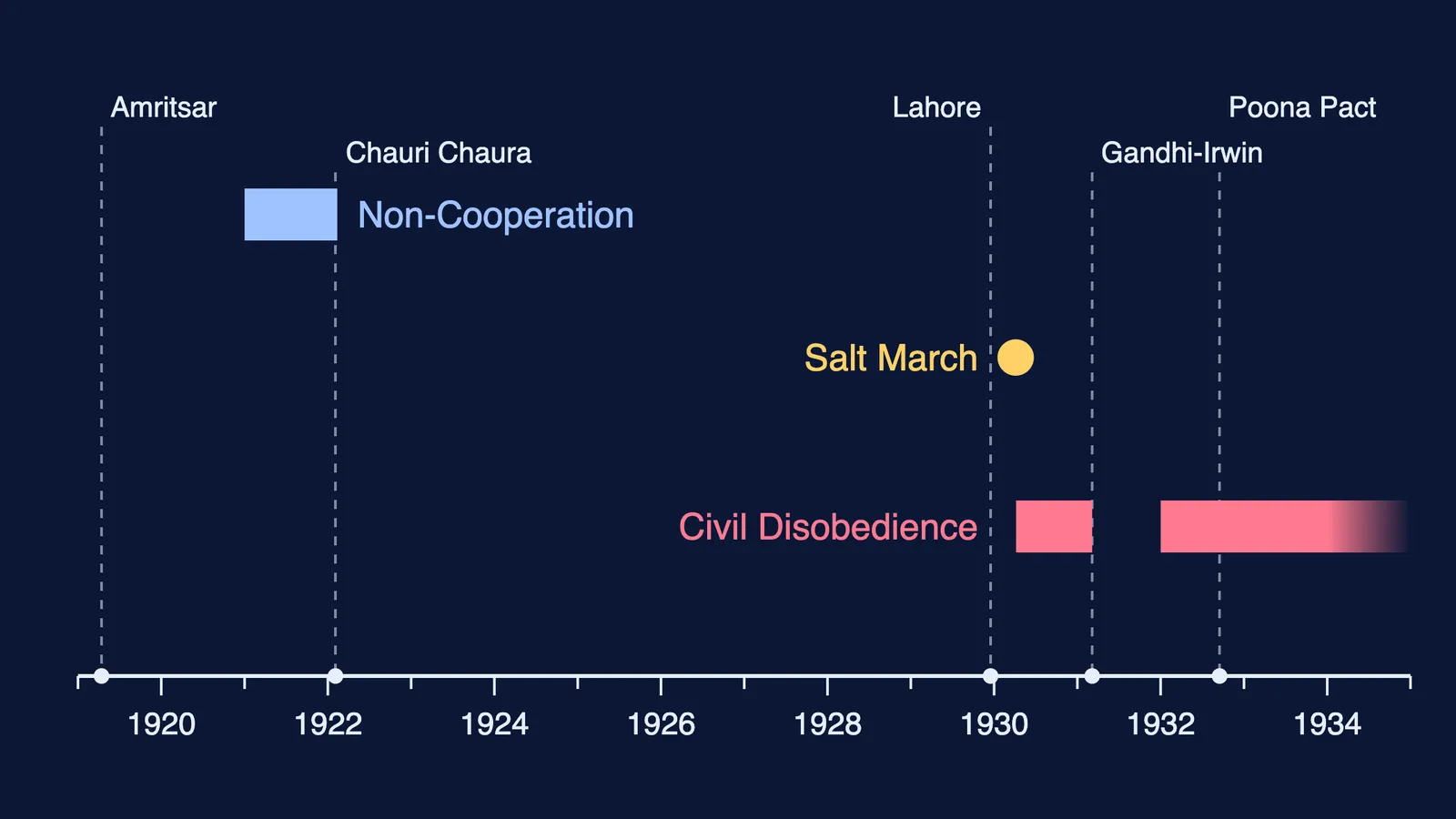
When: adopted at the Nagpur Congress session in December 1920; began, with Khilafat, in January 1921.
Trigger: the Rowlatt Act (1919), the Jallianwala Bagh massacre on 13 April 1919, and the Khilafat issue.
Method: surrendering titles and boycotting civil services, army, police, courts, councils, schools and foreign goods.
Who joined: the urban middle class, Awadh peasants under Baba Ramchandra, Gudem Hills tribals, Assam plantation workers.
How it ended: Gandhi withdrew it in February 1922 after the violence at Chauri Chaura.
The boycott hit trade: NCERT records that the import of foreign cloth halved between 1921 and 1922, from Rs 102 crore to Rs 57 crore.
Civil Disobedience Movement
When: began at Dandi on 6 April 1930; called off when Gandhi signed the Gandhi-Irwin Pact on 5 March 1931; relaunched in 1932.
Trigger: the Lahore Congress demand for Purna Swaraj (December 1929), the all-British Simon Commission, and the Depression.
Method: refusing cooperation and also breaking colonial laws: making salt, refusing revenue and chaukidari taxes, entering Reserved Forests.
Who joined: rich peasants (Patidars of Gujarat, Jats of Uttar Pradesh), business groups, and many women.
How it ended: by 1934 it had lost momentum.
What happened on the Salt March?
According to the NCERT chapter, Gandhi wrote to Viceroy Irwin on 31 January 1930 with eleven demands, the most stirring being the abolition of the salt tax. Salt was eaten by rich and poor alike, so it could unite every class. When Irwin would not negotiate, Gandhi set out from his Sabarmati ashram with 78 trusted volunteers. They walked over 240 miles in 24 days, about 10 miles a day, and on 6 April he made salt at Dandi by boiling sea water. The Wikipedia Salt March article dates Gandhi's letter to Irwin 2 March 1930; in the exam, write the NCERT date.
The government answered with repression, and NCERT says about 100,000 people were arrested. After the Gandhi-Irwin Pact, Gandhi went to the Round Table Conference in London in December 1931, but the talks broke down.
Who joined the movements, and who held back?
The NCERT chapter stresses that swaraj meant different things to different groups. Rich peasants wanted lower revenue and were deeply disappointed when the movement was called off in 1931 without revenue rates being revised, so many refused to join when it restarted in 1932. Industrialists, who formed FICCI in 1927, backed Civil Disobedience at first. Industrial workers did not join in large numbers, except in the Nagpur region.
Dalit participation was limited: Dr B.R. Ambedkar demanded separate electorates, and the Poona Pact of September 1932 gave the Depressed Classes reserved seats elected by the general electorate. Many Muslims felt alienated from the Congress after the Khilafat movement declined.
How do you revise this chapter for the board exam?
Use this plan across one week:
Day 1: build the five-row grid from the textbook, in your own words.
Day 2: write the date ladder from memory (1919, 1921, 1922, 1929, 1930, 1931, 1932), then check each date against NCERT, as in our guide to checking history dates in NCERT.
Day 3: write the model answer below in five minutes and mark it against the book.
Day 7: redraw the grid on a blank page and fill the gaps.
Question: How was the Civil Disobedience Movement different from the Non-Cooperation Movement? A strong answer makes three points. People were asked not only to refuse cooperation but to break colonial laws. It began with a shared grievance, the salt tax, chosen so every class could join. And its supporters differed: rich peasants and business groups were prominent and women joined in large numbers, while many Muslims stayed away.
For the source boxes, practise answering case-based questions in CBSE board exams, and turn each movement into a cause-and-effect chart for a history chapter.
If Social Science revision is squeezing your science and maths time, Fermi's AI tutor is built for STEM subjects: it can work out what you already know and build a plan for the session, so your remaining hours go to the right topics.


