On this page
Your trial balance is out by ₹4,600 and the exam is next week. Rectification of errors fixes this: you find each mistake, decide whether it touched one account or two, and pass the entry that cancels the wrong effect and restores the right one. Everything below follows Chapter 6 of the NCERT Class 11 Accountancy textbook, Part I.
What is the difference between one-sided and two-sided errors?
The NCERT chapter sorts errors into four kinds: commission, omission, principle and compensating. For rectification, ask: does the error affect the trial balance?
Two-sided errors do not affect the trial balance. They sit in two accounts, so one ordinary journal entry between them fixes the error. Examples: a transaction left out completely, a posting to the wrong account on the correct side, and errors of principle such as rent paid recorded as a payment to the landlord.
One-sided errors affect the trial balance. They touch one account: a subsidiary book cast wrongly, the right account posted with the wrong amount or on the wrong side, or an account left out of the trial balance.
A tallied trial balance is not proof the books are correct, because errors such as complete omissions, errors of principle and compensating errors leave the totals equal.
How do you write a rectification entry?
The NCERT rule is to debit the account with a short debit or an excess credit, and credit the account with an excess debit or a short credit.
Use this three-line check every time:
Write the entry that was actually made.
Write the entry that should have been made.
Compare them account by account. The difference is your rectification entry.
NCERT's own example: credit sales of ₹10,000 to Mohan were recorded in the sales book as ₹12,000. Mohan's account has ₹2,000 too much debit and Sales has ₹2,000 too much credit, so the entry is Sales A/c Dr ₹2,000, To Mohan's A/c ₹2,000.
What is a suspense account in rectification of errors?
A suspense account is a temporary account where the accountant puts the trial balance difference, on the shorter side, so that work can continue while one-sided errors are still unfound, according to the NCERT textbook. As each one-sided error is located, you pass an entry with Suspense A/c as the other half. When every such error is fixed, the suspense account closes with no balance. NCERT also allows a correcting note in the affected account instead.
Solved example: five errors and one suspense account
This is our own practice set, built on NCERT's method. A trader's trial balance shows debits ₹4,600 higher than credits, so ₹4,600 goes on the credit side as suspense. These errors are found later:
The sales book was undercast by ₹2,000.
Furniture bought for ₹8,000 was entered in the purchases book.
₹1,500 received from Kavya was posted to the debit of her account.
Discount allowed of ₹400 was not posted to the discount account.
Credit sales of ₹3,000 to Arjun were not recorded at all.
The rectification entries:
Suspense A/c Dr ₹2,000, To Sales A/c ₹2,000. Sales was credited short.
Furniture A/c Dr ₹8,000, To Purchases A/c ₹8,000. Error of principle: two accounts, no suspense.
Suspense A/c Dr ₹3,000, To Kavya's A/c ₹3,000. She was debited ₹1,500 instead of credited, so the correction is double.
Discount Allowed A/c Dr ₹400, To Suspense A/c ₹400. Debited short.
Arjun's A/c Dr ₹3,000, To Sales A/c ₹3,000. Complete omission, so two-sided.
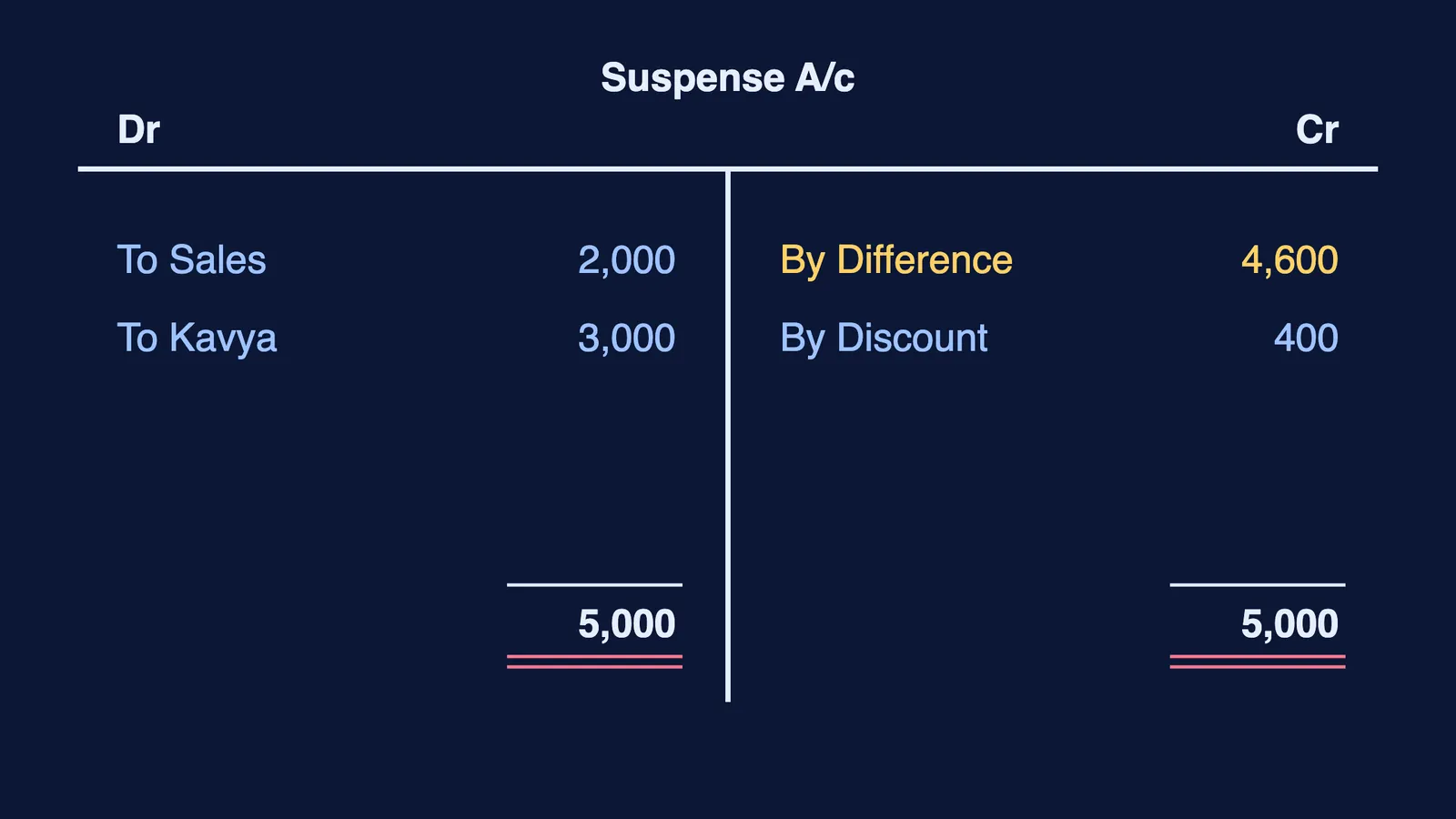
Now post the suspense account. Credit side: difference ₹4,600 and discount allowed ₹400, total ₹5,000. Debit side: Sales ₹2,000 and Kavya ₹3,000, total ₹5,000. It closes with no balance, so every one-sided error has been found. Errors 2 and 5 never touch it.
How do you find errors when the trial balance does not tally?
The NCERT chapter lists checks that save time:
Re-add both columns and compare each balance with the ledger.
If the difference is divisible by 2, look for half that amount posted to the wrong side. Error 3 alone creates a ₹3,000 gap, pointing to a ₹1,500 item.
Look for an item equal to the whole difference that was never posted.
If the difference is divisible by 9, suspect transposed digits: ₹459 posted as ₹954 leaves ₹495.
NCERT also warns against erasing or overwriting, because it reduces the authenticity of records.
A three-day practice plan before the exam
Day 1: classify textbook errors as one-sided or two-sided, without writing entries.
Day 2: write the three-line check for each one.
Day 3: solve one full suspense question. If suspense does not close, find the error you misjudged.
Copy misjudged ones into an error notebook you review each week. If an AI chatbot checks your work, make it justify every debit and credit, as in how to check AI journal entries with the golden rules.
For the maths you study alongside accountancy, Fermi's AI tutor works out what you already know and builds a plan for the session.