On this page
Asking a chatbot to journalise a transaction feels like a shortcut, but Class 11 Accountancy has one rule an AI can quietly break: every amount must sit on the correct side. A 2023 study in Issues in Accounting Education by David Wood and colleagues compared ChatGPT with students on 28,085 accounting questions from 186 institutions in 14 countries. As of January 2023, ChatGPT gave fully correct answers to 56.5% of the questions. Students averaged 76.7% on the assessments, against 47.5% for ChatGPT without partial credit.
Newer models may do better, but the lesson holds: treat an AI journal entry as a draft you mark, not an answer you copy.
What mistakes does AI make in Class 11 journal entries?
These are the slips to look for. Each breaks a rule printed in your textbook, the NCERT Class 11 Accountancy chapter on recording transactions.
Debit and credit reversed. "Cash received from Nidhi" written as Nidhi A/c Dr., To Cash A/c. The amounts match, so it looks fine at a glance.
Missing or vague narration. NCERT says a brief description of the transaction, called the narration, goes below the account titles. An entry without one does not follow that format.
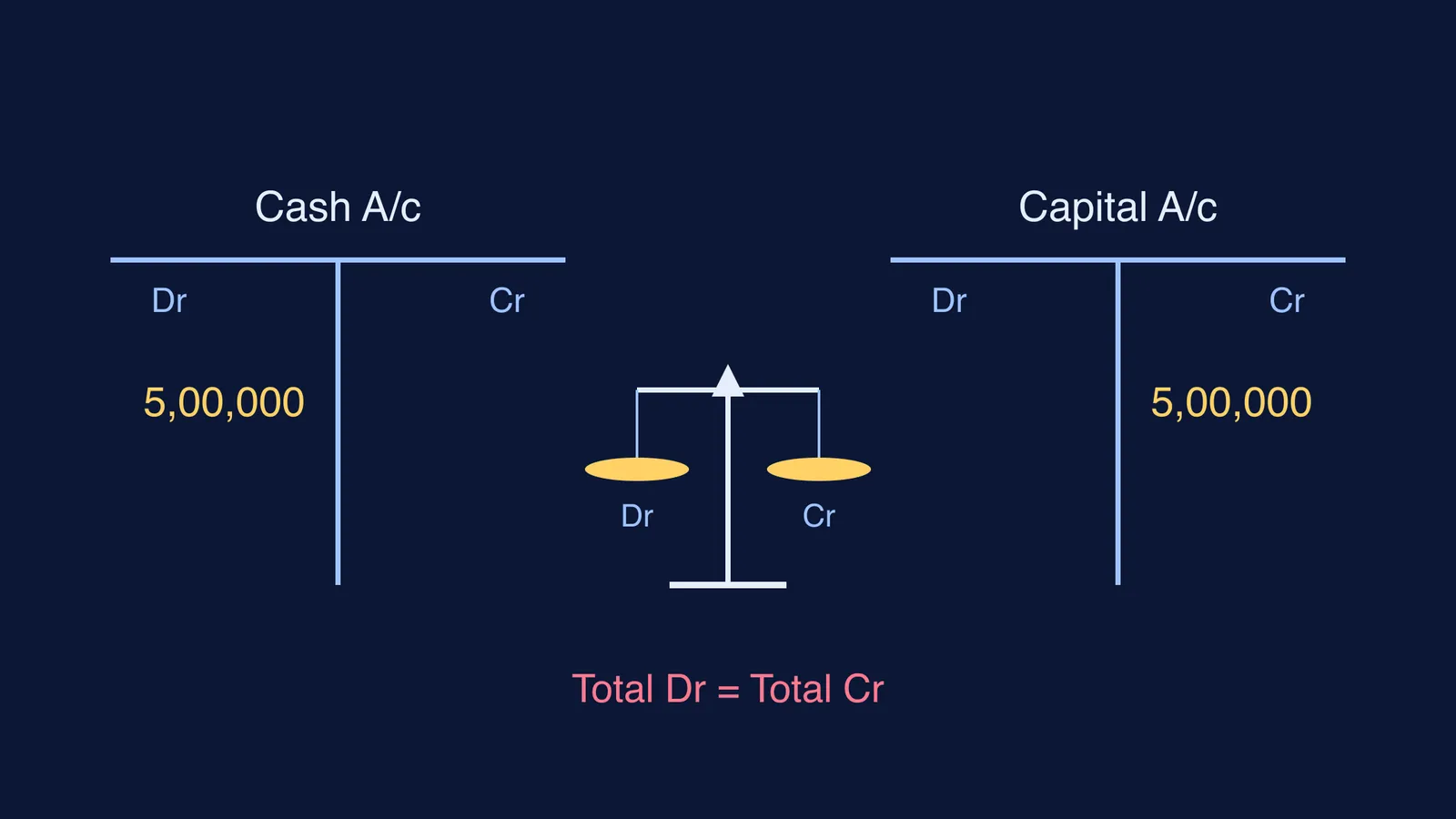
Unequal totals in compound entries. NCERT states that the total amount debited must equal the total amount credited.
The wrong account name. NCERT points out that when goods are bought, the account debited is Purchases, not Goods.
Format drift. The debit account comes first with "Dr.", and the credit account goes on the next line, starting with "To".
What are the golden rules of accounting?
The ICAI Foundation study material on journal entries sets out the traditional golden rules, one pair for each type of account:
Personal accounts: debit the receiver, credit the giver.
Real accounts: debit what comes in, credit what goes out.
Nominal accounts: debit expenses and losses, credit income and gains.
Your NCERT textbook uses the modern version, built on five kinds of account: an increase in assets or expenses is debited, and an increase in liabilities, capital or revenue is credited. Decreases go the other way. Both methods give the same entry. Use whichever your teacher uses.
How do you check an AI journal entry step by step?
Cover the AI's answer and run these five steps. If your result and the AI's differ, find the step where they split.
Say the transaction plainly. What came in, what went out, who gave and who received?
Label every account. Asset, liability, capital, expense or revenue (or personal, real or nominal under the golden rules).
Decide Dr or Cr yourself. Apply the rule for each label, and only then look at the AI's entry.
Add both columns. Total debits must equal total credits, which matters most in compound entries.
Read the narration. It should say what happened in a short bracketed line, such as "(Cash received from Nidhi)".
A worked example
Take a transaction from Illustration 2 in the NCERT chapter: on 8 April, Nidhi pays Saroj Mart ₹14,000 in cash. Suppose an AI gives you this:
Nidhi A/c Dr. 14,000
To Cash A/c 14,000
Run the check. Cash comes into the business: an asset is increasing (under the golden rules, a real account and "what comes in"), so Cash is debited. Nidhi gave the money and now owes less: a debtor, which is an asset, is decreasing (under the golden rules, the giver), so Nidhi is credited.
The AI has reversed the entry and dropped the narration. The NCERT solution reads Cash A/c Dr. 14,000, To Nidhi A/c 14,000, with the narration "(Cash received from Nidhi)".
What should you ask the AI instead?
Change the prompt so the AI shows reasoning you can check. Try these:
"Classify each account as asset, liability, capital, expense or revenue, and say whether it increases or decreases, before you write the entry."
"Write the entry in NCERT journal format, with Dr., To and a narration."
"Here is my entry. Tell me the step where it goes wrong, if it does, but don't rewrite it."
Be careful with the last one: chatbots can be too agreeable, which is why we wrote about why AI sometimes agrees with a wrong answer. When you total a long journal, AI arithmetic slips in long calculations are worth a second look. For board answers, compare the AI's wording with the textbook's too; see AI answers versus NCERT wording in board exams.
Knowing why a rule works matters more than any single entry. That is the idea behind Fermi's AI tutor, part of an AI-powered STEM learning platform: it teaches rather than answers, notices where you are stuck and checks understanding as it goes.
Next time an AI hands you a journal entry, cover it, run the five steps, and mark it the way your teacher would.