

On this page
Many students now revise with an AI chatbot open beside the NCERT book. The explanations are often clear and often right. But a board answer is judged against a list of points the examiner has in hand, and a fluent AI paragraph can walk straight past one of them.
Here is how that happens on a real CBSE question, and a five-step check to run before you learn any AI answer.
Can you write AI answers in board exams?
You cannot use AI in the exam hall, so the real question is whether to learn and reproduce an AI's wording. The answer depends on how CBSE marks.
CBSE's 2025 Class 12 marking scheme for Punjabi opens with general instructions for evaluators. Three of them matter here:
The marking scheme "carries only suggested value points for the answers", and "students can have their own expression and if the expression is correct, the due marks should be awarded".
Evaluation "should not be done according to one's own interpretation", and examiners must ensure marking is "strictly as per value points for each answer".
Each examiner works full 8-hour days and is expected to evaluate 20 answer books per day in main subjects.
Innovative answers are also to be assessed for correctness. So your own words are allowed, but the examiner is checking for specific points, quickly. If a point is missing, there is nothing to tick.
Why can a correct AI answer lose marks?
Take Question 27 from CBSE's Class 12 Biology sample paper for 2025-26: "Expand ELISA. On what principle is the ELISA test based? List two ways by which an infection can be detected by this test." It carries 3 marks.
Here is the kind of answer a chatbot might give. We wrote it to illustrate the pattern; it is not from a specific tool.
"ELISA stands for Enzyme-Linked Immunosorbent Assay. It uses an enzyme attached to an antibody. If the target is present, the enzyme changes the colour of a substrate, which shows a positive result. It is widely used, for example in HIV testing."
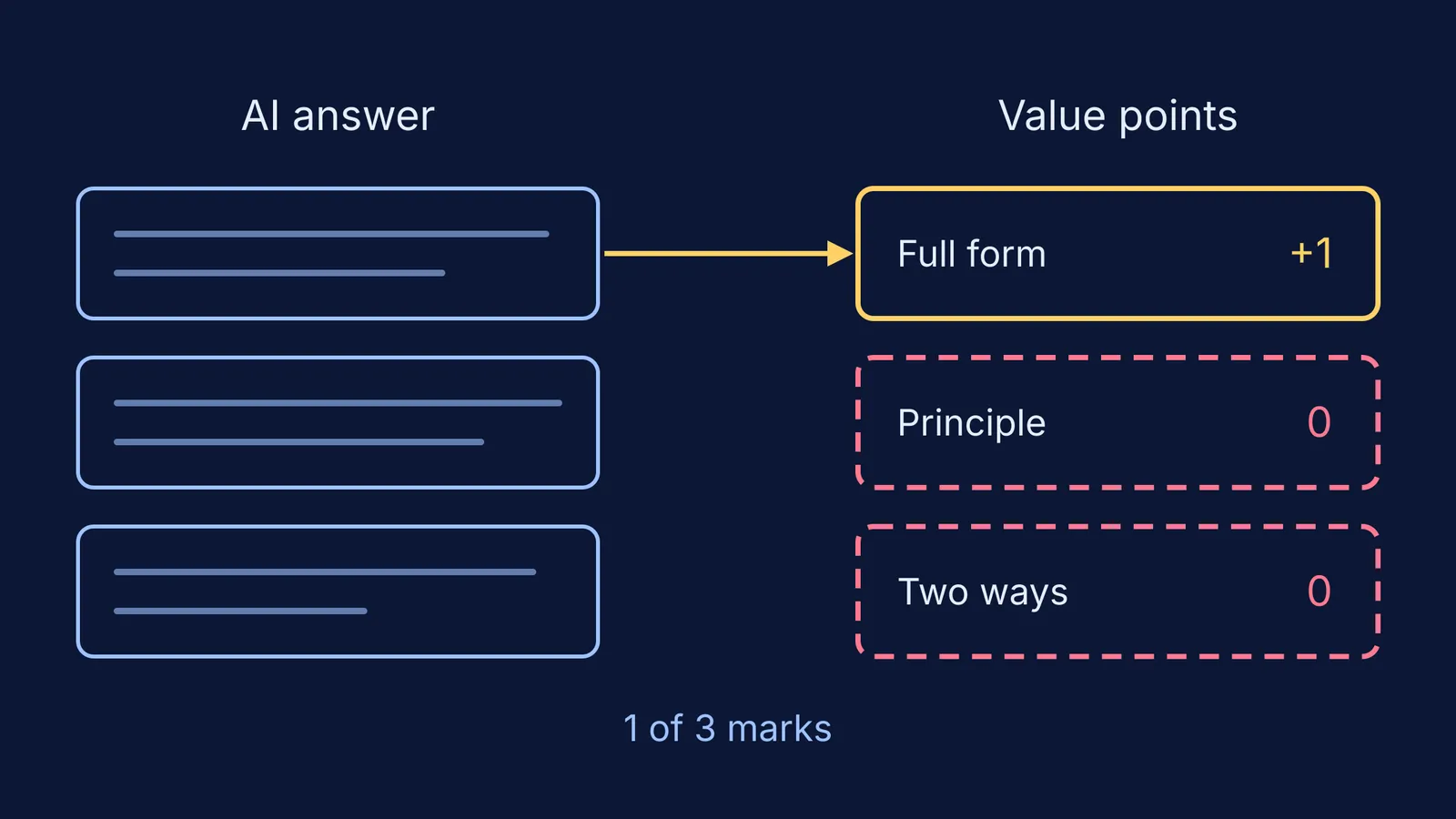
Nothing in it is false. Now compare it with the official marking scheme for that paper, which gives 1 mark for each of three value points:
The full form, Enzyme Linked Immunosorbent Assay.
The principle: ELISA is based on antigen-antibody interaction.
Detection: the presence of antigens (proteins, glycoproteins, etc.) is detected, or antibodies produced against the pathogens are detected.
The AI answer earns the first mark. It describes the colour test but never states the principle, and gives one example of use instead of the ways an infection is detected. Marked strictly against those points, it would earn 1 mark, not 3.
How do you compare an AI answer with NCERT and the marking scheme?
Run this before copying any AI answer into your notes:
Split the question into its demands. Count the verbs and the marks. "Expand", "on what principle" and "list two ways" for 3 marks means three separate points.
Find the topic in your NCERT book. Underline the sentence that answers each demand. That gives you the textbook's own term for each point, such as "antigen-antibody interaction" rather than "the enzyme changes colour".
Open a marking scheme for a similar question. CBSE posts sample papers and marking schemes subject by subject on its Class 12 sample paper page. Note how many value points it lists.
Tick the AI answer against each point. Anything unticked is a gap, however good the paragraph sounds. Anything that contradicts NCERT gets crossed out, not kept.
Rewrite in your own words, keeping the key terms. One line per value point for short answers.
Our guide to using CBSE marking schemes to write answers that earn the marks goes deeper, and physics derivations in CBSE boards applies the same idea to physics.
What should you ask the AI instead?
AI is most useful before the rewrite, when you are still trying to understand. Try prompts like these:
"Explain why ELISA depends on antigen-antibody interaction, as simply as you can."
"Here is my 3-mark answer. Which of these three points is missing: full form, principle, two ways of detection?"
"Ask me three questions to check I understood this, one at a time."
If you cannot explain the idea without the screen, memorised wording will not hold up. Our post on five quick ways to check you understood an AI explanation has more tests like this.
Fermi's AI tutor is built for that part: it decides whether to explain, ask or show, and checks understanding as it goes. If the gap is a concept rather than wording, the Fermi Concept Library covers every concept in physics, chemistry, biology, mathematics and computing, each with its own lesson.
Pick one AI answer from this week's revision, run the five-step check on it, and see how many value points survive.


