

On this page
When you ask an artificial intelligence model to solve a multi-step physics problem, the output often looks immaculate. The explanation quotes the right laws, sets up boundary conditions, and formats every equation with textbook elegance. Yet somewhere on line four, a quiet slip appears: 14.4 divided by 1.2 is miscalculated as 1.2 rather than 12, or an exponent flips sign. The model carries that mistaken value through every remaining line, arriving at an incorrect answer with complete confidence. Students preparing for exams like JEE Main and Advanced often experience this exact failure pattern: a minor arithmetic slip silently corrupts an entire solution, even when the concept was sound.
Why does AI make calculation mistakes in long problems?
Large language models generate text autoregressively, predicting each successive token based on statistical patterns rather than executing instructions on an arithmetic register. When computing addition or division, a model produces text tokens representing digits rather than routing numbers into an arithmetic logic unit.
This design creates a structural bottleneck known as the tokenization problem. Most language models use byte-pair encoding, which merges frequent digit sequences into arbitrary sub-word chunks. In their study on arithmetic fine-tuning, Liu and Low (2023) demonstrated that inconsistent sub-word tokenization prevents standard language models from reliably learning column addition and multiplication. Because digits are grouped unpredictably, the attention mechanism struggles to align place-value columns. Furthermore, transformers generate text from left to right, whereas arithmetic requires right-to-left carry propagation. The model must commit to the most significant digits first before computing the carries that determine them.
How do small arithmetic slips compound across steps?
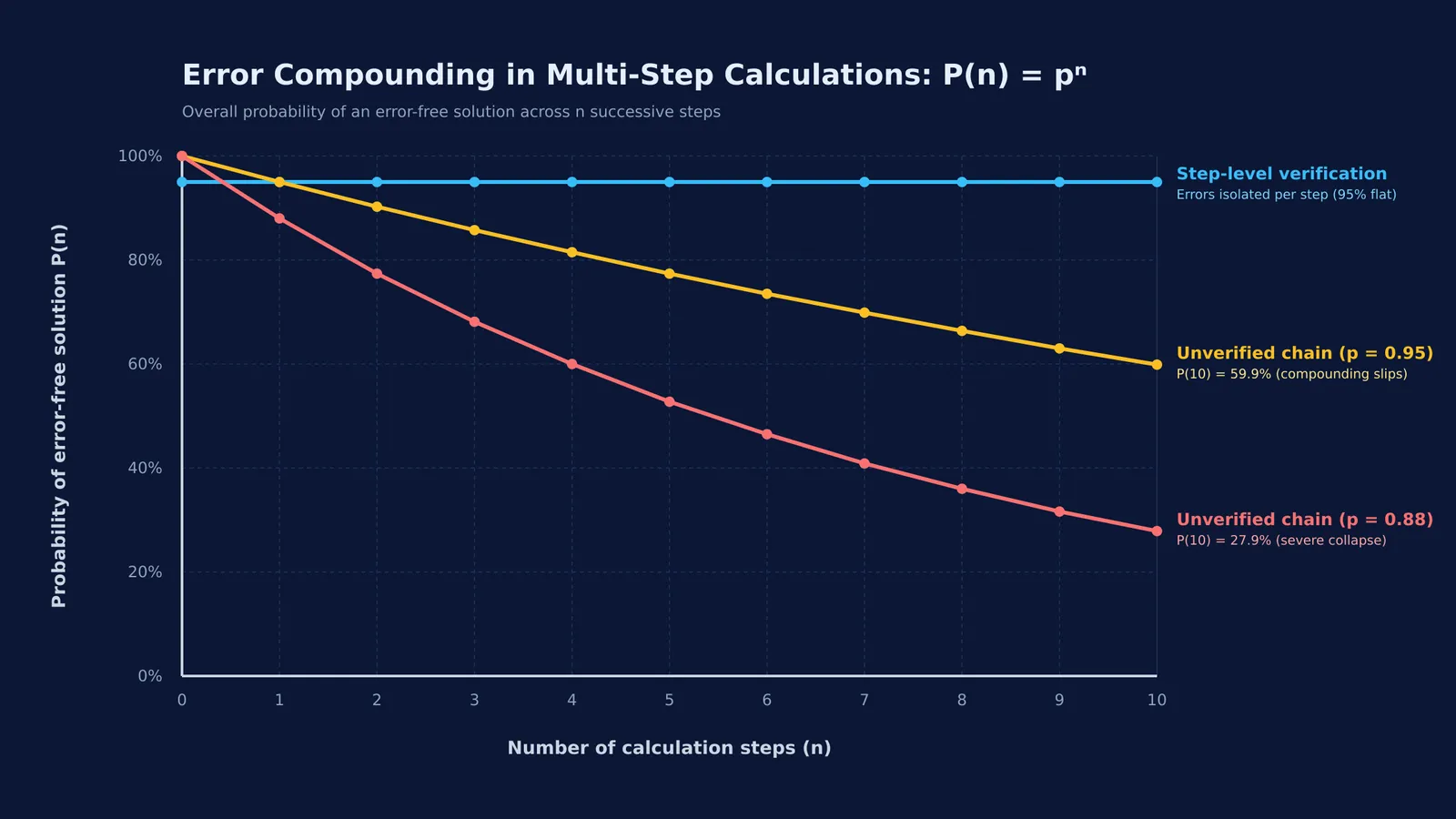
In a multi-step calculation, each successive equation depends on the numbers that preceded it. If an autoregressive model has an individual step accuracy of p, the probability of completing an n-step calculation without a slip decays exponentially as pⁿ.
In a study on compositional reasoning, Dziri et al. (2023) tested transformer models across multi-digit multiplication and computation graphs. The researchers found that GPT-4 achieved 59% accuracy on 3-digit by 3-digit multiplication in a direct zero-shot setting, but collapsed to just 4% accuracy on 4-digit by 4-digit problems. When the model made a single arithmetic slip in an intermediate step, that erroneous number entered its context window. Because autoregressive models treat their previous output as ground truth, every downstream calculation conditioned on the error. As we explored in why AI chatbots get maths wrong, models optimize for linguistic plausibility over numerical precision, continuing with flawed values rather than pausing to recalculate.
Why does step-by-step verification outperform final-answer checks?
Checking only the final number of a long calculation—known as outcome supervision—reveals that a result is wrong, but cannot identify where the reasoning broke down. By contrast, verifying each intermediate step isolates mistakes at the exact line of divergence.
In an empirical study on mathematical reasoning, Lightman et al. (2023) evaluated step-level process supervision against outcome supervision on the MATH benchmark. Using 800,000 step-level human feedback labels from the PRM800K dataset, their process-supervised model solved 78% of problems on a representative MATH test subset. Similarly, Gao et al. (2023) demonstrated across 13 reasoning tasks that delegating mechanical calculations to an external runtime raised GSM8K benchmark accuracy by an absolute 15% top-1 over PaLM-540B with standard chain-of-thought prompting.
When working through difficult numerical problems, studying solutions that unpack every intermediate transformation makes slips obvious before they cascade. The Fermi Problem Library provides worked problems with a step-by-step solver that explains the reasoning rather than printing an answer, keeping each step verifiable.
How can students split multi-step calculations to prevent errors?
Combining algebraic rearrangement and decimal arithmetic simultaneously invites cognitive overload. To prevent small calculation errors from ruining long derivations, separate algebraic structure from arithmetic execution:
Solve symbolically first: isolate the unknown variable in pure algebraic symbols before substituting any values.
Use scientific notation: write numerical quantities as powers of ten to eliminate decimal-point drift.
Check intermediate milestones: verify that intermediate physical quantities remain realistic before proceeding.
Reviewing how to use a step-by-step solver well and getting useful AI feedback on your step-by-step solutions builds an active error-checking habit. For deeper practice, Fermi's AI tutor holds a line of reasoning across a session, notices where a student is stuck, and checks understanding as it goes, helping you catch procedural slips before they cascade.
How should you verify long calculations before submitting?
Before accepting the final answer of any multi-step calculation—whether written by an AI or on your own exam paper—run through this five-point verification routine:
Dimensional consistency: verify that dimensions on both sides match before inserting numbers.
Order-of-magnitude bounds: round values to powers of ten to estimate the rough scale beforehand.
Physical limits: check that intermediate values obey reality, such as ensuring speeds remain subluminal.
Independent arithmetic audit: recalculate final arithmetic on a separate scratch line without reading previous steps.
Reverse substitution: plug the final answer back into the governing formula to confirm boundary conditions.


