On this page
Your cash book says the bank account holds ₹42,000. The bank statement for the same day says ₹41,650. Nobody has lost money. The two records were written by different people on different days, and a bank reconciliation statement is the short working that shows exactly why they differ.
The topic sits in Unit 2, Accounting Process, of the CBSE Class 11 Accountancy syllabus for 2026-27, next to the cash book and the ledger. That unit carries 44 of the 80 theory marks in the same syllabus. The chapter you study it from is Chapter 5 of the NCERT Class 11 Accountancy textbook.
Why do the cash book and passbook balances differ?
NCERT says the differences between the cash book and the passbook are caused by timing differences in recording transactions and by errors made by the business or the bank (NCERT, Chapter 5). The chapter lists seven timing causes, which group into five kinds:
Cheques issued but not yet presented: in your cash book, not yet paid by the bank.
Cheques deposited but not yet collected: in your cash book, not yet credited by the bank.
Direct debits: bank charges, interest on overdraft, payments on standing instructions such as an insurance premium.
Direct credits: interest, dividends collected, money a customer pays straight into your account.
Dishonoured cheques: a cheque you deposited bounces and the bank debits it back.
Errors are the second group. One of the chapter's practice items is a ₹5,000 cheque recorded in the cash book as ₹500.
What is the format of a bank reconciliation statement?
NCERT's table-form proforma has a Particulars column and two amount columns, one for additions (+) and one for deductions (−), and its steps put the date at the top as part of the heading (NCERT, Chapter 5). Following its solved illustrations, the rows run in this order:
Heading: Bank Reconciliation Statement of (firm) as on (date).
Starting balance: usually the balance as per cash book.
Items to add, in the (+) column.
Items to deduct, in the (−) column.
Closing line: balance as per passbook.
NCERT notes that you may start from the passbook balance instead, and then every treatment is the reverse.
How do you decide whether to add or subtract?
Instead of memorising a list, ask one question about each item: because of this, is the passbook balance higher or lower than the cash book? Higher, add it. Lower, subtract it. Starting from the passbook, flip the answer.
Cheque issued, not presented: passbook higher. Add.
Cheque deposited, not credited: passbook lower. Subtract.
Bank charges, a premium paid by the bank, a dishonoured cheque: passbook lower. Subtract.
Interest credited, a customer's direct deposit: passbook higher. Add.
A solved bank reconciliation statement problem
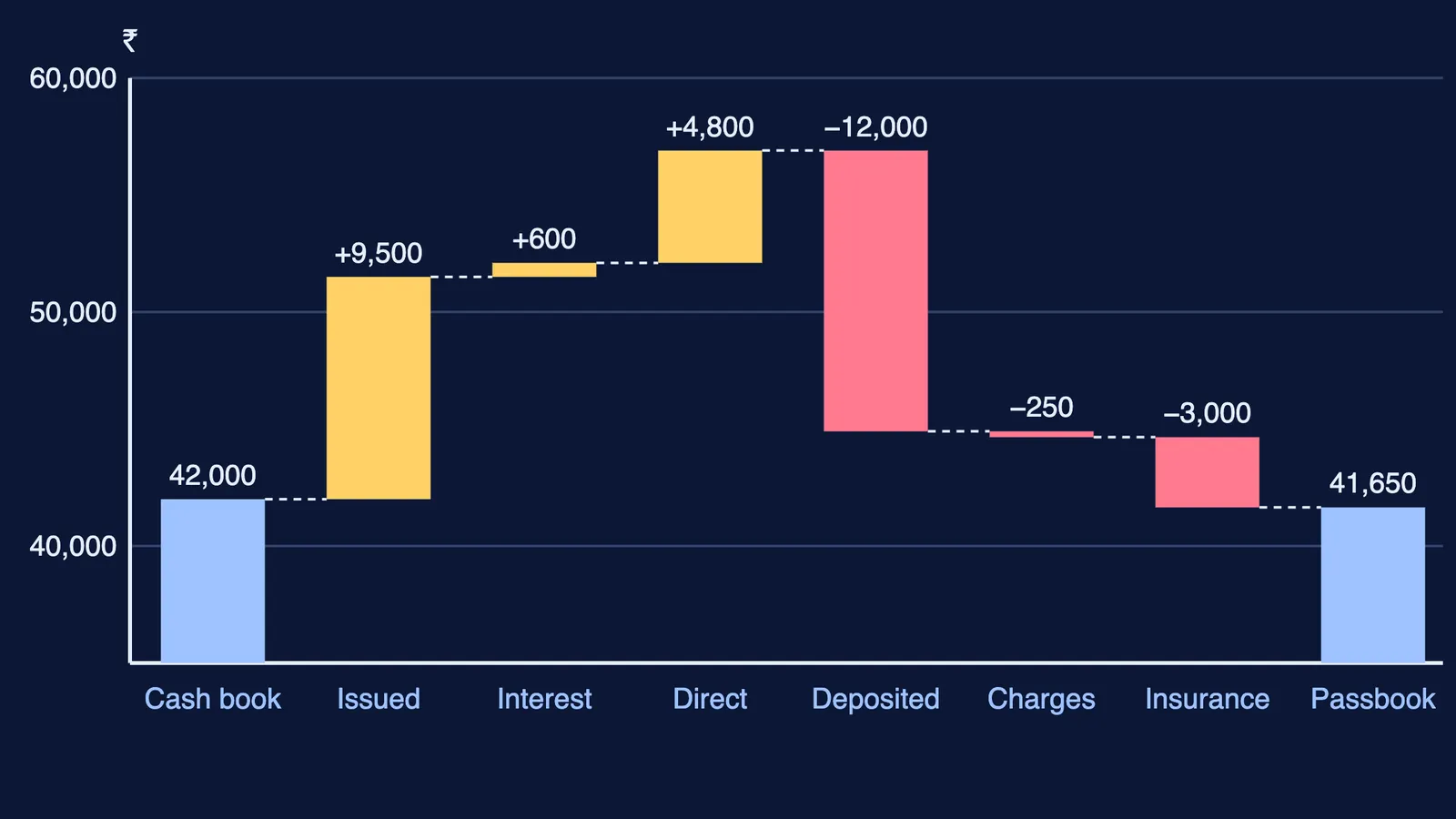
On 30 September 2026 the cash book of Meera Stationers (a made-up firm) shows a debit bank balance of ₹42,000. Comparing it with the passbook, you find:
Cheques of ₹9,500 issued to suppliers were not presented for payment by 30 September.
Cheques of ₹12,000 deposited on 29 September were credited by the bank only in October.
The bank credited interest of ₹600.
A customer deposited ₹4,800 directly into the account.
The bank debited ₹250 as charges.
The bank paid an insurance premium of ₹3,000 on standing instructions.
Bank Reconciliation Statement of Meera Stationers as on 30 September 2026
Balance as per cash book: (+) ₹42,000
Add cheques issued but not presented: (+) ₹9,500
Add interest credited by the bank: (+) ₹600
Add direct deposit by a customer: (+) ₹4,800
Less cheques deposited but not credited: (−) ₹12,000
Less bank charges: (−) ₹250
Less insurance premium paid by the bank: (−) ₹3,000
Balance as per passbook: (−) ₹41,650
The (+) column totals ₹56,900 and the deductions total ₹15,250, so the passbook balance is ₹56,900 − ₹15,250 = ₹41,650. Writing ₹41,650 in the (−) column makes both columns total ₹56,900, which is how NCERT's solved illustrations close.
Check it backwards before you move on: start at ₹41,650, reverse every sign, and you should land on ₹42,000. You do.
What should you check before handing in a bank reconciliation statement?
Run this checklist on every answer:
The date is in the heading.
The starting balance is labelled, cash book or passbook.
If you started from the passbook, every sign is reversed.
An opening overdraft sits in the (−) column.
Items already in both records are left out.
The final line says whether the balance is favourable or an overdraft.
If debits and credits still trip you up, see checking journal entries with the golden rules. Parents can read what maths in Class 11 commerce opens and closes later, and if Class 11 feels steep, try this four-week reset.
If you don't know where to start, Fermi's AI tutor takes a problem set or a scanned assignment, works out what you already know and builds a plan for the session.
Tonight, pick an NCERT illustration, cover the solution and use the one-question test on every line.