On this page
You were near the top of your class in Class 10. Now, a few months into Class 11 PCM, your test scores are lower than you have ever seen, and studying longer does not seem to move them. This is common, and it can be fixed.
Why does Class 11 feel so much harder than Class 10?
Abstraction. The CBSE Class XI Mathematics syllabus for 2026-27 opens with sets, relations and functions, defines trigonometric functions with the help of the unit circle, and introduces the derivative as a rate of change alongside an intuitive idea of limit. You have to use these ideas, not just remember them.
Longer problems. Many Class 10 questions test one idea in one or two steps. Class 11 problems chain several: resolve a vector, write an equation, differentiate, then interpret the answer.
Pace. Chapters arrive faster than they can settle, and physics borrows maths tools before maths class has taught them. Our guide to mathematical tools for Class 11 physics covers that overlap.
Rereading until a chapter feels familiar worked in Class 10. It is not enough now, and that says nothing bad about your ability.
Is it normal for a Class 10 topper to struggle in Class 11?
Yes, and part of the feeling comes from who you are now compared with. Psychologists call it the big-fish-little-pond effect: equally able students rate their own academic ability lower when their classmates are stronger.
In a study of 103,558 fifteen-year-olds across 26 countries, Herbert Marsh and Kit-Tai Hau found that the effect of school-average achievement on academic self-concept was negative in all 26 countries (Marsh and Hau, American Psychologist, 2003).
A PCM section often gathers students who were strong in maths, so your rank can fall even while your skill grows. Judge progress against your own last month, not the student next to you.
If low mood, poor sleep or dread before school lasts for weeks, talk to a parent, teacher or school counsellor. Tele MANAS, the government's free mental-health helpline, answers on 14416 or 1800-891-4416.
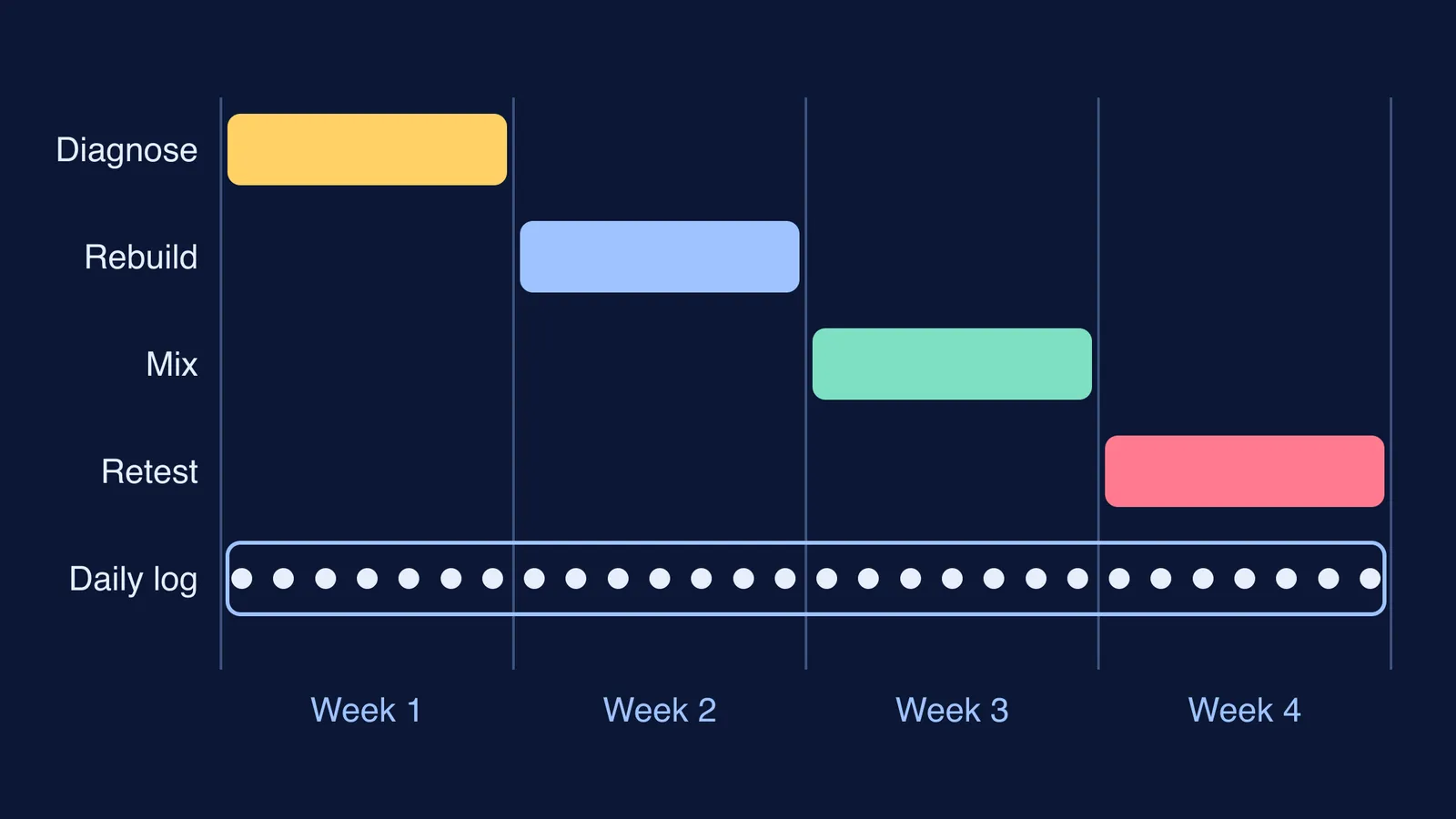
What does a four-week reset look like?
Start with one subject, usually the one with the biggest drop.
Week 1: diagnose. Take your last two tests. Beside every lost mark write one code: C for a concept you did not understand, M for a maths step that failed, S for a slip (sign, unit, copying), T for running out of time. Count the codes.
Week 2: rebuild the basics. Take your most frequent C and M gaps. For each, reread only that NCERT section, close the book, explain the idea aloud in your own words, then solve the easiest solved examples without looking. If a gap turns out to sit in an earlier topic, Fermi's Concept Library gives every concept in physics, chemistry, biology, mathematics and computing its own lesson and its place in the map.
Week 3: mixed practice. Return to current chapters, but mix question types instead of doing many of one kind in a row; our interleaved practice plan explains why. If you keep picking the wrong method, compare your working with a full solution line by line. The Fermi Problem Library has worked problems with a step-by-step solver that explains the reasoning rather than printing an answer.
Week 4: retest. Redo the two tests from week 1 without notes, under time, and code the misses again. The codes should shift from C and M towards S and T.
A worked example of diagnosis
Two students lose the same marks on a question about a ball launched at speed u and angle θ above the horizontal, landing on level ground. The first wrote the initial vertical velocity as u cos θ instead of u sin θ. That is an M: the gap is resolving a vector into components, so week 2 goes there. The second did not know that the time of flight ends when vertical displacement returns to zero. That is a C, so week 2 goes back to the idea of independent horizontal and vertical motion. Same lost marks, different fix.
Why count questions solved instead of hours studied?
Hours measure time spent, not what you can do without the book. Solving a question with the book closed is a small test, and testing helps memory.
In two experiments by Henry Roediger and Jeffrey Karpicke, students who took recall tests on prose passages remembered substantially more after two days and one week than students who restudied, even though restudying made them more confident (Psychological Science, 2006). Rereading can feel productive while teaching you less.
What can parents say to a child whose marks dropped in Class 11?
The aim is to move the talk from rank to process.
Say: "Class 11 is a different kind of work. Show me which marks you lost and why."
Say: "I want to see the log on Sunday, not the score."
Avoid comparing with cousins, classmates or your child's own Class 10 result.
After the reset, our research-based Class 11 physics study plan gives you a steady weekly routine.