

On this page
The jump from Class 10 science to Class 11 physics is often described by students as an academic shock. The reason is rarely the physics concepts themselves. Instead, it is the sudden reliance on mathematical tools—specifically vectors, differentiation, and integration. A major systemic issue across curricula is the lack of alignment between mathematics and physics. Students are often expected to use calculus in physics before it has been formally introduced in their mathematics classes. This timing mismatch forces students to memorise formulas without understanding how they work.
Why do mathematical tools feel different in physics?
It is common for a student to know how to differentiate a polynomial in a mathematics class but stare blankly at a velocity-time graph. According to physics education researcher Edward F. Redish in *The Physics Teacher* (2021), learning to think about physics with mathematics involves blending physical knowledge with math, which changes how equations are interpreted (Source).
In a mathematics class, symbols like x and y are often abstract numbers. In physics, symbols carry units, physical constraints, and tell a story about reality. For example, a derivative is not just a calculation rule; it represents a physical rate of change. An integral is not simply finding an area; it is accumulating a physical quantity over time or space.
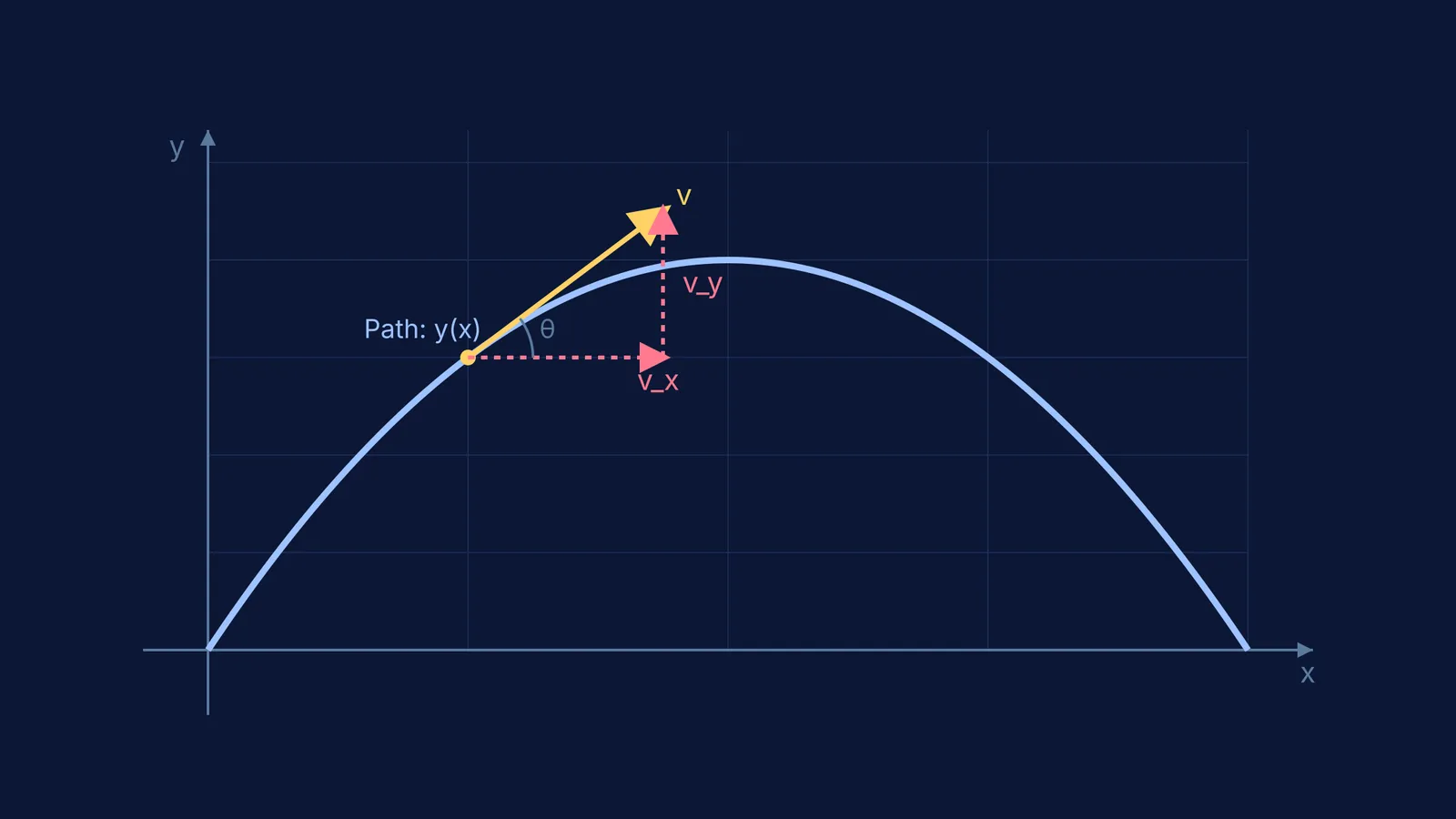
Vectors are often a student's first encounter with directional mathematics. While adding two numbers is straightforward, adding two vectors requires understanding head-to-tail geometry and magnitude. Furthermore, vectors require you to visualise three-dimensional space and resolve forces into components using trigonometry—skills that rely heavily on geometric intuition rather than just algebra. Similarly, differentiation in kinematics introduces the idea of instantaneous change. A student must shift from calculating average speed over a long journey to finding the exact velocity at a single millisecond in time.
How can an AI tutor help you practice?
Because physics problems test your ability to apply mathematics to reality, isolated drills are not enough. You need to practice these tools in physics settings before they appear in heavy mechanics problems involving pulleys and inclined planes. This is where Fermi can act as a bridge.
Instead of waiting for your mathematics teacher to reach calculus, you can ask an AI tutor to explain the intuition behind the tools. A good AI tutor teaches rather than answers. It holds a line of reasoning across a session, notices where you are stuck, and decides whether to explain or ask a guiding question.
For instance, you can use the AI to understand the derivative as the slope of a tangent. You can ask the AI, "Show me how the derivative of position gives velocity using a real-world example of a moving car." The tutor can write on a virtual board, showing how the secant line becomes a tangent as the time interval shrinks.
If you are struggling with resolving components, you can use the Fermi Simulation Lab to see how a vector changes when you alter the angle. Combining visual simulations with a tutor who checks your understanding as it goes helps build the physical-mathematical blend that researchers recommend.
What is a framework for mastering mathematical tools?
When you encounter a new mathematical tool in physics, use this routine with your AI tutor to lock in the concept:
Isolate the tool: Ask the AI for five pure mathematics practice questions on the specific skill, such as vector addition or finding the derivative of a simple polynomial.
Attach physical meaning: Ask the AI, "What does this mathematical result represent physically?" If you integrated an acceleration function, ensure you understand why the result is a change in velocity. The guide on how to learn physics from first principles gives more detail on this approach.
Test the extremes: Ask what-if questions. Check what happens to a vector component if the angle is 0 degrees or 90 degrees. This builds intuition for trigonometric functions.
Predict before calculating: Before solving a full problem, predict the direction of the resultant vector or the sign of the acceleration. You can try a vector addition simulation: predict the resultant first to practice this habit, and then use the Fermi Problem Library to test your skills on actual physics mechanics problems.
When you treat mathematical tools as a physical language rather than a set of rules, the initial shock of Class 11 physics fades, and mechanics becomes a puzzle you actually have the pieces to solve.


