On this page
Unit 8 of CBSE Class 11 Physical Education teaches you to describe any movement precisely: which joint moves, in which direction, in which plane and around which axis. This guide follows the 2026-27 syllabus.
What does Unit 8 cover, and how many marks is it worth?
The CBSE Physical Education (code 048) curriculum for 2026-27 lists five topics for Unit 8, "Fundamentals of Kinesiology and Biomechanics in Sports":
Definition and importance of kinesiology and biomechanics
Principles of biomechanics
Kinetics and kinematics in sports
Types of body movements: flexion, extension, abduction, adduction, rotation, circumduction, supination and pronation
Axis and planes in body movements
The same document gives Unit 8 a weightage of 04+04b* marks, out of 70 theory marks (practicals carry 30 more). The b* marks are concept-based questions, such as tactile diagrams, data interpretation or case studies, for visually impaired candidates. The unit weightages, b* included, add up to the 70.
The prescribed book is CBSE's own Physical Education Class XI textbook (second edition, January 2023).
What is the difference between kinesiology and biomechanics?
Kinesiology is the scientific study of human movement, from the Greek kinesis (movement) and logos (study). Biomechanics applies the laws of mechanics to living bodies, and the textbook describes sports biomechanics as the physics of sport.
Its two branches are often contrasted:
Kinematics describes motion (time, displacement, velocity and acceleration) without asking what caused it.
Kinetics explains motion through the forces that produce or change it, including Newton's laws.
In a cricket cover drive, the bat's path and speed are kinematics; the forces from the feet and muscles are kinetics. For Newton's laws themselves, see the Class 11 physics guide to laws of motion.
For "importance" answers, give three uses with examples: better technique, safer equipment such as helmets, and injury prevention.
What are the nine principles of biomechanics?
The textbook lists nine: force-motion, force-time, inertia, range of motion, balance, coordination continuum, segmental interaction, optimal projection and spin. Learn a sports example for each:
Force-time: a fielder draws the hands back to stop the ball over a longer time.
Inertia: a shot put needs more force to stop than a netball.
Range of motion: small for accuracy (a dart throw), large for maximum speed (a javelin throw).
Balance: a kabaddi defender takes a wide, low stance.
Coordination continuum: together for high force (weightlifting), in sequence for high speed (fast bowling).
Spin: topspin on a tennis forehand makes the ball dip sooner.
Which plane and axis does each movement happen in?
Flexion bends a joint, decreasing its angle; extension straightens it. Abduction moves a limb away from the midline; adduction brings it back. Rotation turns a part about its long axis. Circumduction combines flexion, extension, abduction and adduction into a circle, as at the shoulder. Pronation turns the palm down; supination turns it up.
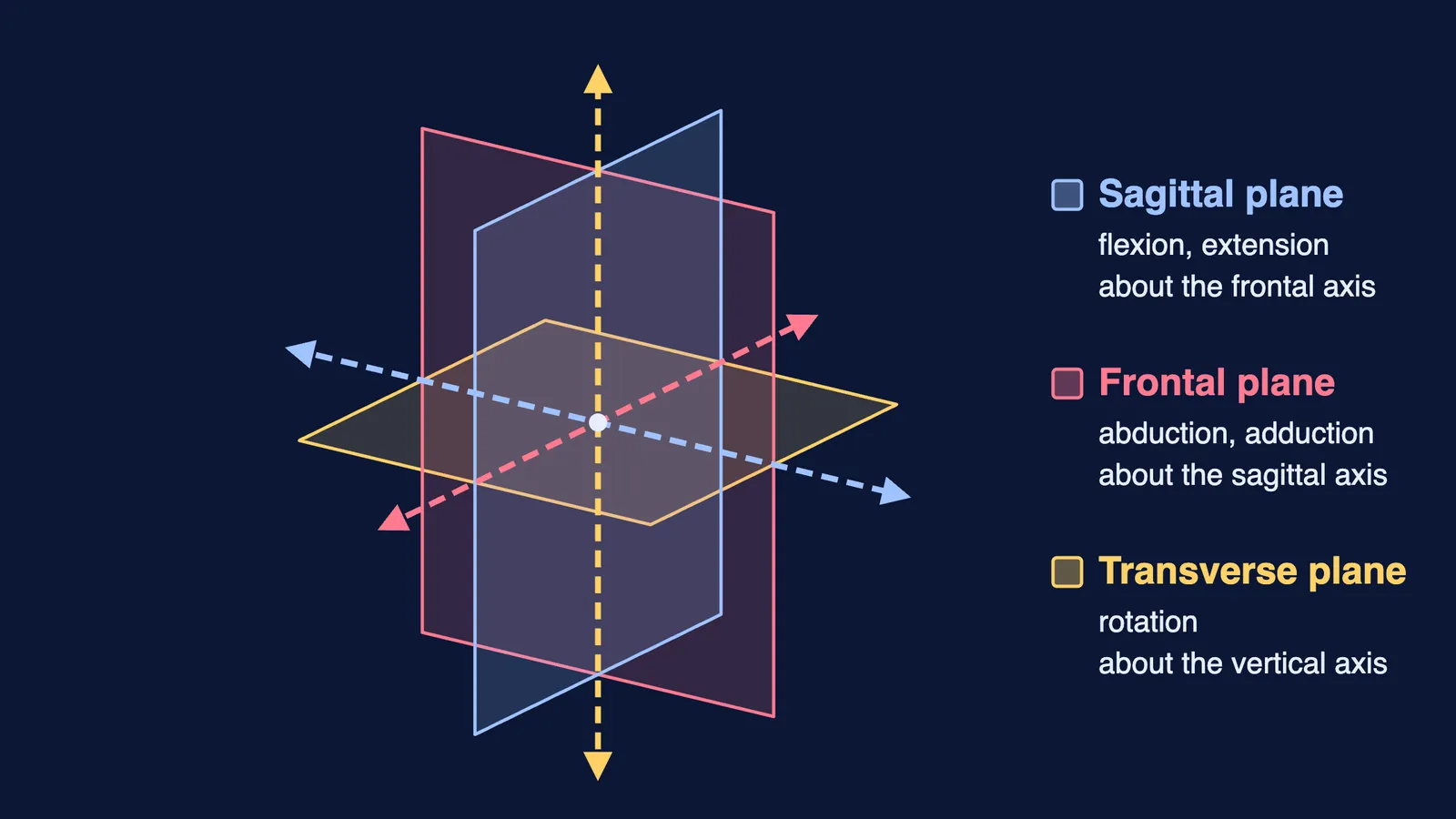
Each plane pairs with the axis that pierces it at right angles:
Sagittal plane (left from right): flexion and extension, about the frontal (mediolateral) axis. A football kick, a squat.
Frontal or coronal plane (front from back): abduction and adduction, about the sagittal (anteroposterior) axis. A jumping jack, a cartwheel.
Transverse or horizontal plane (upper from lower): rotation, about the vertical (longitudinal) axis. A discus turn, a skating spin.
Real skills use all three planes at once (the hip moves in all three when you walk), so name the dominant plane.
Where do levers fit in?
The Class 11 unit only notes that bones act as levers; types of levers are in Class 12 Unit 8, "Biomechanics and Sports". A preview, classed as in the Class XII textbook:
First order (fulcrum between effort and load): the triceps straightening the elbow, which is the fulcrum, with the forearm and ball as load.
Second order (load between fulcrum and effort): rising onto the toes, with the ball of the foot as fulcrum, body weight as load and the calf pulling at the heel.
Third order (effort between fulcrum and load): a biceps curl, with the elbow as fulcrum and the weight in the hand as load.
The full topic is in our Class 12 guide to biomechanics and sports.
How should you practise Unit 8?
Mark labels are our suggestion.
(1 mark) A gymnast performs a cartwheel. Name the plane and the axis.
(2 marks) Distinguish kinematics from kinetics using a badminton smash.
(3 marks) A bowler swings the arm in a full circle at the shoulder. Name the movement and the four movements it combines.
(4 marks) In a basketball jump shot, name the movement at the knees as the player rises, its plane and axis, and one principle of biomechanics the shot shows.
Answers: (1) frontal plane, sagittal axis. (2) Kinematics: racket path and speed; kinetics: the forces from legs, trunk and arm. (3) Circumduction: flexion, extension, abduction and adduction. (4) Extension, sagittal plane, frontal axis and, for example, optimal projection at the release.
Not sure where to start? Fermi's AI tutor works out what you already know and builds a plan for the session.