On this page
Biomechanics is where Class 12 Physical Education borrows from physics: the skill is spotting physics in a cricket stance, a sit-up or a shot put. Here is what the syllabus asks and a worked lever problem.
What is in the Biomechanics and Sports unit for Class 12?
In the CBSE Physical Education (048) curriculum for 2026-27, Unit 8 "Biomechanics and Sports" carries 10 of the 70 theory marks, the highest of any Class 12 unit. It is still in the syllabus, with five topics:
Newton's laws of motion and their application in sports
Types of levers and their application in sports
Equilibrium (dynamic and static) and centre of gravity
Friction and sports
Projectile in sports
The examples below come from Chapter 8 of the CBSE Physical Education Class XII textbook.
How do Newton's laws apply in sports?
First law (inertia): a body stays at rest or keeps moving at constant velocity unless an external force acts on it. A football on the penalty spot stays put until a foot moves it.
Second law (momentum): acceleration is proportional to the net force and inversely proportional to mass, so F = ma. The textbook's example is a 2 kg discus accelerated at 20 m/s², which needs a force of 40 N.
Third law (reaction): for every action there is an equal and opposite reaction. A diver pushes down on the springboard and the board pushes the diver up.
What are the three types of levers, with sports examples?
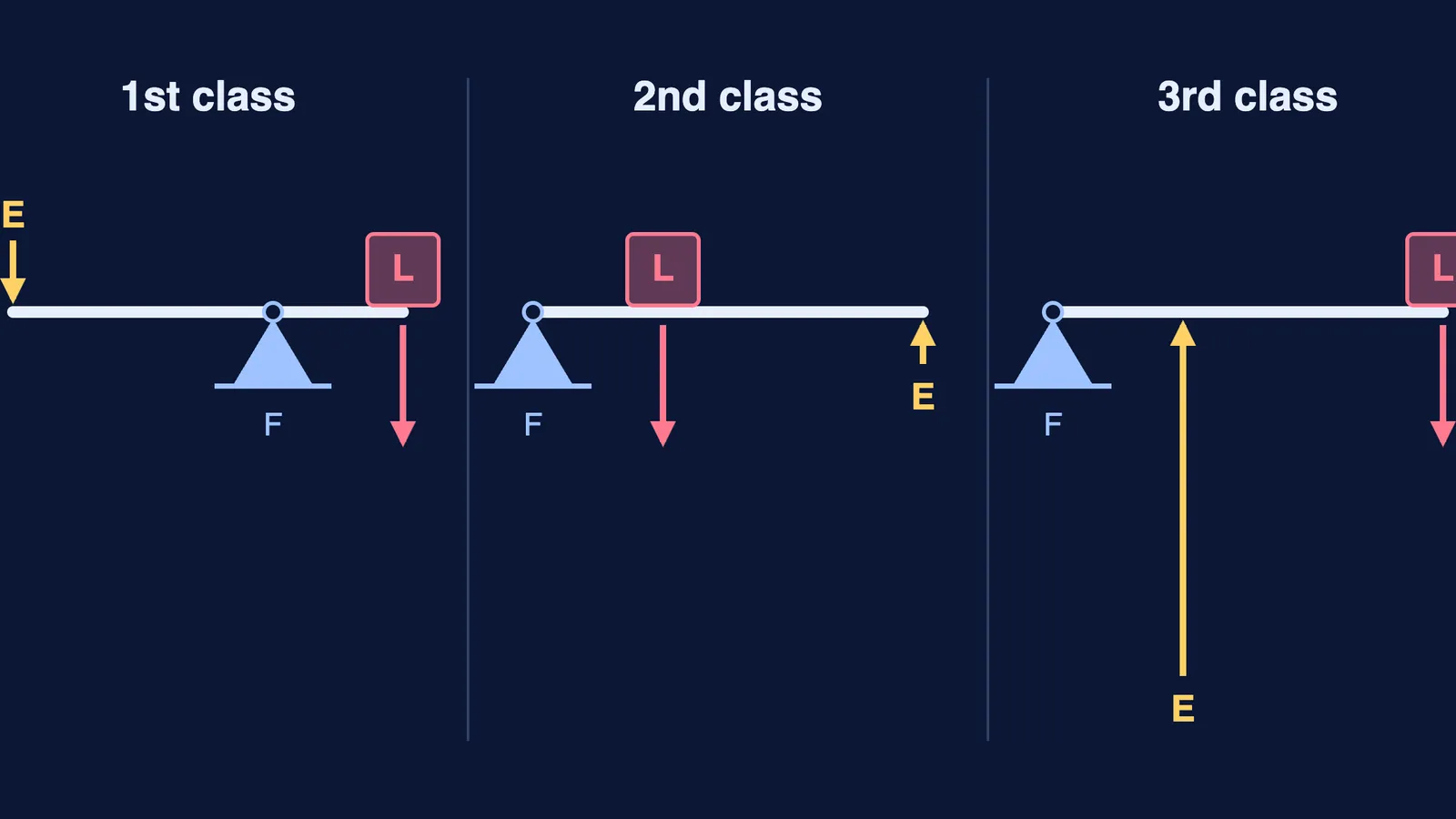
A lever has a fulcrum (pivot), an effort (force) and a load (resistance). The class depends on which part sits in the middle, as the Class XII textbook sets out.
First class, fulcrum in the middle: the triceps straightening the elbow in a throw, or nodding your head.
Second class, load in the middle: rising onto your toes, with the ball of the foot as fulcrum and the calf pulling at the heel. The effort arm is longer, so effort is less than the load.
Third class, effort in the middle: the biceps bending the elbow, or the quadriceps straightening the knee in a kick. The effort arm is shorter, so you need more force, but the load moves faster through a bigger range.
The textbook calls the third class the most common lever in the body.
Worked example: why a biceps curl is hard work
For balance, the torques must add to zero, so effort × effort arm = load × load arm. Take made-up but realistic numbers: the forearm is horizontal, the biceps pulls straight up 4 cm from the elbow and a 2 kg dumbbell sits 32 cm away (ignore the forearm's weight).
Load = 2 kg × 9.8 m/s² = 19.6 N.
Effort × 4 cm = 19.6 N × 32 cm.
Effort = 156.8 N, eight times the load.
The muscle pulls far harder than the weight, but the hand moves eight times as far, and as fast, as the point where the biceps pulls. For more practice, the Fermi Problem Library has worked problems with a step-by-step solver that explains the reasoning rather than printing an answer.
What is the difference between static and dynamic equilibrium?
Static equilibrium is balance at rest: vertical forces, horizontal forces and torques all add to zero, as the CBSE textbook puts it, like a sprinter set on the blocks. Dynamic equilibrium is balance while moving at constant speed and direction, like a cyclist riding.
The centre of gravity is the point where the body's whole weight can be taken to act. Stability rises when:
the base of support is wider (a wrestler's stance)
the centre of gravity is lower (bending the knees to stop)
the centre of gravity sits over the middle of the base (a gymnast raising an arm on the beam)
body weight is greater (a heavier player is harder to move, one reason judo and wrestling have weight categories)
Our post on the physics of kabaddi applies these ideas to a raid.
How does friction help or hurt in sports?
Friction is a force that opposes motion between two surfaces in contact. The Class XII textbook lists static friction, kinetic friction (sliding, as in skating, and rolling, as in a hockey ball slowing on turf) and fluid friction from air and water.
Spikes and racket grips add friction; ball bearings and streamlined helmets cut it. The same trade-off appears in how bicycle brakes use levers and friction.
Projectiles finish the unit: once released, the only force on a javelin or a long jumper is gravity (ignoring air resistance) and follows a parabolic path. The Fermi Simulation Lab has interactive simulations for ideas like this.
A 15-minute revision plan
Write the three laws, each with one sport example.
Draw the three lever classes, label F, E and L, with one body example each.
Redo the biceps example with a 5 kg dumbbell.
List four factors that increase stability.
Name three types of friction with a sport for each.
Then move on to Unit 10 with our guide to training in sports for strength, endurance and speed.