

On this page
Watch a kabaddi defender before a tackle and you will see a textbook stance: knees bent, feet wide, hips low. That is more than style; it follows from the stability condition in rotational mechanics. Here are four Class 11 ideas, centre of mass, friction, impulse and torque, worked through one kabaddi raid.
Why do kabaddi defenders crouch low?
A body that is tipped slightly returns to rest as long as its centre of gravity stays over its base of support, and it rolls over once the centre of gravity moves outside that base, as OpenStax University Physics explains in its section on static equilibrium.
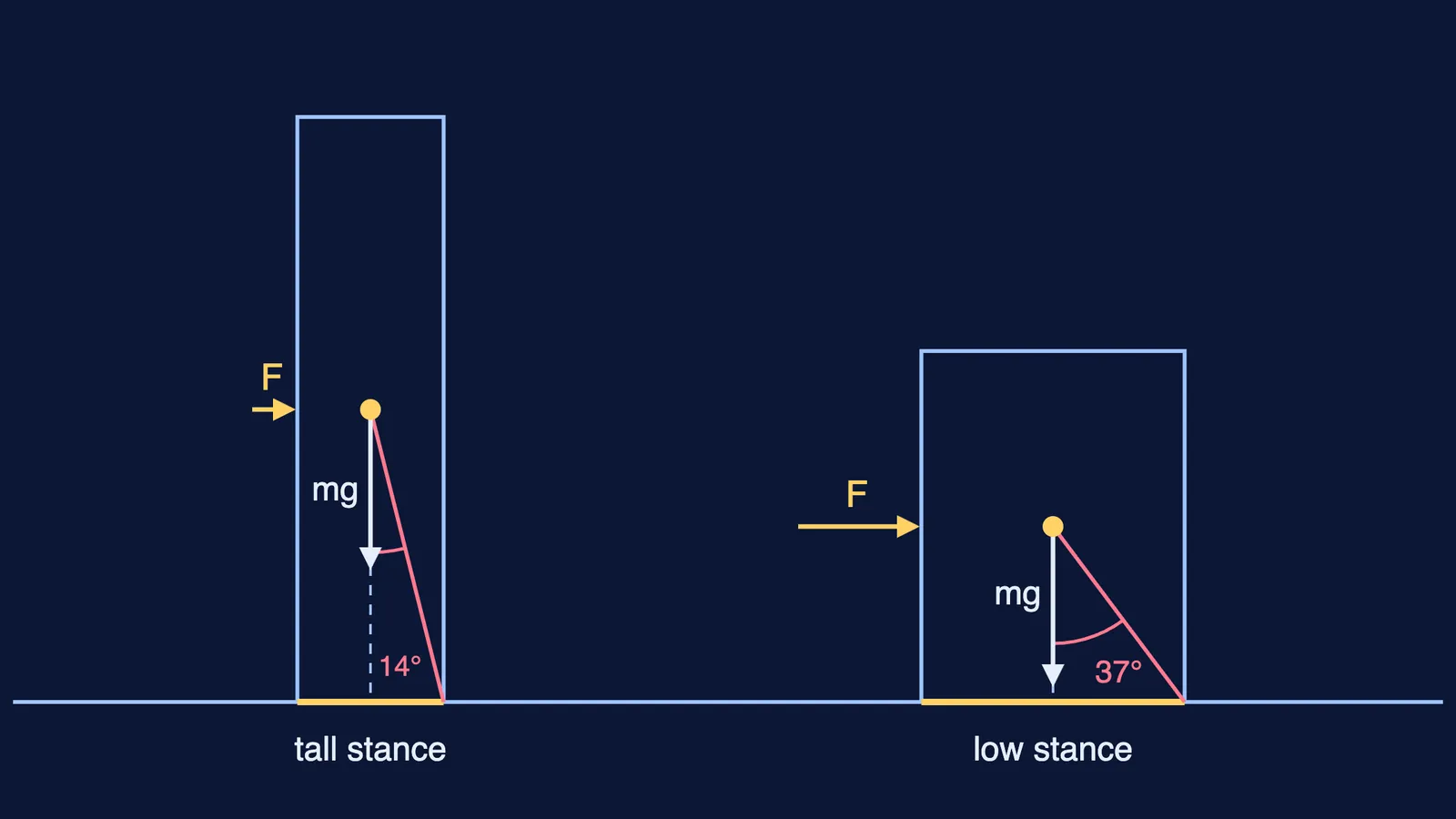
Model the defender as a block. Call the height of the centre of mass h and the horizontal distance from it to the edge of the feet b. Push horizontally at the height of the centre of mass (roughly the hips) with force F, and the defender starts to tip about the far edge of the feet when the turning effect of F beats the turning effect of the weight:
tipping starts when F times h is greater than mg times b, so F must exceed mg b / h;
a crouch lowers h and a wide stance raises b, so both raise the push needed.
A worked example: take a 70 kg defender, so mg is about 686 N (with g = 9.8 m/s squared).
Tall stance: h = 1.0 m, b = 0.25 m. Tipping force = 686 x 0.25 / 1.0, about 172 N.
Low stance: h = 0.6 m, b = 0.45 m. Tipping force = 686 x 0.45 / 0.6, about 515 N.
The low stance needs three times the push to topple. The numbers are illustrative, not measured on players; the ratio is the point.
How does friction on the mat decide a tackle?
If the push does not tip the defender, it can still slide them. Friction opposes relative motion between surfaces in contact, and static friction can grow only up to a maximum of the coefficient of static friction times the normal force, as the OpenStax chapter on friction defines it. The same chapter lists a static coefficient of 0.9 for shoes on wood.
A kabaddi court is either sand or 40- to 50-mm foam mats, and the game is played barefoot or in soft-soled shoes, according to a 2025 review of kabaddi injuries in Annals of Joint. We found no published coefficient for feet on a kabaddi mat, so treat 0.9 as a stand-in.
For our 70 kg defender, the most grip static friction can supply is about 0.9 x 686, roughly 617 N. The tall defender tips at 172 N, long before the feet slip; the low defender holds to about 515 N, close to the sliding limit.
Related: which way friction acts on car wheels when accelerating and whether the coefficient of friction can be greater than 1.
What does impulse have to do with a kabaddi tackle?
Impulse is force multiplied by the time over which it acts, and the impulse applied to a body equals its change in momentum, according to OpenStax on impulse and collisions. Its airbag example makes the key point: the change in momentum is the same either way, but the force is very different.
Say a 70 kg raider runs at 3 m/s (an illustrative speed). Stopping them takes a total impulse of 70 x 3 = 210 kg m/s, however it is delivered. Stop them in 0.1 s and the average force is 2100 N; spread it over 0.4 s with a chain of defenders and it falls to about 525 N. Change in momentum from force and time has more worked examples.
Why is an ankle hold so effective, and so risky?
Torque is force multiplied by the perpendicular distance from the pivot to the line of the force, as OpenStax defines it. Grab a raider's leg 0.45 m from the hip and pull with 200 N at right angles to the leg, and the torque about the hip is 90 N m. Grab the ankle, about 0.9 m away (illustrative lengths), and the same pull gives 180 N m. Twice the lever arm gives twice the turning effect.
The ankle itself pays for that longer lever arm. The Annals of Joint review reports that ankle sprains occur during the tackle, particularly when a defender grapples the ankle as the raider tries a kick, and that sudden twisting forces around the ankle make it prone to injury. A survey of 80 national-level male players, published in 2020 in the Journal of Clinical and Diagnostic Research, found the knee was the most injured lower-limb site at 21.25%, followed by the ankle at 13.75%.
How to use kabaddi to study mechanics
Next time you watch a match, pause on one tackle and do this:
Mark the defender's centre of mass and feet; estimate h and b.
Write the tipping force mg b / h and the sliding force with the stand-in coefficient of 0.9.
Estimate the raider's speed and the tackle time; find the average force.
Pick the grip point and compute the torque about the raider's hip.
To check your working, the Fermi Problem Library has worked problems with a step-by-step solver that explains the reasoning. If you are unsure where to start, Fermi's AI tutor works out what you already know and builds a plan for the session.


