
On this page
The push that speeds a car up comes from the road, not the engine. The engine only turns the wheels; static friction between tyre and road does the pushing.
Which way does friction act on a car's drive wheels?
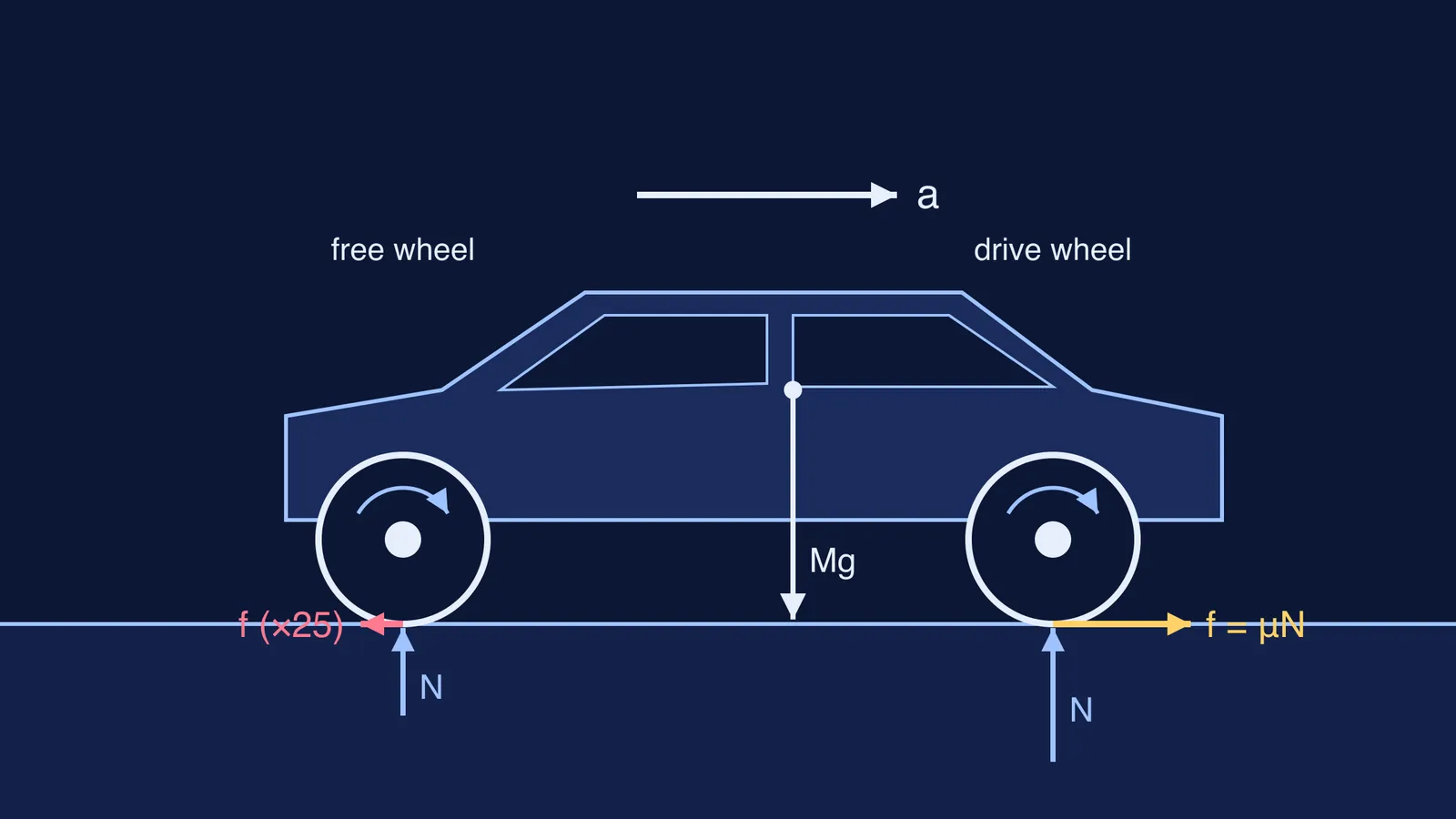
Picture the front wheel of a front-wheel-drive car. The engine applies a torque that tries to spin the wheel, so the bottom of the tyre tries to slide backward over the road. Friction opposes that attempted sliding, so it pushes the tyre forward.
Because the tyre rolls without slipping, its contact patch is momentarily at rest on the road, so the friction is static. Static friction is the friction between two surfaces that are not moving relative to each other, and it can take any value up to a maximum: f ≤ μs N (OpenStax University Physics, section 6.2).
Why does friction act backward on the free wheels?
The rear wheels of a front-wheel-drive car get no engine torque, yet they must spin faster as the car speeds up. Ignoring bearing friction, only the road can supply that torque, and a backward force at the bottom of the tyre is what spins the wheel faster in its rolling direction. So on the free wheels, friction points backward. For a wheel of moment of inertia I and radius R, its size is f = Ia/R², which is small: for a uniform disc of mass m it is ½ma.
J. Güémez and M. Fiolhais make the same point in a 2013 paper in the European Journal of Physics: for a front-wheel-drive car that is speeding up, friction acts forward on the front wheels and in the opposite direction on the rear wheels (free arXiv version).
If a wheel is actually skidding, the logic is the same but the friction is kinetic; we work through those cases in which way friction acts when a rolling body slips.
How fast can friction let a car accelerate?
A worked example for a front-wheel-drive car:
Mass M = 1200 kg, with 60% of its weight on the front (drive) wheels.
Rubber on dry concrete has μs = 1.0, and on wet concrete 0.5 to 0.7 (OpenStax Table 6.1).
Each rear wheel has mass 15 kg and is treated as a uniform disc. Take g = 9.8 m/s².
Ignore air drag, and assume the weight distribution stays fixed.
Normal force on the drive wheels: N = 0.6 × 1200 × 9.8 = 7056 N.
Largest forward friction: f(max) = μs N = 1.0 × 7056 = 7056 N.
Backward friction on the two free wheels: 2 × ½ × 15 × a = 15a newtons.
Newton's second law for the whole car: 1200a = 7056 − 15a, so a = 7056 ÷ 1215 ≈ 5.8 m/s².
Time from 0 to 100 km/h (27.8 m/s): t = 27.8 ÷ 5.8 ≈ 4.8 s. In this model, no engine can do better without spinning the wheels.
On wet concrete with μs = 0.5: a = 3528 ÷ 1215 ≈ 2.9 m/s², so 0 to 100 km/h takes at least about 9.6 s.
The free wheels pull back with only about 87 N in total, roughly 1% of the drive force, which is why textbook problems often ignore them.
What changes for rear-wheel drive, all-wheel drive and braking?
Rear-wheel drive: swap the roles. Friction is forward on the rear wheels and backward on the front.
All-wheel drive: every wheel can push forward, so N becomes the full weight and the limit becomes a = μs g, about 9.8 m/s² on dry concrete (μs = 1.0, OpenStax Table 6.1) in this simple model.
Braking: the contact points would slide forward, so friction points backward on every braked wheel. See finding the coefficient of friction from stopping distance.
Weight shift: a car speeding up presses its rear tyres harder and lightens the front. That helps rear-wheel drive and hurts front-wheel drive, so our 5.8 m/s² is an upper estimate.
On a car rolling without slipping, static friction does no work in the ground frame because the contact point does not move; the energy comes from the engine. For set-ups where it does work, see whether static friction can do work.
How do you get friction direction right in exam problems?
Mark which wheels get a torque (engine or brakes) and which turn freely.
For each wheel, ask which way the contact point would slip on ice.
Draw friction opposite that, and write f ≤ μs N, not f = μs N, unless the wheels are on the verge of slipping.
Write F = Ma for the car and τ = Iα for any wheel whose inertia is given.
Check: the acceleration cannot exceed μs g.
If step 2 trips you up, the Fermi Problem Library has worked problems with a step-by-step solver that explains the reasoning rather than printing an answer. If a rolling wheel's contact point is hard to picture, the Fermi Simulation Lab has interactive simulations for ideas that are easier to see than to read.