On this page
Before a ship hull, pipeline or pressure vessel goes into service, someone has usually broken a small piece of its steel on purpose. The tool for that job is a heavy swinging hammer, and it carries the name of a French engineer born more than 160 years ago.
Who was Georges Charpy?
Georges Charpy was born on 1 September 1865 in Oullins, France, and studied at the École Polytechnique from 1885 to 1887, according to his Wikipedia biography. He taught at the École Monge, published a physics thesis in 1892, became professor of metallurgy at the École des Mines in Paris in 1920, and professor of general chemistry at the École Polytechnique in 1922. He died in Paris in 1945.
How did the Charpy impact test begin?
In 1896 the American engineer S. B. Russell devised a pendulum fracture test, and in 1901 Charpy proposed a standardised method with a redesigned pendulum and a notched specimen with precise specifications (Charpy impact test, Wikipedia). Charpy also established that using a notch was important in making the measurement more accurate and more reproducible (ZwickRoell).
The notch is the clever part. Real parts tend to break at a scratch, a weld flaw or a sharp corner, where stress concentrates. A notch builds that weak spot into every sample, so results from different labs can be compared.
The test's hundredth birthday was marked in 2000 by the ASTM volume *Pendulum Impact Testing: A Century of Progress*, which reprints the landmark papers by Russell and Charpy (ASTM STP 1380).
How does the Charpy pendulum measure energy?
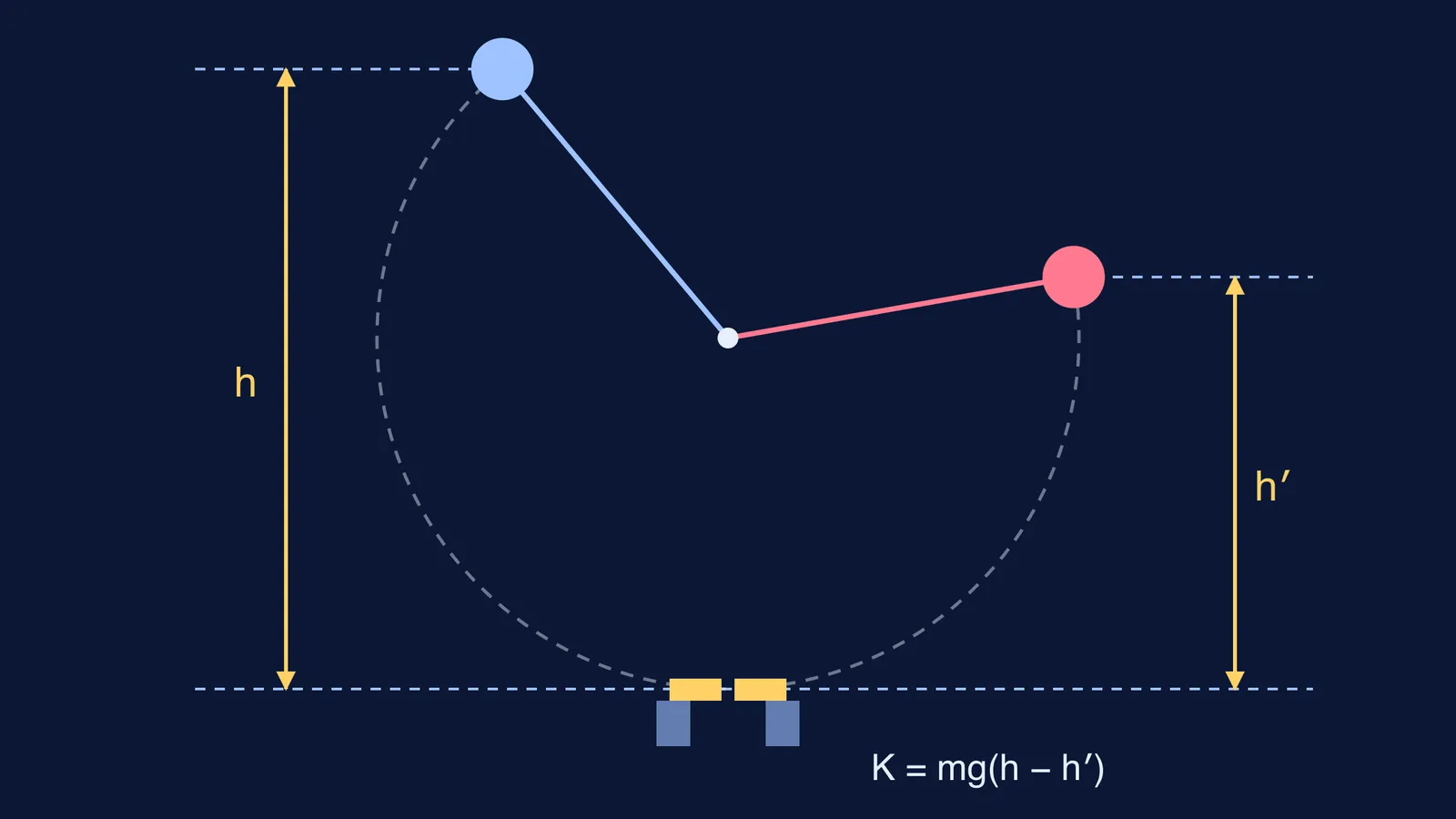
The standard specimen is a 10 mm × 10 mm × 55 mm bar with a 2 mm deep V-notch cut at 45 degrees (Wikipedia). The bar rests on supports at both ends, and the pendulum strikes the face opposite the notch. A pendulum of known mass is lifted to height h and released; it breaks the bar and swings up the other side to a lower height h′.
Neglecting friction, the energy absorbed is K = mg(h − h′), the pendulum's loss of potential energy (Wikipedia).
Here is a worked example, with numbers chosen for practice rather than taken from a real machine. Take a 20 kg pendulum on a 0.8 m arm, released at 140° from the hanging position. After breaking the bar, it rises to 100° on the far side. Ignore friction and air drag.
Height from angle: h = L(1 − cos θ), measured from the lowest point of the swing.
Start: h = 0.8 × (1 − cos 140°) = 0.8 × 1.766 = 1.413 m.
Finish: h′ = 0.8 × (1 − cos 100°) = 0.8 × 1.174 = 0.939 m.
Energy absorbed: K = 20 × 9.81 × (1.413 − 0.939) = 196.2 × 0.474 ≈ 93 J.
Why does temperature change a Charpy result?
Many steels are tough when warm and brittle when cold. Testing at a series of temperatures reveals the ductile-brittle transition, the temperature range where the Charpy energy changes sharply (Wikipedia). The ASTM E23 standard says impact results on notched specimens, when correlated with service experience, have been found to predict the likelihood of brittle fracture accurately; it does not address testing below −196 °C (ASTM E23).
World War II made the lesson painful. Many Liberty cargo ships sent into the cold Atlantic sank unexpectedly, because tensile strength tests did not account for defects inside the steel (NIST). A 1948 National Bureau of Standards report found that plates where cracks had stopped had consistently higher Charpy energies than plates where cracks began, a pattern tensile properties did not show (Wikipedia).
A Charpy test has even been run on steel recovered from the Titanic, which sailed through water just below freezing (University of Illinois MechSE). Impact tests at the University of Missouri-Rolla found the steel was about 10 times more brittle than modern steel at freezing temperature, though it was the best available at the time (Newswise). H. P. Leighly, professor emeritus of metallurgical engineering there, said steel was not the only cause: "It's easy to point a finger and say, 'Bad steel.' But it's uncomfortable to point at yourself and say, 'Bad design.'"
How do you read a Charpy number?
A Charpy result is a number in joules that only means something in context. When you see one, ask:
At what temperature was it tested? The same steel can give very different energies warm and cold.
Which specimen and notch were used? Only compare results from the same geometry.
What did the broken faces look like? A ductile break is jagged; a brittle one is flat and smooth (Wikipedia).
If step 4 of the worked example felt shaky, the Fermi Problem Library has worked problems with a step-by-step solver that explains the reasoning rather than printing an answer. The Fermi Simulation Lab has interactive simulations for ideas that are easier to see than to read.
Next time you see a ship or a bridge, remember the pendulum and the notched bar that helped clear its steel.