On this page
Every time a plane takes off from Delhi or Bengaluru, its engines run a thermodynamic cycle named after a mechanical engineer from Rhode Island who never saw a jet. His idea, burning fuel at steady pressure instead of in a bang, outlived his machines.
Who was George Brayton?
George Bailey Brayton was born on 3 October 1830 in Rhode Island and died on 17 December 1892, according to his Wikipedia biography. Old Machine Press records that he died in 1892, aged 62, while travelling in England.
His key patent, US 125,166 for an "Improvement in Gas-Engines", was granted on 2 April 1872 to "George B. Brayton, of Boston" (Google Patents).
What was Brayton's Ready Motor?
Brayton sold his engine as the "Ready Motor" because it was immediately ready for operation, unlike a steam engine (Old Machine Press). It split the job into separate parts:
a pump that compressed air and fuel gas into a reservoir
the reservoir, which held the mixture under pressure
a working cylinder, where the mixture was lit by a constant pilot flame as it flowed in, pushing the piston
The patent states the difference plainly: the burning charge "exerts not a spasmodic or explosive force upon the piston, but a true pressure due to expansion" (US patent 125,166).
According to Old Machine Press, the compressor pushed the mixture to about 65 psi, a 10-horsepower Brayton engine was shown at the 1876 Centennial Exposition in Philadelphia, and John Holland's submarine the Fenian Ram, launched in 1881, used a 15-horsepower Brayton engine.
Why did Otto's engine win the car instead?
The same source says that by the late 1880s, Nicolaus Otto's four-stroke engine, which burns its charge at roughly constant volume, had outclassed Brayton's design on efficiency; Brayton's engine lost energy to friction, pumping and heat losses between its separate compression and combustion cylinders (Old Machine Press). For Otto's side, see our piece on Nicolaus Otto and the four-stroke engine.
Brayton's engine even ended up in court. George Selden filed a patent on 8 May 1879 for a car built around an improved Brayton engine, and it was granted on 5 November 1895 as US 549,160. In January 1911, Henry Ford won his appeal by arguing that cars ran on Otto's engine, not Brayton's (Wikipedia: George B. Selden).
What is the Brayton cycle?
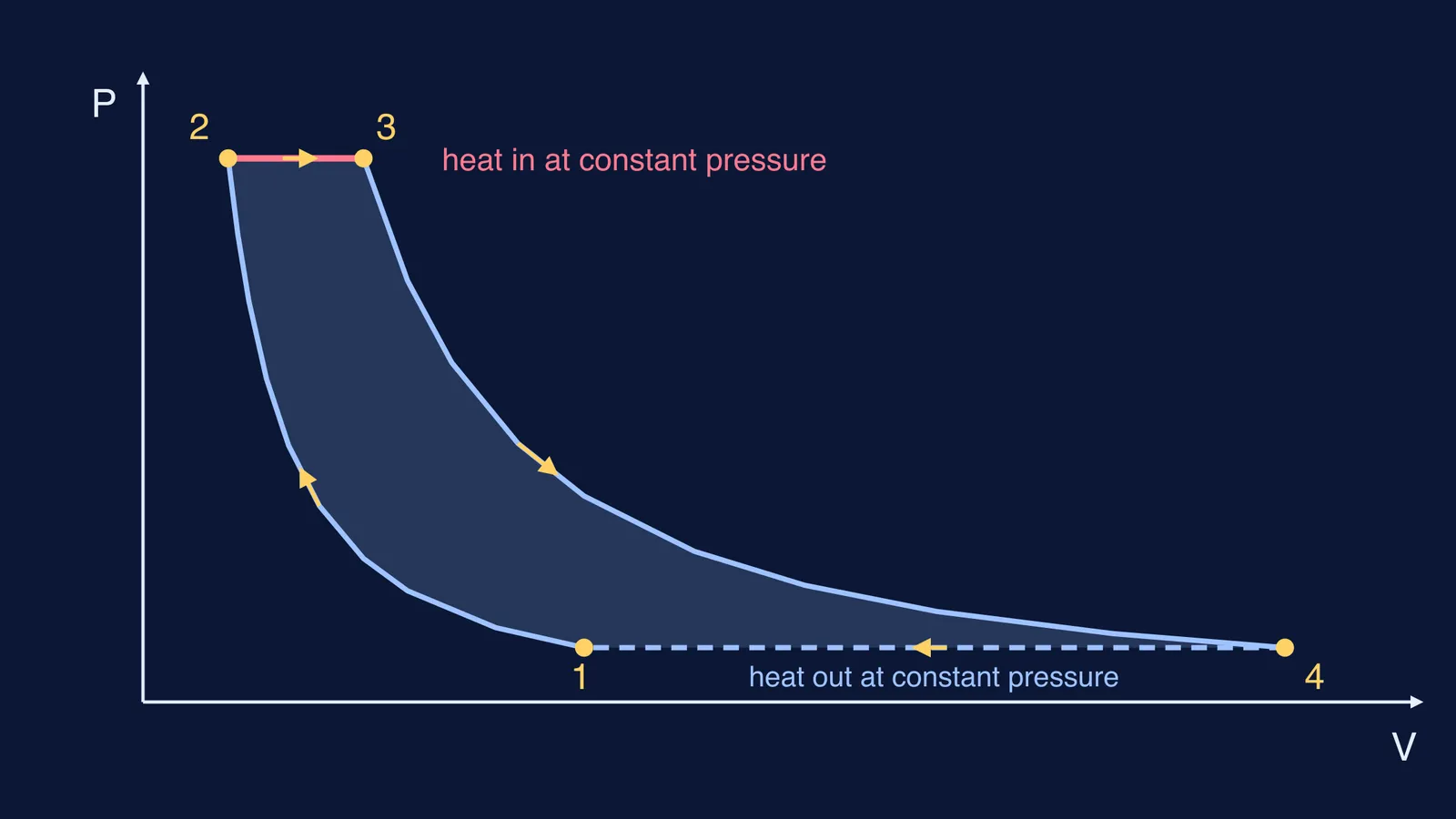
The Brayton cycle, also called the Joule cycle, is the thermodynamic cycle of heat engines that use air or another gas as their working fluid. Its ideal form has four steps (Wikipedia: Brayton cycle):
Adiabatic (isentropic) compression: the compressor squeezes the air.
Heat added at constant pressure: fuel burns in the combustor.
Adiabatic expansion: hot gas spins the turbine.
Heat rejected at constant pressure: exhaust cools in the atmosphere.
NASA's Glenn Research Center states that the Brayton cycle "is used in all gas turbine engines" (NASA Glenn). Brayton was not the first to propose it: Englishman John Barber patented an engine using the cycle in 1791 (Wikipedia: Brayton cycle). Brayton built it with pistons; turbines later took their place, as in Frank Whittle's jet engine.
How efficient is the Brayton cycle?
MIT's thermodynamics notes give the ideal efficiency as η = 1 - 1/PR^((γ-1)/γ), where PR is the compressor pressure ratio, or equivalently η = 1 - T1/T2, the inlet temperature over the compressor exit temperature (MIT Unified Engineering notes). For air, take γ = 1.4, so the exponent is 0.4/1.4 = 0.2857.
PR = 4: 4^0.2857 = 1.486, so η = 1 - 1/1.486 = 0.33, about 33%.
PR = 10: 10^0.2857 = 1.931, so η = 1 - 0.518 = 0.48, about 48%.
PR = 30: 30^0.2857 = 2.643, so η = 1 - 0.378 = 0.62, about 62%.
Check it with temperatures: at PR = 10, air entering at 300 K leaves the compressor at 300 × 1.931 = 579 K, and 1 - 300/579 = 0.48.
Notice that peak flame temperature does not appear in the ideal efficiency, only the pressure ratio. The MIT notes add the catch: chasing efficiency with very high pressure ratios gives little work per kilogram of air, so real engines are designed for a balance limited by how hot turbine blades can get. This is the same move as the compression ratio in the Otto cycle efficiency formula.
How do you picture the cycle?
Draw the four steps on a P-V diagram: two steep adiabatic curves joined by two flat lines, one high (heat in) and one low (heat out). The enclosed area is the net work per cycle. If the curves feel abstract, the Fermi Simulation Lab has interactive simulations for ideas that are easier to see than to read, and the Fermi Problem Library has worked problems with a step-by-step solver that explains the reasoning rather than printing an answer.
Next time you hear a jet spool up, you are hearing step one of Brayton's cycle: the compressor.