

On this page
Every jet aircraft you have flown in works on a short sentence from Class 11 physics: force equals the rate of change of momentum. Frank Whittle, a young Royal Air Force officer, saw how to turn that sentence into an engine that could fly faster and higher than propellers allowed. This post sets out what he did, using his patent, the Royal Society's memoir and IEEE and BBC history pages, works through the thrust calculation, and ends with what you can borrow from his way of working.
Who was Frank Whittle?
The Royal Society's biographical memoir by G. B. R. Feilden and W. Hawthorne gives his dates as 1 June 1907 to 9 August 1996. The BBC's archived History profile says he was born in Coventry, the son of a mechanic. His first attempts to join the RAF failed because of his lack of height; on his third attempt he was accepted as an apprentice in 1923, and he qualified as a pilot officer in 1928.
As a cadet he wrote a thesis arguing that aircraft would need to fly high, where air resistance is much lower, to reach long ranges and high speeds. The BBC notes that he thought piston engines and propellers were unsuitable, and that jet propulsion was not yet part of his thinking.
What did his 1930 patent describe?
By October 1929 he was considering a fan enclosed in the fuselage to drive a fast flow of air, powered by a gas turbine. When the Air Ministry turned him down, the BBC records, he patented it himself. His British patent GB347206, "Improvements relating to the propulsion of aircraft and other vehicles", was filed on 16 January 1930 and published on 16 April 1931. Its abstract describes an apparatus "in which air is taken in, compressed, heated, and expelled with high velocity", in which "the compressor is driven by a turbine".
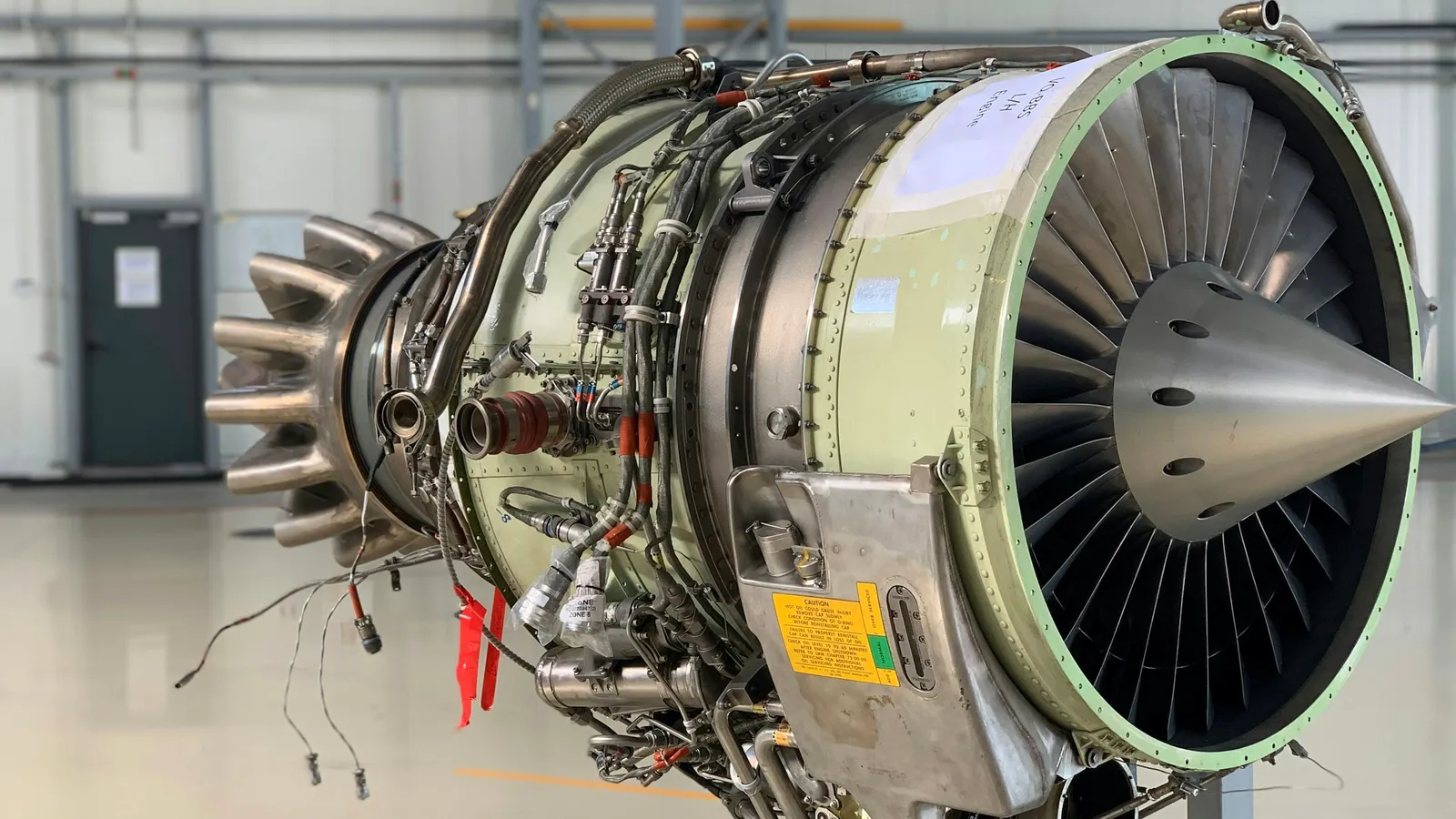
That is the turbojet in one line. The turbine takes some energy from the hot gas to drive the compressor, and the rest of the gas leaves through the nozzle as a fast jet.
How did the engine get from paper to flight?
The BBC profile says Power Jets Ltd was formed in 1935 and began building a test engine in July 1936. The IEEE's Engineering and Technology History Wiki page on the jet engine says Whittle could demonstrate it in the laboratory by 1937. Funding stayed difficult until 1940, and the first flight, in the Gloster E.28/39, was on 15 May 1941. ETHW also notes that Hans von Ohain in Germany reached the same idea independently, and his He 178 flew first, in 1939.
The engineering gap was large. A 1998 paper by Cyrus Meher-Homji, The Development of the Whittle Turbojet, says Whittle had to push centrifugal compressor pressure ratios from the prevailing 2.5:1 to 4:1, and compressor efficiencies from 65 to 80 percent, while burning fuel at about 10 times the combustion intensity of boilers of the time.
How does a jet engine produce thrust?
The NCERT Class 11 chapter Laws of Motion (2026-27 reprint) states the second law as: "The rate of change of momentum of a body is directly proportional to the applied force and takes place in the direction in which the force acts."
Apply it to the air passing through the engine. If a mass ṁ of air flows through each second, entering at speed v(in) and leaving at speed v(out), the engine changes the air's momentum by ṁ(v(out) − v(in)) every second. That is the force the engine exerts on the air. By the third law, the air pushes the engine forward with the same force:
F = ṁ(v(out) − v(in))
Worked example with sample numbers for a small engine (not Whittle's actual figures). We ignore the mass of fuel added and any pressure difference at the nozzle, as textbook problems usually do.
Air flow ṁ = 20 kg/s, flight speed v(in) = 200 m/s, jet speed v(out) = 550 m/s.
Change in speed = 550 − 200 = 350 m/s.
Thrust F = 20 × 350 = 7,000 N.
On the runway, v(in) = 0, so F = 20 × 550 = 11,000 N.
The same engine gives less thrust in flight than standing still, because the air already arrives moving.
What mistakes do students make with thrust problems?
Using only the exit speed. In flight the air enters at the aircraft's speed. Thrust depends on the change in speed.
Mixing up the force pair. The engine pushes the air backwards; the air pushes the engine forwards. They act on different bodies.
Treating a jet like a rocket. A rocket carries its own oxidiser, so all its exhaust starts at rest relative to it. A jet engine takes in air. Our post on variable mass and rocket thrust covers the rocket case.
If you know the formula but keep setting up momentum problems wrongly, the Fermi Problem Library has worked problems with a step-by-step solver that explains the reasoning rather than printing an answer.
What can a student take from Whittle's way of working?
Start from the requirement. His cadet thesis asked what high, fast flight would need, and only then looked for an engine. Read what a question needs before choosing a formula.
Keep going after a no. The Air Ministry declined his idea, so he patented it himself.
Rebuild when a test is unclear. The BBC notes his first test engine proved inconclusive and he decided it needed a complete rebuild.
Set numbers to beat. A 4:1 pressure ratio was a target he could measure progress against.
Try it now: an engine takes in 50 kg of air per second at 250 m/s and expels it at 600 m/s. Find the thrust.


