On this page
You were probably taught that friction opposes motion. On a ball that rolls and slips at the same time, that rule can mislead you. What matters is which way the contact point slides.
Which way does friction act when a rolling body slips?
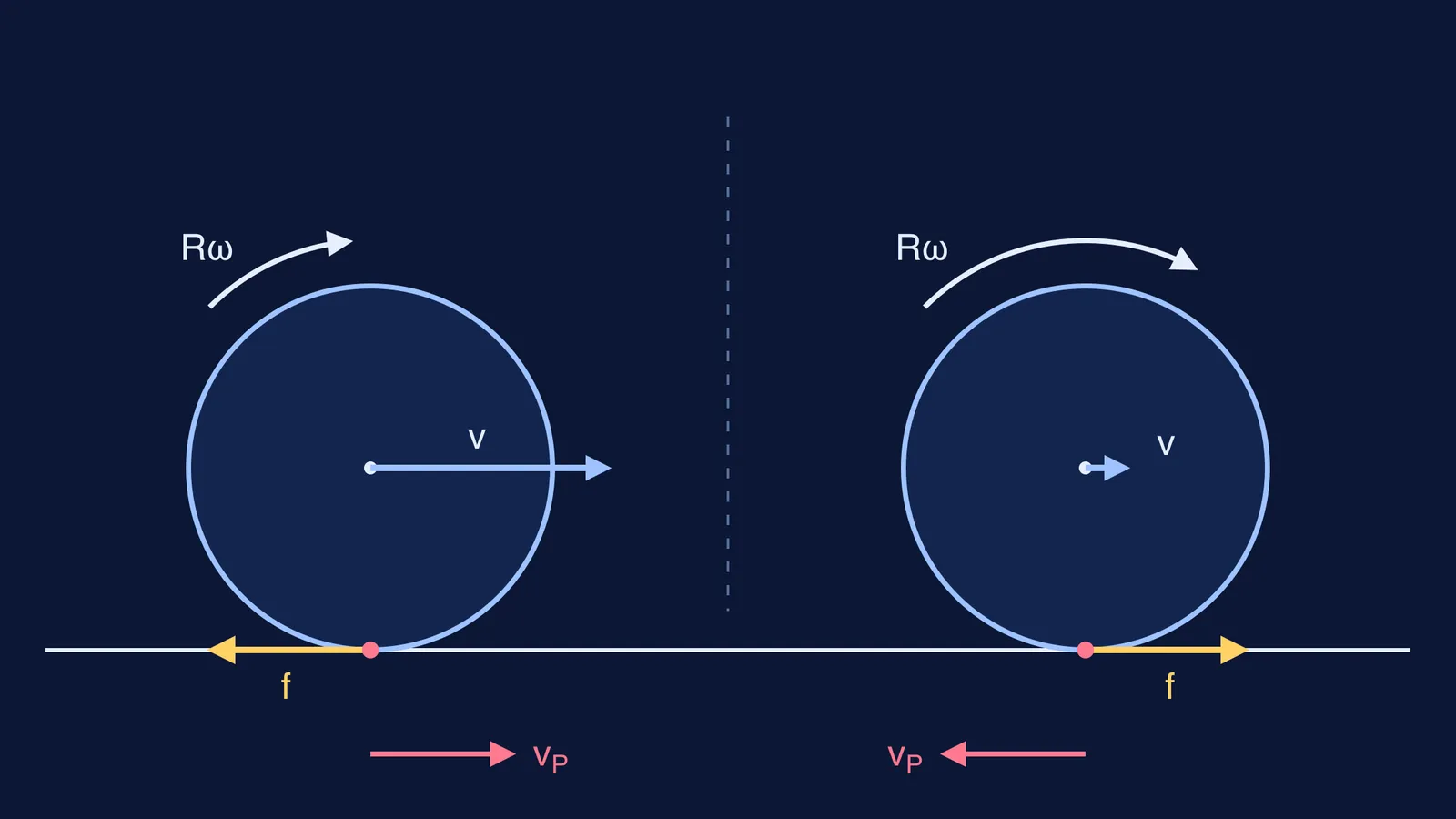
Kinetic friction acts opposite to the velocity of the contact point relative to the surface. For a ball or cylinder whose centre moves forward at speed v while it turns forward at angular speed ω, the bottom point moves at v_P = v − Rω.
The bottom point carries the centre's velocity v forward and the rotation's Rω backward. When the two cancel, the body rolls without slipping. OpenStax University Physics, section 11.1 defines that case by v_CM = Rω, with the contact point at rest on the surface. Otherwise the contact point slips, and you use kinetic friction, f = μ_k N.
That leaves three cases:
v > Rω (sliding too fast, spinning too slowly): the contact point slides forward, so friction acts backward. It slows the centre and speeds up the spin.
v < Rω (spinning too fast): the contact point slides backward, so friction acts forward. It speeds up the centre and slows the spin.
v = Rω: nothing slides, so there is no kinetic friction. On level ground with no other push, friction is zero; see why pure rolling at constant speed needs no friction.
In both slipping cases, friction pushes v and Rω together until they match, and the sliding stops. Timon Idema's TU Delft textbook shows that a body starting to slide without spin ends up rolling at v_0/(1 + I/mR²), a speed independent of the friction coefficient, while the time taken scales as 1/μ_k (Idema, Mechanics and Relativity, section 5.8/5%3A_Rotational_Motion%2C_Torque_and_Angular_Momentum/5.8%3A_Rolling_and_Slipping_Motion)).
What happens to a bowling ball released without spin?
MIT's Down the Alley problem uses a 6.0 kg solid sphere, 22 cm across, released sliding at 2.8 m/s with no rotation on a lane where μ_k = 0.10. Its solution shows the ball ends up rolling at 5/7 of the release speed, which is 2.0 m/s (MIT RELATE, Down the Alley). Step by step, with g = 9.8 m/s²:
Contact point: v_P = 2.8 − 0 = 2.8 m/s forward. Friction acts backward, with f = μ_k mg.
Centre: a = −μ_k g = −0.98 m/s², so v = 2.8 − 0.98t.
Spin: the torque is fR = Iα, with I = (2/5)mR². That gives Rα = (5/2)μ_k g = 2.45 m/s², so Rω = 2.45t.
Sliding stops when 2.8 − 0.98t = 2.45t, which gives t = 2.8/3.43 ≈ 0.82 s.
At that moment v = Rω ≈ 2.0 m/s. Mass and radius cancel out.
Friction slowed the centre but sped up the spin.
What if the ball spins too fast?
Now set the same ball down with no forward speed, spinning forward so that Rω = 2.8 m/s, like a ball landing with heavy topspin. Idema's section 5.8/5%3A_Rotational_Motion%2C_Torque_and_Angular_Momentum/5.8%3A_Rolling_and_Slipping_Motion) notes that here friction slows the rotation until rolling begins.
Contact point: v_P = 0 − 2.8 = −2.8 m/s, so it slides backward. Friction acts forward.
Centre: v = 0.98t, so the ball speeds up.
Spin: Rω = 2.8 − 2.45t, so the spin slows down.
They match at t ≈ 0.82 s, when v ≈ 0.8 m/s forward. That is 2/7 of 2.8 m/s.
Here friction pushes the ball forward. To check, use angular momentum about a fixed point on the floor: friction has no torque about it, and the torques of gravity and the normal force cancel. So (2/5)mR(2.8) = (7/5)mRv, and v = 0.8 m/s again.
With backspin, the contact point slides forward even faster, so friction acts backward, slowing the centre and eating the backspin. By the same equations, if the backspin's Rω starts above 5/2 of the forward speed, the ball stops while still sliding and comes back towards you.
How do you find the friction direction in an exam problem?
Choose a forward direction. Give v a sign, and count ω as positive when it turns in the forward-rolling sense.
Work out v_P = v − Rω at the instant in the question.
If v_P is not zero, use kinetic friction of size μ_k N, pointing opposite to v_P.
If v_P = 0, friction is static, with unknown size and direction. Assume one, solve with a = Rα, and if f comes out negative, flip it. Check |f| ≤ μ_s N. A cylinder pulled at the top shows static friction pointing forward.
Once v = Rω, stop using μ_k mg and switch to the rolling equations, as in rolling without slipping on inclines.
To practise picking the right case, try the Fermi Problem Library: it has worked problems with a step-by-step solver that explains the reasoning rather than printing an answer. If the condition v = Rω itself still feels shaky, the Fermi Concept Library gives each physics concept its own lesson.
Next time you draw a friction arrow on a wheel, find the contact point first.