On this page
Most textbook problems use μ values like 0.2 or 0.5, so many students quietly turn a habit into a rule. Here is why the rule is wrong, which surfaces break it, and a two-minute test you can do at your desk with a book.
Can the coefficient of friction be greater than 1?
The coefficient of friction is a dimensionless number equal to the friction force divided by the force pressing the two surfaces together (Wikipedia: Friction). For static friction at its limit, that is f = μN.
So μ > 1 simply means the largest friction force the surfaces can supply is bigger than the normal force. No law forbids that. The same article says directly that the idea that μ is always below 1 is not true, and that rubber in contact with other surfaces can give coefficients from 1 to 2.
Why do students think μ must be less than 1?
Three common reasons:
Most textbook numericals use values well below 1, so 1 starts to feel like a ceiling.
μ gets mixed up with efficiency or probability, which really are capped at 1.
'Friction cannot be more than the normal force' sounds sensible, but no equation says it. The only rule is f ≤ μN, for whatever μ the two surfaces have.
A related trap: μN is the maximum static friction, not the friction acting at every moment. Our post on why static friction is not always equal to μsN works through that one.
What does μ greater than 1 look like? The tilted-book test
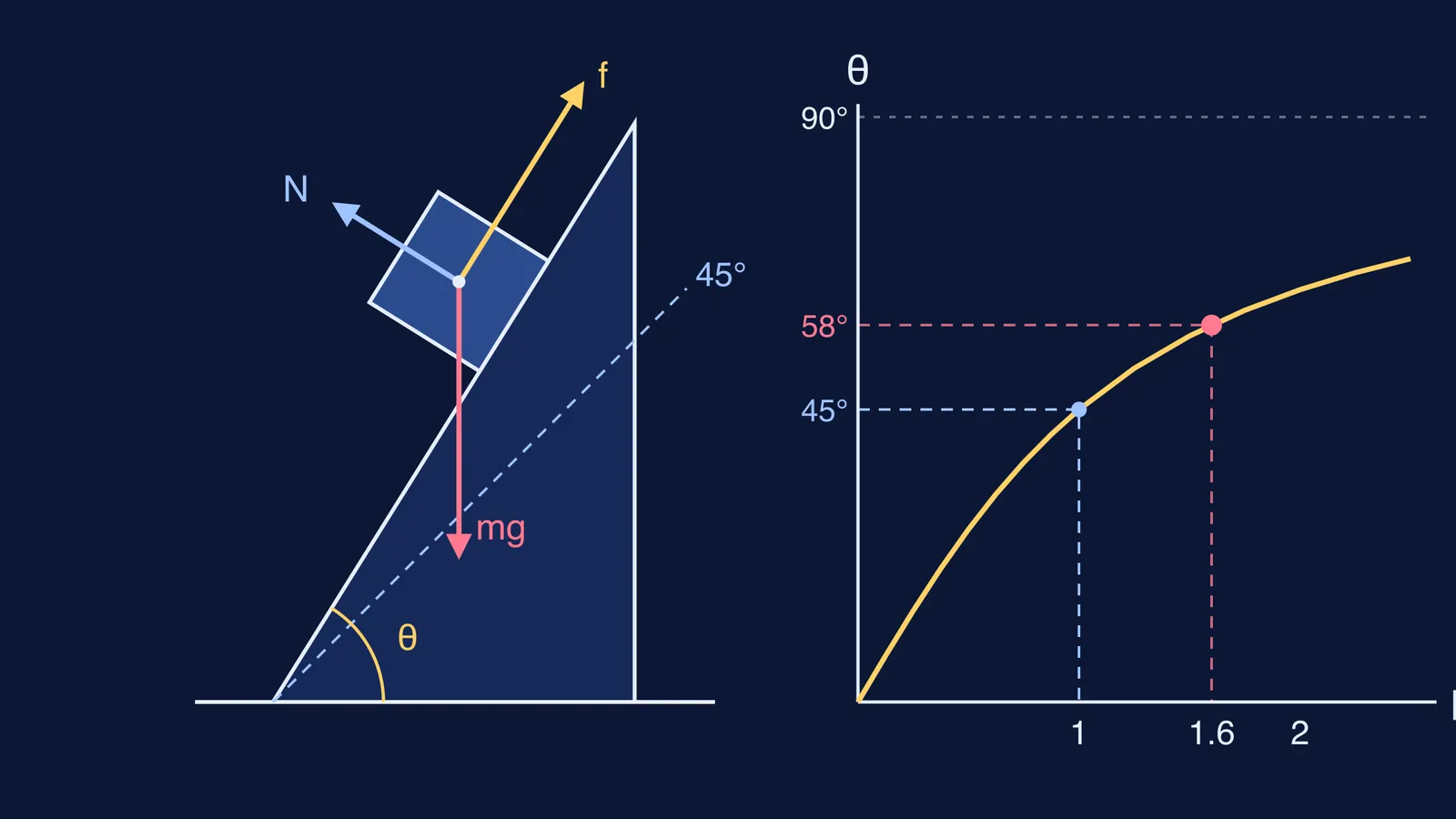
Put a small object on a book and slowly lift one end. At the instant it starts to slide, friction f = mg sin θ, normal force N = mg cos θ, and f = μN. Divide one by the other:
μ = (mg sin θ) / (mg cos θ) = tan θ
This is the angle of friction relation, tan θ = μs, where θ is measured from the horizontal (Wikipedia: Friction). Because tan 45° = 1, you get a clean test:
If the object slides before the book reaches 45°, μ is below 1.
If it still holds beyond 45°, μ is above 1.
You do not need a protractor. When the object starts to slip, measure the height h of the raised end above the table and the horizontal distance d from the hinge (the spine resting on the table) to directly below that end. Then μ = h/d. If h is bigger than d, you have found μ > 1.
Try it: a worked example
Put an eraser on a hardcover book and lift one end until it slips.
Say it slips at h = 8 cm and d = 18 cm. Then μ = 8/18 ≈ 0.44 and θ = tan⁻¹(0.44) ≈ 24°.
Now try a rubber phone case. Say the book reaches h = 16 cm and d = 10 cm before it slips. Then μ = 16/10 = 1.6 and θ = tan⁻¹(1.6) ≈ 58°, well past 45°.
Lift slowly and repeat each trial three times; average the results.
The numbers above are illustrations; yours will differ. For more on this angle, read our post on the angle of repose and the tan θ = μ result.
Which real surfaces have μ above 1?
The friction table at Engineering ToolBox lists several clean, dry metal pairs with static coefficients above 1:
Copper on copper: 1.6
Silver on silver: 1.4
Aluminium on aluminium: 1.05 to 1.35
Cast iron on cast iron: 1.1
The same table lists clean ice on ice at 0 °C at 0.1, and greasy aluminium on aluminium at 0.3, so lubricants and dirt can pull these values down a long way.
Rubber is the other big family. Rubber on other surfaces can give 1 to 2, and silicone or acrylic rubber-coated surfaces can have coefficients substantially larger than 1 (Wikipedia: Friction). For comparison, HyperPhysics quotes about 0.8 as the maximum static coefficient between a car tyre and the road (HyperPhysics).
What should you do when a problem gives μ > 1?
It is not a typo. Use it like any other value:
Work out the maximum static friction, μN, and compare it with the force friction actually has to supply.
On an incline, compare tan θ with μ. If tan θ ≤ μ, the block stays put, whether μ is 0.3 or 1.6.
In steepest-slope questions, μ > 1 means the answer is steeper than 45°. The same tan θ = μ logic decides the steepest slope a car can climb without slipping.
If friction questions keep going wrong in the same way, the Fermi Problem Library has worked problems with a step-by-step solver that explains the reasoning rather than printing an answer, so you can see where your method went off track. To revise the idea itself, the Fermi Concept Library gives every physics concept its own lesson and its place in the map.
Tonight, grab a book and two objects and find one surface that holds past 45°.