

On this page
When an engineer designs a mountain road or a student solves a mechanics problem, the question is the same: what is the absolute steepest hill a vehicle can conquer? Assuming the car's engine has enough torque, the ceiling is set entirely by the grip between the tires and the surface.
Why does a car slip on a steep hill?
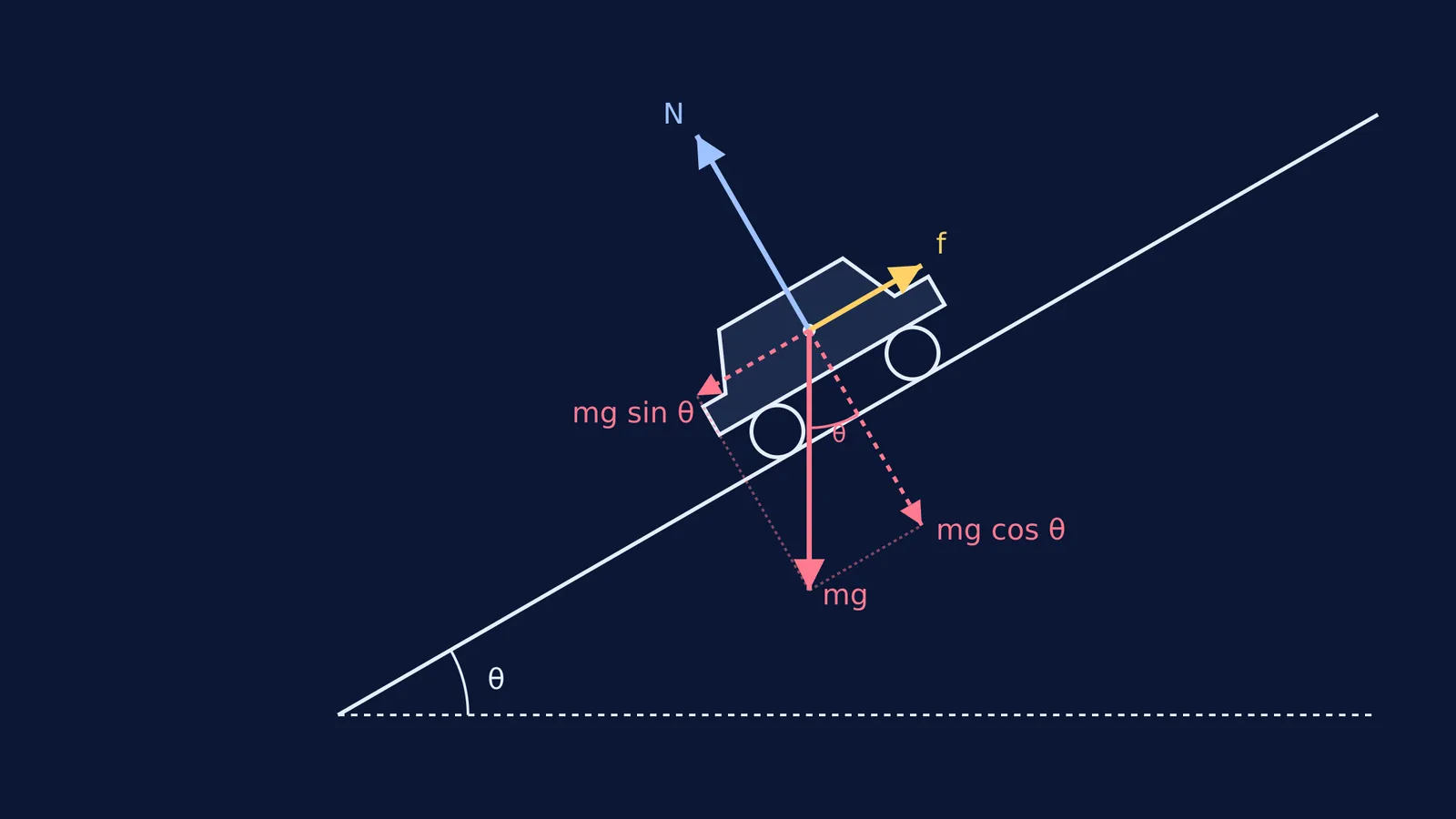
As a car drives up an incline, gravity pulls straight down. This weight (mg) splits into two components. One part pulls the car backward down the slope, acting with a force of mg sin θ. The second part presses the car perpendicular into the road surface, which is known as the normal force (mg cos θ).
The normal force is crucial here. On flat ground, the normal force equals the full weight of the car (mg). But as the hill gets steeper, the cosine of the angle shrinks, reducing the normal force pressing the tires into the pavement. Less normal force means less available static friction. At the same time, the sine of the angle grows, increasing the backward pull of gravity. The car is losing its grip precisely when it needs it the most.
To move forward, the car's tires must push against the road, and the road pushes back with static friction. The maximum friction the road can provide is the coefficient of static friction (μ) multiplied by the normal force: μ mg cos θ. If the downward pull of gravity exceeds this maximum possible friction, the tires will spin.
What is the steepest slope a car can climb?
The physical limit of traction occurs exactly when the friction pulling the car up the hill matches the gravity pulling it down. Setting them equal gives:
mg sin θ = μ mg cos θ
Because mass (m) and gravity (g) appear on both sides, they cancel out, meaning the car's weight does not change the maximum climbing angle. Dividing both sides by cos θ leaves the fundamental rule for the steepest slope: tan θ = μ (OpenStax). The maximum gradient a vehicle can climb depends entirely on the coefficient of friction.
This is the exact same mathematics that defines the angle of repose for a block resting on a ramp.
How does this translate to real roads?
In road design, a hill's steepness is usually written as a gradient percentage, which is the "rise over run". Because the tangent of an angle is literally the rise over run, the coefficient of friction translates directly into the maximum decimal gradient.
The coefficient of static friction for a standard rubber tire on dry asphalt is approximately 0.7 (HyperPhysics). Using tan θ = 0.7, the steepest angle a car can climb is about 35 degrees, which equals a 70% gradient. On a wet road, the friction coefficient drops to around 0.4, lowering the maximum climbable angle to 22 degrees.
What happens when a car starts to slip?
If a driver encounters a slope steeper than what the static friction can support, or if they apply too much power causing the tires to spin, the physical regime shifts from static to kinetic friction. Because kinetic friction (sliding) is weaker than static friction (gripping), a car that breaks traction will immediately lose climbing ability. The tires will spin helplessly or the vehicle will slide backwards down the incline. This is why steady throttle control is critical in off-road driving; maintaining that static grip is the only way to utilize the full tan θ = μ potential. Once sliding begins, the effective coefficient drops, and the maximum climbable angle plummets.
How can you practice these forces?
You will see this tan θ = μ relationship constantly in mechanics, from sliding blocks to a car driving over a curved hump. When you are stuck on how to split gravity into sine and cosine components, you can work through the Fermi Problem Library. Instead of just printing the final angle, the AI tutor walks you through drawing the free-body diagram and balancing the forces step by step. Once you master the basic inclined plane, applying it to friction and motion becomes second nature.


