On this page
Laws of Motion is Chapter 4 of NCERT Physics Part I, and this guide follows the current NCERT text (Reprint 2026-27) for the CBSE school exam. Preparing for JEE instead? Read how to prepare Laws of Motion for JEE Main.
What does Laws of Motion cover in the 2026-27 CBSE syllabus?
The CBSE Physics curriculum for 2026-27 puts the chapter in Unit III with these topics:
Inertia and Newton's three laws; momentum and impulse
Conservation of linear momentum
Equilibrium of concurrent forces
Static and kinetic friction, laws of friction, rolling friction, lubrication
Circular motion: centripetal force, vehicles on level and banked roads
Marks are printed per group of units, not per chapter: Units I, II and III together carry 23 of the 70 theory marks, with no separate figure for Laws of Motion. The curriculum also says content NCERT marks as excluded for 2026-27 is not to be tested by schools, so revise from the current reprint, not an older copy.
How do you draw a free-body diagram for a board answer?
NCERT's section 4.11 sets out the method. In exam terms:
Sketch the set-up.
Choose one body (or group) as your system.
Draw it alone with only the forces acting on it: weight, normal force, tension, friction.
Fix the directions you are sure of (tension along the string, N perpendicular to the surface); the rest are unknowns.
Pick axes and apply F = ma along each one.
The classic trap: a book's weight and the table's push on it are equal at rest, but they are not an action-reaction pair, because both act on the book.
Worked example: how fast can a car take a banked turn?
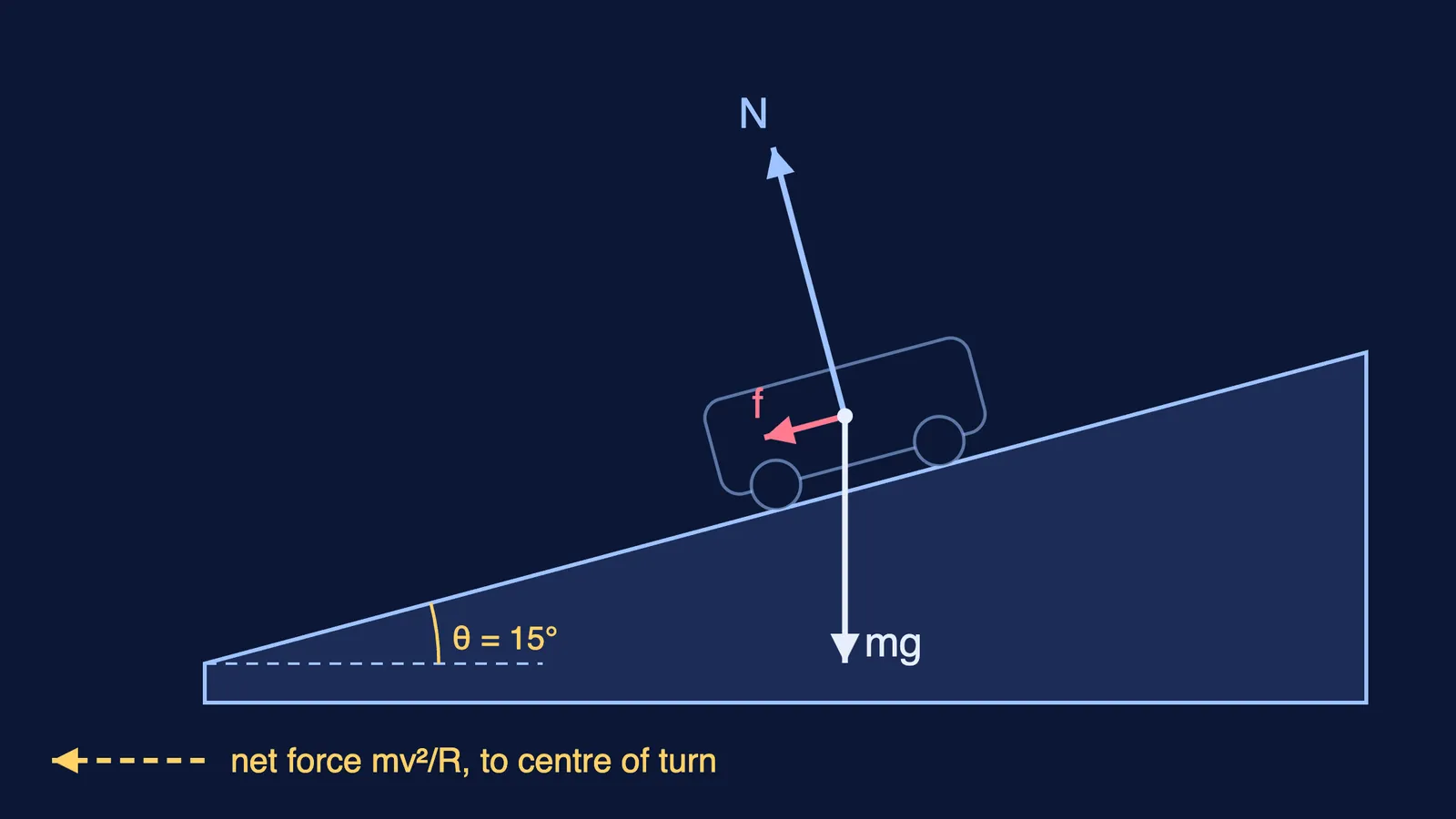
A 1200 kg car rounds a curve of radius R = 40 m banked at θ = 15°, with μs = 0.3 and g = 9.8 m s⁻². Find the optimum and maximum safe speeds.
FBD. Three forces act: weight mg, normal force N perpendicular to the road, and friction f along it. At the maximum speed the car tends to slide outwards, so friction points down the slope.
Optimum speed (no friction needed). Using NCERT's result v₀ = (Rg tan θ)^½:
v₀² = 40 × 9.8 × 0.2679 = 105.0 m² s⁻², so v₀ = 10.2 m s⁻¹ (about 36.9 km/h).
Maximum speed. Vertically, N cos θ = mg + μsN sin θ. Horizontally, N sin θ + μsN cos θ = mv²/R. Eliminating N gives
v²max = Rg (μs + tan θ)/(1 − μs tan θ) = 392 × 0.5679/0.9196 = 242.1 m² s⁻²
so vmax = 15.6 m s⁻¹, about 56.0 km/h.
Check. On a flat road with the same tyres, vmax = (μsRg)^½ = 10.8 m s⁻¹, so banking raises the safe speed by about 43%, consistent with NCERT's point that Eq. (4.21) gives a higher maximum speed than Eq. (4.18). At vmax, N = 1.32 × 10⁴ N and f = 3.97 × 10³ N; their horizontal parts add up to mv²/R = 7.26 × 10³ N. The diagram at the top draws these forces to scale.
Which mistakes cost marks in this chapter?
Drawing "centripetal force" as an extra arrow. It is the net of the real forces.
Writing f = μsN when nothing is about to slip. Static friction reaches μsN only at the limit.
Mixing km/h and m/s inside v²/R.
Using μk before the body moves.
Friction and banking also explain the physics of a water slide.
What questions should you practise for the Class 11 exam?
The curriculum refers schools to the Class XII sample paper for question design. The 2026-27 Class XII physics sample paper uses 1-mark MCQs and assertion-reason items, 2-, 3- and 5-mark questions and 4-mark case studies. Try these (answers in brackets):
MCQ (1 mark). The reaction to the earth's pull on a book lying on a table is (a) the table's push on the book (b) the book's pull on the earth (c) the book's push on the table. [(b)]
Assertion-reason (1 mark). A: A car can take a banked curve at the optimum speed even on ice. R: At that speed the horizontal component of N alone supplies mv²/R. [Both true; R explains A.]
2 marks. A 0.2 kg ball moving at 10 m s⁻¹ is stopped in 0.05 s. Find the impulse and the average force. [2 N s; 40 N]
3 marks. A 5 kg block sits on a floor (μs = 0.4, μk = 0.3, g = 9.8 m s⁻²). Find the friction under a 15 N push, and the acceleration under 25 N. [15 N, no motion; 2.06 m s⁻²]
5 marks. Derive vmax on a banked road with friction, and show it reduces to v₀ when μs = 0.
Draw the FBD first every time. For the whole year, see our study plan for Class 11 physics. If you keep getting stuck at the same step, Fermi's AI tutor works out what you already know and builds a plan for the session, so you sit down to a clear next step.