

On this page
You sit in the water at the top and let go. The rush and the swing up the wall come from three ideas in Class 11 physics: energy conservation, friction and circular motion.
Where does the speed on a water slide come from?
At the top you have gravitational potential energy, mgh. At the bottom much of it has become kinetic energy, ½mv². OpenStax states the rule: mechanical energy stays constant unless non-conservative forces such as friction do work, and the change in mechanical energy equals the work those forces do. The normal force from the slide does no work, because it is always perpendicular to your motion.
So on a perfectly frictionless slide, your speed at the bottom depends only on the height you dropped: v = √(2gh). Your mass cancels, so a child and an adult would arrive at the same speed if nothing else acted. Our post on deriving kinetic energy from force times distance shows where ½mv² comes from.
Why does water make a slide faster?
Friction takes energy away. The kinetic friction force is f = μN, where μ is the coefficient of kinetic friction and N is the normal force. The same chapter notes that lubrication makes both friction coefficients considerably less. In its table, steel on steel has a kinetic coefficient of 0.3 dry and 0.03 when oiled, a tenfold drop.
On a slide, water does the job of the oil. Physicists at the PMMH laboratory of ESPCI in Paris presented a lab-scale model of a water slide at the American Physical Society's 2015 fluid dynamics meeting, describing slides as body-size inclined pipes in which flowing water forms a lubrication film that reduces friction. You skim on a layer of water instead of rubbing on the plastic.
The same kind of film makes tyres lose grip on a flooded road; our post on why tyres have treads to stop aquaplaning shows the other side, where engineers want the film gone.
How much speed does friction steal on a water slide?
Take a straight slide that drops h = 12 m over a horizontal run of d = 40 m, with g = 9.8 m/s². These are made-up numbers for practice, not a real ride.
No friction: v = √(2gh) = √(2 × 9.8 × 12) ≈ 15.3 m/s, about 55 km/h.
On a straight incline of length L and angle α, friction does work μmg cos α × L, and L cos α is just the run d, so v² = 2g(h − μd).
Wet, with μ = 0.03 (the oiled-steel value from the OpenStax friction table, used as a stand-in): h − μd = 12 − 1.2 = 10.8 m, so v ≈ 14.5 m/s, about 52 km/h.
Dry, with μ = 0.3 (the dry-steel value): h − μd = 12 − 12 = 0, so v = 0. The slope (12 ÷ 40 = 0.3) equals μ, so friction exactly cancels the downhill pull and a rider starting from rest never moves.
Same slide, same rider: in this model, the water decides whether you fly or stay put. Real slides also lose energy to the water and air, so real speeds are lower.
Why do you ride up the wall on a turn?
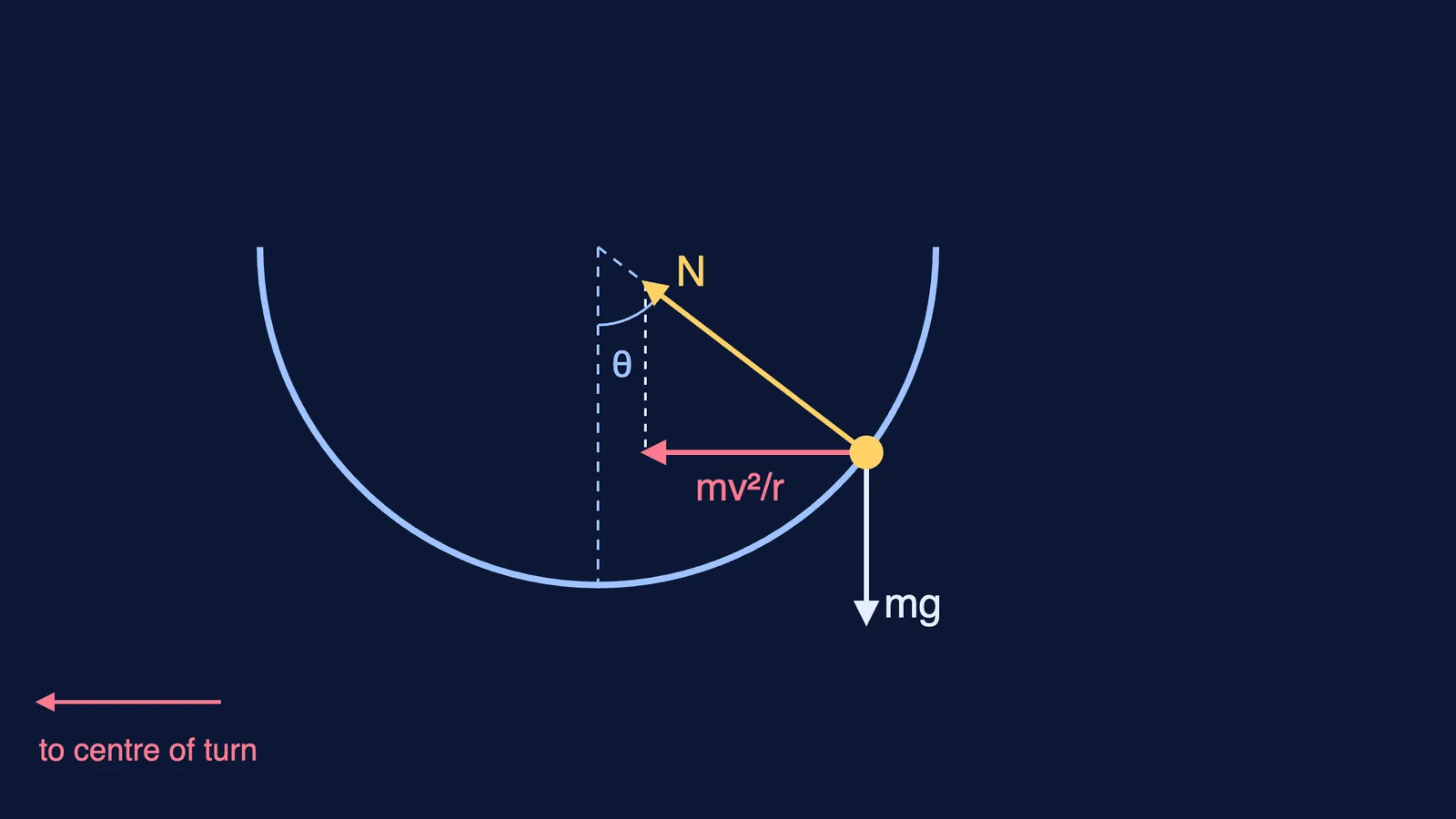
In a curve you need a net force towards the centre of the turn, mv²/r. On a slide that force comes from the normal force of the tilted wall. OpenStax derives the ideal bank angle for a frictionless curve: tan θ = v²/(rg), and θ does not depend on mass. The vertical part of N balances your weight; the horizontal part turns you.
A tube or half-pipe has no fixed bank angle. The higher up the wall you sit, the steeper the surface under you, so you slide up until the angle matches your speed. Suppose you enter a turn of radius 5 m at 8 m/s: tan θ = 64 ÷ (5 × 9.8) ≈ 1.31, so θ ≈ 53°. Because N cos θ = mg, the normal force is about 1.65 times your weight, which is the squeeze you feel through the turn. Go faster and you ride higher. The same equation sets the safe speed of a road curve, as our post on the maximum safe speed on a banked road with friction shows.
How do you solve a water slide problem?
Draw the free-body diagram first: weight straight down, normal force perpendicular to the surface, friction along the surface, opposite the motion.
Write the energy at the top and at the bottom, then subtract the work done by friction.
In a turn, split N into a vertical part (equal to mg) and a horizontal part (equal to mv²/r), then divide one by the other.
If the banked turn is hard to picture, the Fermi Simulation Lab has interactive simulations for ideas that are easier to see than to read. And if one step will not click, Fermi's AI tutor works out what you already know and teaches through it, drawing the figure as it goes.


