On this page
Laws of Motion is where JEE physics stops being about describing motion and starts asking why it happens. Much of the mechanics that follows, from connected bodies to rotation, starts with the step you learn here: draw the forces, then write Newton's second law.
What does Laws of Motion cover in the JEE Main syllabus?
In the official Syllabus for JEE (Main) 2027, linked from jeemain.nta.nic.in, Laws of Motion is Physics Unit 3. It lists force and inertia, Newton's three laws, momentum and impulse, conservation of linear momentum, equilibrium of concurrent forces, static, kinetic and rolling friction, and uniform circular motion, including a vehicle on a level road and on a banked road.
The matching chapter is Chapter 4, Laws of Motion, in NCERT Class 11 Physics Part I (2026-27 reprint). Pulleys, strings and connected blocks are not named separately in the syllabus; they are how questions test the second and third laws.
How do you draw a free-body diagram that works?
Use the same five steps every time:
Pick one body and draw it alone, as a box or a dot.
Add only the forces acting on it: weight, normal force, friction, tension, any applied push. A force the body exerts on something else does not belong here.
Choose axes along the likely acceleration, such as along an incline, not horizontal and vertical by habit.
Write ΣF = ma along each axis, with signs.
Count unknowns and equations. Connected bodies share one acceleration if the string stays taut, and a light string over a light, frictionless pulley has one tension throughout.
Worked example: a block on an incline tied to a hanging mass
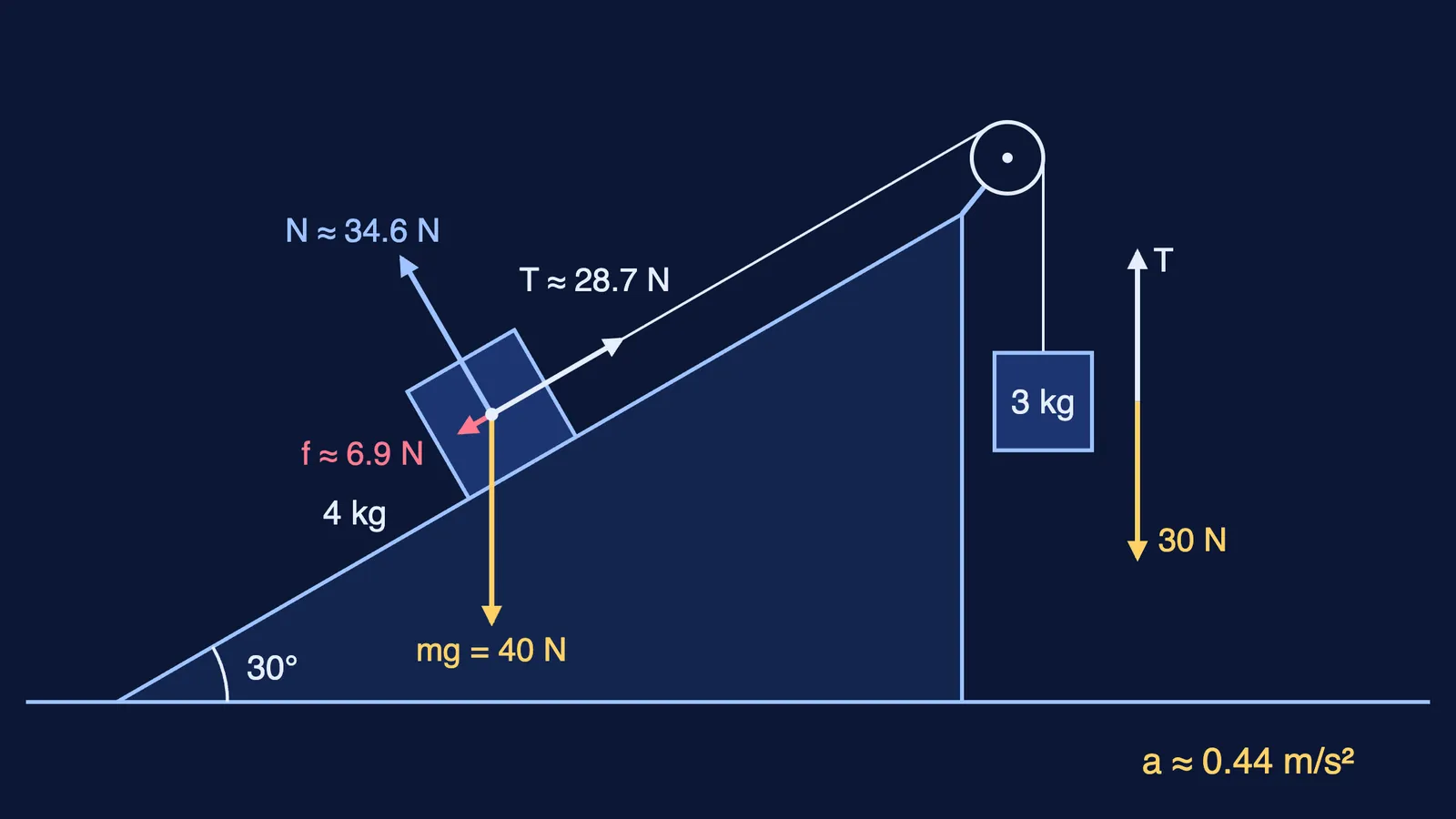
Our numbers, with g = 10 m/s²: a 4 kg block rests on a 30° incline. A light string over a frictionless pulley at the top connects it to a hanging 3 kg mass. The coefficients of friction are μs = 0.25 and μk = 0.2. Does the block move, and if so, how fast does it accelerate?
Normal force: N = 4 × 10 × cos 30° ≈ 34.6 N.
Weight component down the slope: 4 × 10 × sin 30° = 20 N. Pull of the hanging mass: 3 × 10 = 30 N.
Check static friction first. Its maximum is 0.25 × 34.6 ≈ 8.7 N, so the most the slope can resist is 20 + 8.7 = 28.7 N. That is less than 30 N, so the block slides up the slope.
Now friction is kinetic and acts down the slope: 0.2 × 34.6 ≈ 6.9 N.
Treat both bodies as one system: a = (30 − 20 − 6.9) N ÷ 7 kg ≈ 0.44 m/s².
Tension, from the hanging mass: T = 3 × (10 − 0.44) ≈ 28.7 N. Check on the block: 28.7 − 20 − 6.9 = 1.8 N, and 4 kg × 0.44 m/s² ≈ 1.8 N.
Notice that T is less than 30 N: if tension equalled the hanging weight, the mass could not accelerate.
Which friction and circular-motion traps cost marks?
Using μsN as the friction force. It is only the maximum. Push a 5 kg box on a floor with μs = 0.5 and g = 10 m/s² using 20 N: the limit is 25 N, so the box stays put and friction is exactly 20 N.
Fixing friction's direction too early. Friction opposes relative sliding, or the tendency to slide. In the example, it points down the slope only because the block moves up.
Inventing a centrifugal force in an inertial frame. On a level circular road, friction itself supplies the centripetal force, so the top speed is v = √(μs g r). With μs = 0.6, r = 60 m and g = 10 m/s², v = √(0.6 × 10 × 60) m/s = √360 m/s ≈ 19 m/s, about 68 km/h.
Mixing up action-reaction pairs. Third-law pairs act on different bodies, so they never cancel in one free-body diagram.
How should you practise Laws of Motion?
A two-week plan alongside school:
Days 1-3: Read the NCERT chapter; redo its examples with your own numbers. For a gap in the basics, such as why tension is the same along a light string, the Fermi Concept Library has every concept in physics, chemistry, biology, mathematics and computing, each with its own lesson.
Days 4-7: Ten free-body diagrams a day: inclines, two blocks on a table, Atwood machines, lifts. Equations before arithmetic.
Days 8-10: Friction and circular motion, including the banked road. Always test static friction before assuming motion.
Days 11-14: Timed sets of previous year questions, used the right way. Log each error as diagram, sign, friction or arithmetic.
When a wrong answer comes from the method, not the arithmetic, the Fermi Problem Library has worked problems with a step-by-step solver that explains the reasoning rather than printing an answer. Next, watch for the three work-energy mistakes that quietly cost marks. On exam day, slot these questions into your three-pass JEE Main attempt strategy.