On this page
CBSE calls Unit 8 Small Business and Enterprises, but the NCERT chapter that teaches it is titled MSME and Business Entrepreneurship (Chapter 9, NCERT Business Studies Class 11, reprint 2026-27). This guide follows that reprint and the CBSE Business Studies curriculum 2026-27.
How many marks is Small Business worth in 2026-27?
The CBSE course structure prints one shared figure: Unit 7, Sources of Business Finance, and Unit 8, Small Business, together carry 20 of the 80 theory marks (CBSE curriculum 2026-27). There is no separate figure for this chapter. The finance half is in our guide to sources of business finance for Class 11.
The curriculum's Unit 8 covers entrepreneurship development, the Start-up India Scheme and ways to fund a start-up, intellectual property rights, small enterprises as defined by the MSMED Act 2006, the role of small business with special reference to rural areas, and government agencies: the National Small Industries Corporation (NSIC) and the District Industrial Centre (DIC), with reference to rural, backward areas.
How does NCERT define micro, small and medium enterprises?
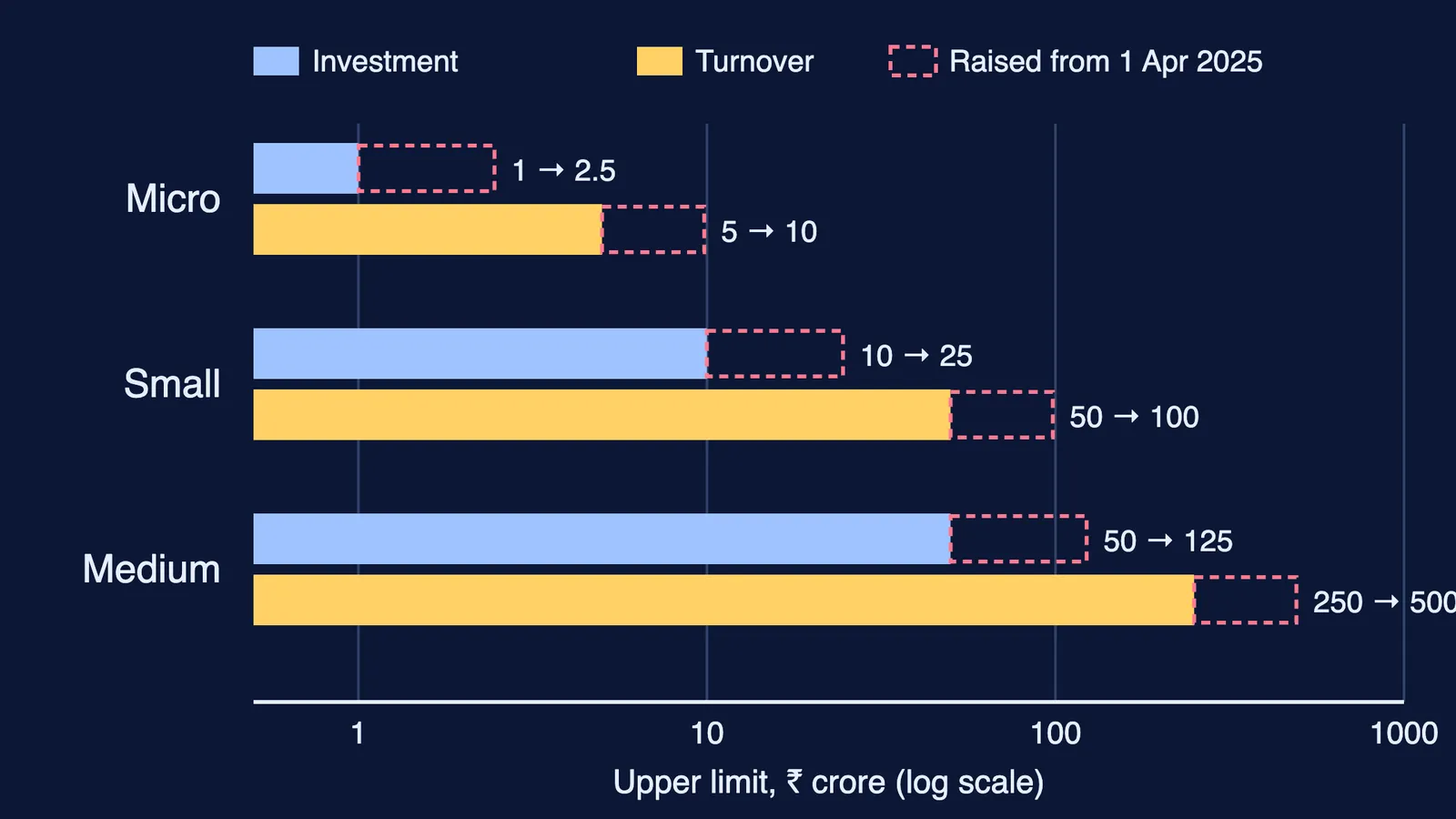
NCERT says the Government of India defines MSMEs by investment in plant and machinery and by turnover. The chapter's table gives these limits (NCERT Chapter 9):
Micro Enterprises: investment 1 Crore; turnover "Does not exceed 5 crore"
Small Enterprises: investment 10 Crore; turnover "Does not exceed 50 crore"
Medium Enterprises: investment 50 Crore; turnover "Does not exceed 250 crore"
The same table puts micro enterprises at 99.4% of MSMEs, small at 0.52% and medium at 0.1% (NCERT Chapter 9). NCERT adds that the MSMED Act, 2006 came into force in October 2006.
The official limits have since changed. The Ministry of MSME's year-end review (PIB, 30 December 2025) gives ₹2.5 crore investment and ₹10 crore turnover for micro, ₹25 crore and ₹100 crore for small, and ₹125 crore and ₹500 crore for medium, effective from 1 April 2025 (PIB, Year End Review 2025). A PIB backgrounder of 11 August 2026 says the MSMED (Amendment) Bill, 2026, passed by Parliament, classifies MSMEs by investment and turnover (PIB backgrounder). In the school exam, use the NCERT figures unless your teacher says otherwise.
Worked example: classify three units
Three made-up units (figures in ₹ crore):
A pickle unit: 0.4 (₹40 lakh) in machinery, turnover 3. Within 1 and 5, so micro under NCERT and under the 2025 limits.
A printing press: 8 in machinery, turnover 45. Above micro, within 10 and 50, so small. Under the 2025 limits (25 and 100): still small.
A tailoring workshop: 2 in machinery, turnover 8. Above 1 and 5, so small under NCERT, but within 2.5 and 10, so micro under the 2025 limits.
So always name the set of limits you use.
What role does small business play in rural India?
NCERT presents MSMEs as a way to create jobs in rural and backward areas and to reduce migration to cities (NCERT Chapter 9). Its main points:
balanced regional development using local materials and skills
second largest employer after agriculture, with more jobs per unit of capital
scope for entrepreneurship with little capital, low costs and quick decisions
in villages, extra non-farm income and work for traditional artisans and weaker sections
NCERT also lists the problems: finance, raw materials, managerial skills, marketing, quality, capacity utilisation and global competition.
What does the chapter say about entrepreneurship, Start-up India and IPR?
NCERT describes entrepreneurship as setting up one's own business, with five characteristics: systematic activity, lawful and purposeful activity, innovation, organisation of production and risk-taking. A box lists the Startup India Scheme's aims as NCERT states them, including building an entrepreneurial culture and reaching under-represented groups such as women (NCERT Chapter 9).
The chapter names seven types of IPR recognised in India: copyright, trademark, geographical indication, patent, design, plant variety and semiconductor integrated circuit layout design. A patent lasts 20 years; a design 10 years, renewable for 5 more. To see which form suits a small unit, read our guide to forms of business organisation.
Practice questions
Our own questions; the mark labels are our suggestion, not CBSE's.
(1 mark) Name the two measures in NCERT's MSME table.
(3 marks) A unit has ₹60 lakh in machinery and ₹4.5 crore turnover. Classify it with NCERT's table, showing both checks.
(3 marks) Riya registers the name and logo of her millet-snack brand. Which IPR protects them, and how does it help a small firm?
(4 marks) A trader pays Kavya's village weaving unit months late, and she cannot afford yarn in bulk. Name and explain the two problems shown.
(6 marks) Young people in one district leave for city jobs after harvest. Using three points from the chapter, explain how local small units could help.
Not sure where to begin revising? Fermi's AI tutor can work out what you already know and build a plan for the session, so you sit down to a clear next step.